Showing posts with label baseball. Show all posts

Thursday, May 21, 2026

Q Toon: Us vs. Theme Nights


 It’s time to crank out a cartoon for LGBTQ2SAII+ Pride Month, so this year’s topic is the perpetual straight white cisgender sourpuss who gets upset whenever something is not all about him.

We’ve all met the guy. He’s terribly inconvenienced when offered to marcar dos por español (although he’ll happily have another margarita on Cinco de mayo). He voted for Trump to white-out Black History Month. And he’s only going to run into the store for a second, so anyone needing the handicap parking space will just have to hold their horses.

Major League Baseball teams put on a wide variety of special theme nights throughout the season, from movie tie-ins to cancer benefits to every ethnicity and nationality under the sun. If your favorite team doesn't have a Heritage Night celebrating your ancestry, rest assured that somewhere, some other team does.

Well, maybe there's no Tajikistani Heritage Night anywhere, but give the league time.

Anyway, Pride Nights are a staple in June, marking the anniversary of the Stonewall Riots. Naturally, people who hate gays hate Pride Nights.

I’ve only been to one Pride Night at the Brewers. We didn’t buy our tickets through the special promotion, so we didn’t get the promotional tee-shirts, although I did buy a cap with a rainbow “M” logo. 

I even made it onto the Jumbotron during an Everybody Get Up And Dance between late innings. My better half is a better dancer than I, but he  happened to be off talking to a cousin in another section of the stands, so I had the screen all to myself. (Well, the Cardinals fans behind me stooped down to get on camera, too.) 

It ain’t easy to dance like nobody’s watching when everybody is watching.

Saturday, October 22, 2022

Big Al's Sports Report (Love That Tinkle!)

In honor of the World Series, in which no other country in the world has been invited to play, Sliderback Saturday winds up and pitches some cartoons from the even more exclusive World Series of 1922.

"The Fan" by Clifford Berryman in Washington (DC) Evening Star, Oct. 4, 1922

Not only was the 1922 World Series limited to teams from one country, it was limited to teams from just one city. The series pitted the New York Giants against the New York Yankees, so you might suppose that the rest of the country would have lost all interest in what had become a strictly New York affair.

"Total" by Bill Sykes in Philadelphia Evening Ledger, Oct. 4, 1922

But that wouldn't sell papers, would it?

"The Ball Weevils" by John Knott in Galveston Daily News, Oct. 8, 1922

If any interest in the series fell off in the rest of the country, there were still enough fans of the game, or at least gambling on it, to warrant this cautionary cartoon out of Dallas.

Any gamblers who bet on the Yankees were shut out of luck: the New York Baseball Giants swept them four games to none. (There were five games in this subway series; Game 2 ended in a 3-3 tie after ten innings.)

"Hats Off to M'Graw" by Bud Counihan in New York Evening World, Oct. 9, 1922

One newspaper job that disappeared decades ago was that of the sports cartoonist. Major newspapers like the New York Evening World might even have more than one on staff.

Here Bud Counihan salutes the winning coach, John J. McGraw and illustrates highlights of the final game of the series for the benefit of those who might have only read about the games the next day in the paper, if they didn't happen to have access to one of them new-fangled radio thingamabobs.

"Oh, the Melancholy Days" by John Knott in Galveston Daily News, Oct. ,4 1922

Fortunately for fans then and now, if one's baseball team falls by the wayside short of the World Series, one can always turn to football. It's the start of the gridiron season, and anything is still possible.  

"Impressions of the Pitt-Bucknell Football Game" by Bertin F. Link in Pittsburgh Press, Oct. 29, 1922

Judging by the sports cartoonists of the day, there were more fans of college-level football than of the professional variety. The newly-named National Football League consisted of sixteen teams, only two of which remain with us today: the Decatur Staleys (now the Chicago Bears) and Racine/Chicago (now Arizona) Cardinals.

"A Tragedy of the Football Field" by John T. McCutcheon in Chicago Tribune, Oct. 29, 1922

One thing that has changed has been efforts to protect football players from serious injury. You'll notice in these cartoons that the football players' helmets are nothing more than leather caps. They have no mouth guard (although by the 1920's, some players were improvising attempts at creating them); disfiguring facial injuries were commonplace. Concussions were expected and accepted. 

This may seem difficult to believe, but in football, there was more of a priority in protecting the player’s upper body, than in head protection. The invention of football shoulder pads was by L.P. Smock, who was a student a Princeton. His 1877 design were made of wool and leather and were actually stitched onto the player’s jersey. After the turn of the century, we see the development of the ‘harnessed’ shoulder pads that are over the head and attached via the chest area. While an improvement in design, they continued to be made of a combination of canvas and leather. It wasn’t until the 1960’s and 70’s that plastic shoulder pads appeared. By the 1990’s we saw the advent of the bulky padding that our players today wear.

"Speaking of Fullbacks" by Woodson M. Cowan for George Matthew Adams Syndicate, ca. Oct. 13, 1922
The general attitude was that players were tough guys able to withstand a little brain damage. Since the print is quite small, I'll point out the doctor examining University of Iowa fullback Gordon Locke on the right side of Iowa native Wood Cowan's cartoon:

Scientist: "The X-ray shows your skull to be exceedingly thick."

Text: "Scientist discovered that his dome is especially constructed for use as battling ram to hit the line with."

As pointed out elsewhere in the cartoon, Locke was no simple-minded bonehead. He would graduate third in his class at the University of Iowa College of Law, graduating in the top three of his law school class. After coaching football at U of I and Western Reserve University, he was general assistant law director for the city of Cleveland, then general counsel in Washington D.C. for the Committee for Oil Pipe Lines.

Sticking with football for one more cartoon, I'll note here that off the playing field, striking coal miners had reached agreements with mine owners and gone back to work. But then as now, supply chain issues meant that cold weather was moving in before adequate supplies of coal to heat everyone's homes and businesses. What supplies there were fetched premium prices.

"Neighborhood News" by Fontaine Fox for Wheeler Syndicate, Oct. 28, 1922

Then as now, it was surely all Joe Biden's fault.

Thursday, August 18, 2022

Q Toon: Getting to First Base

We are told that Amazon Prime's adaptation of "A League of Their Own" into a television series will not shy away from the presence of lesbians in the teams of the wartime All-American Girls Professional League (AAGPL).

There was no acknowledgment of that in the 1992 movie. In fact, director Penny Marshall specifically instructed actor Rosie O'Donnell not to portray her character, Doris Murphy, as lesbian. (O'Donnell shows up in Amazon Prime's version as the proprietor of a drinking establishment catering to customers who, in the parlance of the day, "played for the other team.")

The new version also addresses issues of race that you might have missed in the original. DeLisa Chinn-Tyler played an unnamed spectator who returns an overthrown ball to Geena Davis's character with impeccable speed and accuracy, a scene Marshall had written into her movie to point out that there were no Black players in the AAGPL. But you won't find Chinn-Tyler in imdb.com's list of the cast, either.

In a twofer role in the 2022 series, Chanté Adams plays "Max" Chapman, a Black lesbian pitcher who is barred from trying out for the league on account of the color of her skin. Her story line in Season One never merges with those of the characters who do make the Rockford Peaches' roster, but if the series ends up lasting longer than the AAGPL ever did, perhaps we'll see some historical revisionism.

Heck, CBS's "M*A*S*H" outlasted the Korean War long enough for Major "Hot Lips" Houlihan to become a women's libber and Captain "Hawkeye" Pierce to develop what we would now call "wokeness."

All of the Amazon "League of Their Own" characters are fictional, so I suppose their careers can go in any direction the writers fancy. If Max Chapman doesn't end up in the AAGPL, perhaps she will join Mamie Johnson, Connie Morgan, and Toni Stone, three real-life women who played in the Negro Leagues during WWII. As long as she doesn't marry her girlfriend at St. Mary Oratory, pilot the Enola Gay, and get elected Governor of Illinois, I'm willing to grant the writers some poetic license.

CBS, by the way, attempted a series based on "A League of Their Own" back in the 1990's, recasting all but two of the roles. It lasted for only three episodes, so it never had a chance to introduce any lesbian or Black story lines — as if that were particularly likely. 

Getting back to today's cartoon: as longtime readers have probably figured out by now, I try to include diversity, racial and otherwise, in my cartoons whenever possible. Given attitudes of the 1940's, including a non-White person in this week's scenario didn't seem realistic, even for a cartoon. And even considering that the blonde in the pink dress is clearly not a ballplayer.

In hindsight, however, perhaps a will-they-won't-they romantic relationship with one of the Rockford Peaches is how the writers will eventually integrate Max into the series.

Assuming it lasts more than three episodes this time.

Saturday, June 25, 2022

Too Jejune for Junes

Last Saturday, I asked what was so rare as a J.N. "Ding" Darling cartoon in June. The answer, for now, would be mine. 40 years ago, my June cartoons were rare indeed, whereas "Ding" drew nearly three dozen of them 100 Junes ago.

"South Atlantic," June, 1982

Starting out as a cartoonist for college newspapers, I didn't have anyone to publish anything I drew in June at first. But if I had an idea I really liked, I'd draw it anyway. Clearly, I had expended a considerable amount of thought coming up with this parody of "South Pacific" about the Falkland War between Great Britain and Argentina in May and June of 1982.

"Contingencywise," June, 1982

Drawing cartoons like this one about the resignation of Reagan's first Secretary of State, Al Haig, was useful in terms of keeping in practice and honing the craft. And in this particular case, beefing up the portfolio of work I would send out to newspapers who might be looking to hire a cartoonist.

"Isn't It a Shame..." in Quayle Quarterly, Winter, 1992?

Skipping ahead one decade, here's a cartoon I drew in June of 1992 that wasn't published for months later. It happens to be the only cartoon I drew in June of 1992 in spite of freelancing for the Racine Journal Times. Perhaps there were no local issues of interest that month.

Instead, I offered this to a national magazine, The Quayle Quarterly, devoted to the wet-behind-the-ears Vice President of the United States, J. Danforth Quayle. Quayle had spoken out strongly against Candice Bergen's TV sitcom "Murphy Brown" for a plot arc about the title newscaster choosing to become a single mother.

Given the Republican Party's committed opposition to abortion, those of you too young to remember 1992 might have expected Mr. Quayle to have applauded Ms. Brown's decision to carry a pregnancy to term. But those of us with a few more birthdays under the bridge remember that the abortion issue to the religious right was never about when a fertilized egg becomes a human. 

It was always about sex. Sex outside of marriage = always bad. Shame, shame, shame on you, Murphy Brown. And your little bastard, too.

With no other cartoons from June, 1992 to show here, let's now leap ahead another decade.

"Mixed Marriage," for Q Syndicate, June, 2002

To balance the drawing vs. publication discrepancy of my Dan Quayle cartoon, this next cartoon was actually drawn in December (hence the 2001 copyright tag) for release in June.

As helpful as it may be to have some ready-drawn cartoons on hand for those occasions when I wouldn't be sending a fresh new one for syndication, it is nearly impossible to predict what topics and issues will be a propos in the future. Routine events such as Pride Month, Thanksgiving, and Christmas only go so far, and might not coincide with a vacation, health crisis, or everyday writer's block.

Continuing the topic of trying to stay in the closet:

"Out to the Ballgame," June, 2002

Now, I don't remember whether there was some ballpark that observed Pride Month with a Cross-Dressers Get In Free Day in 2002. But this cartoon does remind me of the time a guy pretended to be Front Row Amy at a Milwaukee Brewers game some years back. 

Front Row Amy is a Milwaukee institution of sorts. For years, this young lady has had season tickets in a front row seat behind home plate. She always pays rapt attention to the game, keeps score, and applauds every pitch that goes the Brewers' way. You never, ever see her having refreshments of any kind.

She favors — exclusively — very low-cut tops that highlight her impressive cleavage. In tight TV shots of left-handed batters, you can't miss that cleavage in the background. These days, she always wears a facemask, but Brewers fans would recognize her anywhere.

She doesn't attend each and every home game; her seat may be empty, but there's usually somebody else more than happy to fill such a prime spot. And for one game, it was some dude who showed up in a long-haired black wig and a top that was as low-cut as any of hers.

Until a later inning when he switched to a Batman costume.

Finally, I could have drawn this Pride Month cartoon six months early, but I didn't.

President Obama had rescinded the military's "Don't Ask, Don't Tell" policy back in December, 2010; and yes, military recruiters did start showing up at Pride events to enlist new recruits. 

The homophobic Right has since dropped the word "recruiting" in favor of the apparently more ominous sounding "grooming," so this cartoon doesn't work as well as it did ten years ago. I mean, this guy could be telling Darlene that he spied a hair stylist's booth or a dog show, but do you even find that sort of thing at Pride events? 

So, no, it doesn't make sense as an editorial cartoon with groomers instead of recruiters. But fear not: there are still opportunities for parody.

Some enchanted evening
You may see a groomer
With a sense of humor
across a crowded room.
You'd better decide
to hang up the phone
And leave any briders or groomers alone!  

Monday, April 4, 2022

This Week's Sneak Peek


More roughs from the sketchbook.

D.D. Degg at Daily Cartoonist has come through with background on the cartoonist "Callaghan" included in Saturday's Graphical History Tour. Callaghan was editorial and sports cartoonist for the short-lived Minnesota Daily Star (Aug. 19, 1920-June 30, 1924).

During its early months, the Star was able to build its circulation, but it was never able to show a profit. The paper had difficulty attracting advertisers who were willing to contend with its overtly political agenda. Even so, it continued to advocate for left-leaning causes and candidates.

The Star was proud enough of Mr./Ms. Callaghan to put his/her cartoons on the front page from time to time, but never, apparently, proud enough to print his/her name.

in Minneapolis Daily Star, June 24, 1922

Tuesday, March 1, 2022

Remembering Richard Guindon

Daily Cartoonist passed along the news yesterday that Dick Guindon has died at the age of 86.

"Guindon" in Minneapolis Tribune, Jan. 15, 1978

His eponymous cartoon panel in the Minneapolis Tribune (later Star Tribune) was something I looked for every day when I was in college, and which I missed after I graduated and returned to Wisconsin. Because I saw his cartoons nowhere else until the internet became a big deal, I've always associated his off-beat sense of humor with Minnesota.

"Guindon" in The World According to Carp, 1983

So, several years later, when I wanted to include a Minnesota native in a cartoon for the Business Journal of Greater Milwaukee, did I draw Mary Richards Tyler Moore? Garrison Keillor? Al Franken? Prince? 

No.

Even though there was very, very, very close to zero percent of the Beej readership who would have the remotest glimmer of an off-chance possibility of recognizing her, I drew my Minneapolitan in the style of Dick Guindon.

in Business Journal, Milwaukee, March 24, 2005

To one of my all-time favorite cartoonists: rest in peace, sir. We'll fly the carp at half-staff in your memory.

Saturday, October 16, 2021

October Affairs: Domestic

Hey, kids! It's time to catch up on all the domestic national news from October, 1921!

We'll start with something that seems as relevant today as ever, because, like the weather, everybody talks about it but nobody ever does anything about it.

"Rather Late Canning Time..." by Clifford Berryman in Washington (DC) Evening Star, Oct. 13, 1921

It was Republicans who had complete control of the White House and both houses of Congress in 1921. But the filibuster was a favorite tactic of senators from southern states — Democrats in those days — who would thwart an anti-lynching bill throughout the entire 67th Congress. 

Other legislation killed by filibusters from both parties during that congressional session included the Harding administration's ship subsidy bill, a Railroad Refunding bill, the Rogers Foreign Service bill, the "Blue Sky" securities regulation bill, the Radio Regulation bill, and a Statute Codification bill.

"So Near, And Yet" by Bill Sykes in Philadelphia Public Ledger, Oct. 10, 1921

If getting legislation passed was easier said than done, so was breaking Americans' alcohol habit. Prohibition was in its second year, and not only were folks learning how to brew hooch in their private basements, but since not every home has its own basement, a thriving black market in liquor had sprouted up across the country in major cities and small towns.

"Autumn Leaves..." by Ted Brown in Chicago Daily News, by Oct. 27, 1921

Ted Brown's consumers look mighty happy with their crop, for now. Who that fellow is back there saying "Never again," I'm afraid I can't tell.

"Is He Worth It?" by John Cassel in New York Evening World, Oct. 19, 1921

The major national story of October was a threatened strike by railroad workers for better pay and working conditions. This was three decades before the interstate highway system; trains, not trucks, were primarily responsible for transporting goods across the country, as well as for passenger travel and mail delivery.  

"There's a Limit to All Things" by Albert Levering in New York Tribune, Oct. 23, 1921

Railroad corporations demanded significant cuts in wages and benefits to their workers in 1921, and also increased farming out work to non-union sub-contractors. Five major unions indicated they were all set to go out on strike, but the Railroad Labor Board ordered union leaders to keep their workers on the job. After the Board consented to delay Interstate Commerce Commission orders to slash half of the increases workers had enjoyed during World War I, union members voted to cancel the strike.

It was only a temporary peace, kicking the can down the railroad; the unions would go on strike within a year when that pay cut delay ended.

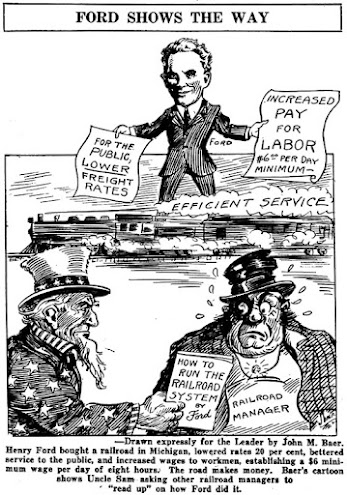
"Ford Shows the Way" by John Baer in Nonpartisan Leader, Fargo ND, Oct. 31, 1921

As peculiar bedfellows as they may have been, leftist former Congressman John Baer (Nonpartisan League-ND) here holds up right-wing Republican Henry Ford as an example for how to run a railroad. Baer cartooned for the National Railroad Union newspaper Labor as well as the Nonpartisan League's official paper (which was published in Minneapolis as the National Leader after the October 31, 1921 issue).

Looking to improve supply and distribution lines for his auto plant in Dearborn, Ford bought the Detroit, Toledo and Ironton Railroad in 1920, modernizing and transforming it, in the words of railroad historian William Pletz, "from a streak of rust into an extremely efficient and profitable operation, the likes of which has or will seldom be seen in this country." 

Under Ford, DT&I employees made higher wages than others in the industry. He also launched an electrification program for the railway, which was, however, abandoned after he sold the DT&I (at a hefty profit) to a subsidiary of the Pennsylvania Railroad in 1929.

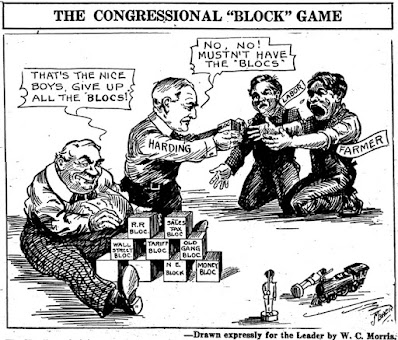
John Baer in Nonpartisan Leader, Fargo, Oct. 31, 1921
Baer (not William Morris) here accuses President Harding of trying to break up the Nonpartisan League's alliance between farmers and laborers, Minnesota's Democratic-Farmer-Labor Party being the last vestige of the movement. Republican efforts to gin up farmers' resentment of organized labor have been remarkably successful, even in ostensibly Democratic Minnesota.

"Th' Hog" by William Sykes in Philadelphia Public Ledger, Oct. 3, 1921

Oh, and the World Series was held in October, but it was the New York Yankees vs. the New York Giants, so nobody beyond the outer boroughs really cared all that much.

(Just kidding. Even game 4 getting rained out made banner headlines across the country. And the Giants took the series five games to three.) 

Saturday, September 18, 2021

Saturday Sports Report

I was preparing this review of century-old cartoons a few weeks ago, only to shelve it when Milwaukee Mayor Tom Barrett was appointed U.S. Ambassador to Luxembourg. I figured that such a momentous event was of more immediate import; these 100-year-old cartoons could stand to wait a few weeks longer.

"The Pep and Vigor of Their Grandparents" by Gaar Williams in Indianapolis News, ca. Aug./Sept. 1921

When I had originally planned to publish this post, the U.S. Open was about to start, which is a big thing in our house. I had always assumed that tennis had remained a genteel sport until, oh, I don't know, John McEnroe showed up; but Gaar Williams here shows that genteelity on the court went out of fashion along with the bustle. I can't tell, however, whether the players in the lower panel had yet adopted the habit of loudly grunting, groaning, and shrieking with every shot.

"What We May Come to..." by Herbert S. Thomas in London Opinion, by Sept. 1921

Shrieking aside, if Bert Thomas's cartoon from London Opinion is to be believed, Messrs. MacEnroe, Connors, Borg, et al. had some catching up to do before they achieved the athleticism of their female forebears. 

"Man, the Master" by Alfred G. "Zere" Ablitzere in New York Post, September 12, 1921

Turning to other popular summertime sports (we do still have a couple more days of summer, don't we?), there's baseball — of that storied American trilogy with motherhood and apple pie.

"Dad Rushes Out..." by Fontaine Fox in Providence Journal, Aug./Sept., 1921

Meanwhile, the grown-up Boys of Summer were closing in on the World Series; New York's Giants and Yankees were in hot pursuit, respectively, of the American League Pittsburgh Pirates and National League Cleveland Indians.
"The Baseball Stage" by Thornton Fisher in New York Evening World, August 30, 1921

Thornton Fisher's complaint about the National League centered on a number of rules changes, described by Evening World sports reporter Robert Boyd thusly:
"Rules makers introducing drastic measures, the livelier ball and reducing the size of the parks to increase the revenue of the club by avaricious magnates, has changed the game. Where close games and a touch of the dramatic atmosphere once prevailed, wild batting orgies now predominate. Loose fielding, pitching that once would have turned the rawest 'busher' to shame, has now robbed the great national institution of much of its former grandeur."
"In the Sportlight" by Daniel "Bud" Counihan in New York Evening World, September 30, 1921

A month later, the New York ball clubs were riding high, having just drubbed the Indians and the Philadelphia Athletix.

Sports page cartoonist Bud Counihan would later go on to pen the comic strip version of Betty Boop. (An earlier strip of his, "The Big Little Family" showed up in this here blog back in May.) 
"Outdoor Sports" by Thomas A. "Tad" Dorgan in New York Journal, ca. Sept. 16, 1921

And finally, let's check out the action on the links, where we find "Tad" Dorgan, taking his New York Journal comic panel "Indoor Sports" outside from its usual office milieu.

Whether you know it or not, you are familiar with several phrases Dorgan contributed to American slang as cartoonist and as a sports reporter: he is responsible for dumbbell (meaning idiot), cat's pajamas/whiskers, for crying out loud, cheaters (meaning eyeglasses), hard-boiled (meaning tough and unsentimental), 23 skiddoo, dumb Dora, and —earworm alert!— "Yes, we have no bananas."
"He Got Madder and Madder..." by A.B. Frost in Life, September 29, 1921
Perhaps we had best leave these duffers alone. I'd hate to see how this guy handles a sand trap.

Thursday, April 15, 2021

Q Toon: Casscoe at the Bat

The Arkansas legislature overwhelmingly overrode a veto by Governor Asa Hutchinson of its new punitive bill banning any and all therapy for transgender youth in the state. The vote in their Senate was 75 to 25; their House voted 25-8.

Hutchinson, no friend of the LGBTQ community in the first place, complained that the law steps over the line: it contains no "grandfather" provision for transgender persons who have already begun treatment, and it is antithetical to the theory of small government.

Perhaps the governor fails to appreciate that "small government" ideals appeal only to conservatives who want the government out of their own business. Conservatives have been only too happy to have government intervene in the affairs of other people.

But what really bothers me most is how easily I could simply repurpose this cartoon to be about state governments in South and North Dakota, Mississippi, Montana, West Virginia, Kansas, Maine, North Dakota, Iowa, North and South Carolina, Tennessee — and I haven't even gotten to the states that do have Major League Baseball franchises.

Saturday, February 20, 2021

Impeaching Kenesaw Mountain Landis

Have you had enough of impeachment proceedings yet? If not, you're in luck! 100 years ago this month, there was a move in Congress to impeach Judge Kenesaw Mountain Landis.

Judge Landis was a crusty old fellow who had once told a convicted defendant who protested that he wouldn't live long enough to serve his five-year sentence, "You can try, can't you?" Two years after Teddy Roosevelt appointed him Judge of the U.S. District Court for Northern Illinois, he gained national prominence ruling against Standard Oil of Indiana in an antitrust case, fining the company the equivalent of $800 million in today's money. (His ruling was overturned in higher courts; it was not the only time that happened.) He also oversaw some high-profile draft resistance cases during World War I.

"It Must Be Some Job" by Harry Westerman in Ohio State Journal, Columbus, OH, Feb., 1921

And then there was baseball.

Landis had been the judge asked to rule in a 1915 antitrust lawsuit brought by the Federal Baseball League against the American and National Leagues; the Federal League ultimately withdrew its case and soon went out of business. Baseball fan Landis let it be known their lawsuit would have been "if not destructive, at least injurious to the game of baseball." 

In the shadow of the Black Sox Scandal, still making its way through the courts, the American and National Baseball Leagues turned to Judge Landis to be their commissioner in November, 1920, offering him a $42,500 salary (around $600,000 in 2021 dollars).

Charging that the leagues' hiring of Judge Landis was tantamount to bribery by "this illegal trust,"  Congressman Benjamin Welty (D-OH) urged Congress to impeach Landis and remove him from the bench:

"Judge Landis has a right to yield to the fleshpots of illegal combination, but he should not bring all our judiciary into ill-repute. If the country approves the dual role of Judge Landis, then the House will be called upon to preserve a new standard for our judiciary, because there are others who would be pleased to employ some judge 'for he is worth any price he might wish to ask."

In the Senate, Nathaniel Dial (D-SC) was also agitating for Landis to be tossed from the bench over the case of a bank clerk accused of embezzling $96,000 from the National City Bank of Ottawa, Illinois. Landis had let the clerk off with a light sentence, reasoning that the bank managers were themselves to blame, having paid the man a measly $90 per month. (According to Wikipedia, Landis issued this ruling in April, 1921, but I'm finding Dial citing the ruling as reason to impeach Landis in newspaper reports two months before that.) 

"That Kill the Umpire Spirit" by Clifford Berryman in Washington Evening Star, Feb. 24, 1921

Landis dismissed both congressmen's allegations, telling a caller, "I'm not worried about this thing. Why, I'm no more interested in this than I am in the appointment of a new bellhop in that hotel across the street."

Welty, a Democrat, had lost his seat in the 1920 Republican landslide, so he would be out of office less than three weeks after moving for Landis's impeachment on February 15, 1921. By the time the 67th Congress adjourned in March, Rep. Welty's impeachment motion had made it no further than a House Judicial Subcommittee, which did refer it favorably to the full committee.

"The Defi" by Harry Murphy for Star Company, ca. March 1, 1921

As far as I can tell, an impeachment trial was never held, although the American Bar Association would eventually vote to censure the judge. Landis resigned from the federal bench in February, 1922, and would remain Commissioner of Baseball for almost a quarter century. He was elected to the Baseball Hall of Fame the year he retired; and his name was on the Most Valuable Player award until last year, when it was removed over his sorry record against integrating the all-White major leagues.

✍

I had considered returning to 1991 for today's blog post, but I found that I have already posted nearly every cartoon from that February in these Saturday retrospectives. I might have instead dug up any cartoons I've drawn about Rush Limbaugh, who shuffled off his fetid coil this week, but in the interest of "De mortuis nil nisi bonum," I just don't feel like it. (Well, if you really must see them, there's a keyword link at the bottom of this post.)

I might have liked to come up with something a propos for African-American History Month, but I just haven't found any cartoons from February, 1921 that aren't cringeworthy. It's not as if there was nothing a cartoonist couldn't have drawn about. The Klan assured the Dallas Express that it wasn't prejudiced against Blacks; White newspapers made sure that if a Black man were accused of a crime, the first word in the headline was "Negro"; and I was starting to think that there winter was a slow season for lynching, until I checked out the Black newspapers.

But, as I said, I found no cartoons about any of that.

So I went back to get a number of cartoons I'd come across about Judge Landis, only to find that quite a few of the websites I rely upon don't seem to be working. This week's weather may be to blame for a couple of them; others I can't explain. Once those sites are up and running again, I may come back and add some  more cartoons here.

Meanwhile, there's still another Saturday this month. Since when did February get to be so long?

Saturday, July 6, 2019

Five Toons in Search of a Theme

Having dealt with Stonewall, the end of World War I, and the start of Prohibition over the past couple weeks, this edition of Surveyback Saturday rummages through my own cartoons from 1989 for the Racine, Wisconsin Journal Times.
in Racine (WI) Journal Times, February, 1989
Most of my cartoons for the JT were about transient local issues and local persons, but here are a handful for which I guess you didn't have to have been there. I don't remember how the furor over Health: Choosing Wellness turned out, but you can probably easily imagine how the story shaped up: educrats select a sex ed textbook that accomplishes teaching kids important information about sex, vs. religious conservatives who don't want their kids learning about sex until their wedding night.

There was sex ed in Racine before 1989; I remember my dad taking me to what was called "Sixth Grade Boys' Hygeine" one evening, where the school showed us a film strip about (among other things) how babies are made. I also remember that I came away from that evening with a completely erroneous understanding of how babies are made.
in Racine Journal Times, April 7, 1989
1989 was the year Pete Rose of the Cincinnati Reds was accused of gambling on games in which he played or managed. For those of you younger than us baby boomers, my cartoon riffs on a series of TV commercials for a brokerage firm.
in Racine Journal Times, June 2, 1989
I drew these last three cartoons to accompany editorials the Journal Times announced ahead of time and invited readers send in their comments to be printed on the same day as the editorials. "Training wage" was one of those Republican counter-proposals to raising the minimum wage, the idea being that employers could offer new employees a less-than-minimum wage for some set period of time.

The Democratic proposal at the time was to raise the minimum wage, then at $3.25/hour since January, 1981, to $4.35 per hour; the 60-day "training wage" was supported by President George H.W. Bush and Governor Tommy Thompson. But as one letter-writer pointed out, why wouldn't "unscrupulous employers hire unskilled people at the lower training wage, retain them for a few weeks and then fire them when they are eligible for an increased wage and fringe benefits. Then these employers hire another group of unskilled workers at the lower, training wage"?

Bush and Congress agreed to raise the minimum wage to $4.25 in stages over the next two years, with a training wage of $3.35 in 1990 and $3.61 in 1991, restricted to laborers aged 16 to 19.

in Racine Journal Times, July 20, 1989
In July, the Journal Times invited readers' opinions of Wisconsin's child support law determining what non-custodial parents are expected to provide to custodial parents in cases of divorce. Responses were numerous and strong; the JT quoted one non-custodial father who showed up at the newspaper office in person but who didn't want his name used: "All I need to do is say how I feel about it and my ex-wife will haul me back into court faster than you can imagine."
in Racine Journal Times, July 4, 1989
Since it's a long Independence Day Weekend for many of you, how better to close today's installment than by resurrecting the 1989 controversy over flag burning. The Supreme Court had ruled that burning the flag in protest was protected by the First Amendment to the Constitution, so Bush and the GOP proposed adding another amendment to criminalize that form of protest.

That amendment never got very far; it was far more effective as an issue to whip up the Republican base than as actual legislative policy. And they soon found railing against gay people was more effective still.

Which is why you would be free to burn your Betsy Ross Flag shoes from Nike, but tossing them at Colin Kaepernick can get you charged with assault and battery.

And wearing them might also be illegal.