Showing posts with label Bill Sykes. Show all posts

Saturday, May 16, 2026

Ice Cream, Ice Cream Everywhere, Nor Any Drop to Drink

"The Navy's First Lord Passes the Grog" by Edmund Duffy in Sun, Baltimore, May 31, 1926

I enjoyed the characterizations of a seaman and Navy Secretary Curtis Wilbur in Edmund Duffy's cartoon, so it gets to lead off today's Graphical History Tour. 

The U.S. didn't have army bases all over Europe during Prohibition, but recruits in the U.S. Navy got to take shore leave in ports where beer, wine, and liquor were sold like, well, beer, wine, and liquor.  

To combat naval inebriation, Wilbur authorized the sale aboardship of chewing gum and the like as something to replace the sailors' appetite for booze. In Duffy's cartoon, Wilbur is mollifying a tar with the offer of an ice cream cone —vanilla, of course — just the thing for a tar's night on the town.

"The Circus" by T.E. Powers in New York Evening Journal, ca. May 7, 1926

T.E. Powers correctly pointed out that the Republican Party platforms of 1920 and 1924 were solidly in favor of Prohibition. He overlooked, however, that there was still significant support of Prohibition within the Democratic Party, particularly in the deep South and the West.

"Something Bound to Happen" by Harold Talburt for Newspaper Enterprise Assn. ca. May 23, 1926

A bipartisan proposal to allow the manufacture and sale of less intoxicating beverages such as beer and wine had support among Americans who were not so devoted to complete and total abstinence. Liquor would have remained illegal under most versions of modification, with acceptable levels of Alcohol By Volume (ABV) in legalized libations set by the government.

A primary election in Pennsylvania may have been a bellwether of actual public sentiment on the Prohibition issue.

"A Soaking" by Ed LeCocq in Des Moines Evening Tribune, May 20, 1926

Philadelphia Congressman William Scott Vare won the three-way Republican primary race for Senator over Dry candidates Governor Gifford Pinchot and incumbent Senator George W. Pepper on May 18. Vare ran on an anti-Prohibition platform, charging that the Volstead Act was resulting in a police state, and blaming Prohibition for a 300% rise in alcohol-related crimes in Philadelphia.

"The Ship of the Desert" by Nelson Harding in Brooklyn Daily Eagle, May 20, 1926

The Philadelphia Inquirer dismissed Vare's calls for relaxing, if not repealing Prohibition as a distraction from his well-earned reputation as a machine politician. Nicknamed the "Duke of South Philadelphia," Vare was cozy with gangsters Waxey Gordon and "Lucky" Luciano. The cartoons of its editorial cartoonist, William Hanny, while highly critical of Vare, were mostly predictions that voters would send him down to defeat. 

"And That's What Little Candidates Are Made Of" by J.N. "Ding" Darling in Des Moines Register, May 28, 1926

National cartoonists conveniently overlooked the other major race in Pennsylvania, to succeed Pinchot as Governor. John S. Fisher narrowly edged out former Lt. Governor Edward E. Beidelman, who, in his legal practice, was more closely associated with the Wet cause than Vare.

"The New Band Wagon" by Wm. Sykes in Life, May 27, 1926

Even at least one international cartoonist (albeit a half-American one) also took gleeful note of Pennsylvania's Republican Senate primary, and his cartoon graced the front page of one of Germany's leading satirical weeklies.

"Der Sieg de Nassen in Pennsylvanien" by Arthur Johnson in Kladderadatsch, Berlin, June 13, 1926

(Note: I've attempted to recolor some of Arthur Johnson's cartoon.)

There is a good chance that we shall return to Pennsylvania's Senate campaign in future Graphical History Tours, so let's not get ahead of ourselves there. Suffice it to say for today's purposes that Vare's plurality win encouraged a number of politicians elsewhere to voice their reservations against the Noble Experiment.

"Page Moses" by Gustavo Bronstrup in San Francisco Chronicle, May 29, 1926

But repealing — or modifying — a Constitutional Amendment was never intended to be an easy task. Any celebratory champagne toast would have to wait.

Chewing gum, anyone?

🍸

And so ends Graphical History Tour for another day. Be sure to check in again tomorrow for a much more recent editorial cartoon from your humble scribbler!

Saturday, November 22, 2025

Awakening the Spirit of Locarno

Our Graphical History Tour, as is so often its wont (where there’s a will, there’s a wont), journeys back a century ago to check up on international developments, this time in the late fall.

"Prins Locarno en Sneeuwwitje" by Louis Raemaekers in De Telegraff, Amsterdam, Nov. 21, 1925

The major European powers reached a peacekeeping agreement at Locarno, Switzerland. A series of treaties were initialed in mid-October, 1925 for official signature on December 1.

"Got Him Going" by Arthur G. Racey in Montreal Star, Nov. 28, 1925

Not everyone was involved in the Locarno conference, however. Racey depicts Russia and the U.S. peering over the fence while Mr. Globehead punches War in the nose. Racey has helpfully written Great Britain, Belgium, France, Germany, and Italy on Mr. Globehead's pate.

It must be pointed out that the conference was strictly among countries of western Europe. No eastern European countries were invited; nor were any nations of Asia, Africa, or the Americas.

"The Real Treaty of Peace" by Wm. A. Rogers in Washington Post, Oct./Nov., 1925

The view from the U.S. was nevertheless hopeful. W.A. Rogers tended to be skeptical of international agreements, so one could perhaps interpret this cartoon to suggest the possibility that the Locarno agreement might fall short of a "real treaty of peace"; he seats Poland at the table even though Poland was not represented at the conference.

You may recall where World War II was started.

"Inside the Breakwater" by Nelson Harding in Brooklyn Daily Eagle, Nov. 29, 1925

Nelson Harding's cartoon acknowledged that the agreement would not bring an end to war, but believed that it would keep war from European shores.

"Hier Stehe Ich" by Arthur Johnson in Kladderadatsch, Nov. 8, 1925

Arthur Johnson meant the above cartoon, drawn sometime around Reformation Day, depicting German Chancellor Hans Luther quoting Martin Luther, as a rebuke of the warlike inclinations of Germany's rivals. The armored knights on the right side of the cartoon include British negotiator Austen Chamberlain and French representative Aristide Briande, while the monk behind Hans/Martin Luther bears resemblance to German delegate Gustav Stresemann.

"Mussolini Furioso" by Arthur Johnson in Kladderadatsch, Berlin, Nov. 22, 1925

I do not recognize a representative of Italy in Johnson's November 8 cartoon. Italian dictator Benito Mussolini gets the starring role in his cover cartoon of November 22 after Il Duce gave a speech in Rome glorifying war at what was supposed to be a celebration of the Locarno accords.

I may not have translated the last word of the caption, “Gottstrammbach,” accurately. Literally “God tight stream,” the best I’ve been able to determine is that it’s some sort of colloquialism in Saxony.

"De Aanslag op Mussolini" by Leendert Jordaan in de Notenkraker, Nov. 14, 1925

Speaking of Signore Mussolini: Tito Zaniboni, a former Socialist deputy, was arrested on November 4 for plotting to assassinate Mussolini during a planned public speech. Mussolini seized upon the plot — he may even have engineered it himself — as an excuse to consolidate power and imprison political rivals.

"The True Status of Benito" by "O. Zim" Zimmerman in Daily Worker, Chicago, Nov. 27, 1925

The communists at the Daily Worker labored under the misapprehension that Mussolini was somehow held by the chains of banker J.P. Morgan. This surely would have come as a surprise to Mussolini himself.

"She Had So Many Children She Didn't Know What to Do" by Edward G. McCandish in Washington Post, Oct. 31, 1925

Getting back to the prospects for world peace: Edward McCandish outlined the international disputes outside the Locarno accords' purview. Spain continued their suppression of the Riffian revolt in Morocco. French forces, while also helping put down the Riffian revolt, were forcibly quelling the Hama uprising against French rule in Syria. And Bulgarian soldiers crossed into Greece in "The War of the Stray Dog," a brief skirmish in October allegedly sparked when a Greek soldier chasing a dog across the countries' border was shot and killed.

"This Ought to Be Easy to Settle" by John Knott in Dallas News, Oct./Nov., 1925

The errant sentry and a captain were killed before the Bulgarians withdrew. Greece demanded an apology and reparations, and mobilized its military to occupy the Bulgarian border town of Petrich to enforce its demands.

"Premature" by Rollin Kirby in New York Evening World, Oct./Nov., 1925

The League of Nations stepped in and quickly resolved the conflict between Bulgaria and Greece, which Rollin Kirby* held up as proof to the doubting "Irreconcilables" in Congress that the League could act, and act decisively.

Bulgaria issued an apology for its soldiers' actions and agreed to pay compensation to the first two Greek soldiers' families. The League of Nations made Greece pay Bulgaria to compensate for the occupation of and civilian death toll in Petrich.

"Something Else Again" by Wm. Sykes in Philadelphia Public Ledger, Oct./Nov. 1925

As for Franco-Syrian hostilities, France would quash the Hama uprising by late November, capturing its leaders and bombarding Damascus from air and ground, resulting in large-scale destruction and a death toll in the thousands. Occasional guerilla attacks by the Syrians continued for the next two years, but without achieving independence.

――――――――

* Tour Guide's Note: My source credited the "Premature" cartoon to Bill Sykes, I believe incorrectly. I find no signature on the cartoon, either because it is missing or cropped out, but the style, and the copyright line included in the original source indicate to me that Rollin Kirby was the probable cartoonist.

Saturday, November 1, 2025

Clean-up in Aisle Beback

Today's Graphical History Tour catches up on a few news items from a century ago that we left unresolved last Saturday, and had overlooked in previous episodes.

We'll start with the inconclusive federal election in Canada, in which the coalition government of Liberals and Progressives suffered significant losses, but without giving the Conservatives a majority in Parliament.

"Tit for Tat" by Ed LeCocq in Des Moines Register, Nov. 2, 1925

A major issue in the 1925 campaign particularly a propos today was tariffs against United States imports: the Conservatives wanted them raised, while the Liberals and Progressives were opposed. I posted some Canadian cartoonists' arguments for and against higher tariffs last week; Ed LeCocq, filling in for "Ding" Darling at the Des Moines Register, is the only cartoonist from across the line I've found addressing the issue.

"After the Assault" by Sam Hunter in Toronto Star, Nov. 3, 1925

Cartoons by "Passepoil" in last week's installment showed Baptiste Ladébauche, the characterization of French Canada, mocking Québécois Conservative Esioff-Léon Patenaude. This cartoon by Sam Hunter in Toronto, with his own version of M. Ladébauche, cheered Patenaude's election loss as a rebuff to "Montreal big interest dictation" and "Montreal Star dictation." The "Noble Lord" in the cartoon is the founder of the Montreal Star, Sir Hugh Graham, 1st Baron Atholstan, who had sold the newspaper earlier that year but still had a hand in its management.

By the way, it seems that at least for now the identity of "Passepoil" will have to remain a mystery. His cartoons on the front page of Le Canada stopped abruptly after the 1925 election. Since his version of Baptiste Ladébauche was virtually identical to that of Albéric Bourgeois, I have to wonder whether those two cartoonists were one and the same.

"And the Cat Came Back" by Arthur G. Racey in Montreal Star, Nov. 5, 1925

Over at the Montreal Star, A.G. Racey was hugely disappointed that Prime Minister William Mackenzie King was back at Canada's doorstep in spite of his party having lost 18 seats in Parliament — including his own.

King managed to stay in Parliament by getting one of the other members of his party to resign so that King could run in his place. Somehow that's perfectly acceptable in a parliamentary system, even though King had represented a Toronto, Ontario neighborhood, and the guy who gave up his seat for him represented Prince Albert, Saskatchewan.

In my country, we call that carpetbagging.

"When the Western Train Comes In" by Sam Hunter in Toronto Star, Nov. 17, 1925

Sam Hunter used a different baggage reference to depict the Conservative and Liberal leaders wooing Progressive leader Robert Forke. The Progressives' 22 seats would be more than Conservative leader Arthur Meighen needed for a majority, but not enough to do the same for King's Liberals. Ideologically, however, they had little in common with Meighen's party.

"Still Going Strong" by John T. McCutcheon in Chicago Tribune, Nov. 4, 1925

I have overlooked some of the other elections taking place in the fall of 1925, the most prominent of which in the U.S. was for mayor of New York. I presume that since William Randolph Hearst supported the incumbent, John Hylan, cartoonists for his New York newspapers were obliged to do the same; I unfortunately do not have any examples of them. Brooklyn Daily Eagle cartoonist Nelson Harding, on the other hand, attacked him relentlessly throughout his term in office.

"Trimming His War Bonnet" by Dorman H. Smith for Newspaper Enterprise Assn., ca. Nov. 9, 1925

Hylan, a somewhat dull-witted fellow who was not a particularly good public speaker, lost the Democratic Party primary in September to flashy man-about-town Jimmy Walker, a protegé of Governor Al Smith. Charismatic and benefiting from a smear campaign out of Tammany Hall, Walker easily bested the Republican candidate, pen magnate Frank Waterman, by 35 percentage points, and would go on to be one of the city's most colorful, albeit not ethical, mayors.

"Washington Bedtime Story" by Ed LeCocq in Des Moines Register, Nov. 1, 1925

Updating this page's cartoons of Wisconsin's special election of Robert M. La Follette, Jr., to succeed his late father in the U.S. Senate, we have a belated Hallowe'en cartoon by Ed LeCocq. "Young Bob" was elected as a Republican, but with the active opposition of the national GOP. Republicans grudgingly accepted his landslide win as at least adding to their numerical majority in the Senate, trusting that, as the Senate's most junior member, he wouldn't be as much of a problem to them as La Follette Sr. had been.

"Nathan Hale—Mitchell" by Tom Foley in Minneapolis Star, Nov. 2, 1925

Wisconsin has a tie to one other news item that I've overlooked: Army Brigadier General Billy Mitchell was demoted to colonel, then court-martialed for insubordination in November of 1925. A commander of all American air combat units in France during World War I, he advocated after war publicly and strongly that the next war would be fought in the air, necessitating the creation of a separate Air Force.

"Chief Witness for the Defense" by W.A. Rogers in Washington Post, Nov. 3, 1925

This antagonized Army and Navy brass, who were more interested in beefing up the nation's fleet of battleships, particularly because he accused them of "an almost treasonable administration of the national defense."

"Did I Get Him" by Bill Sykes in Philadelphia Public Ledger, ca. Nov. 14, 1925

Convicted of insubordination in December, Mitchell resigned his military commission the following February. Later events would vindicate Mitchell's views, although the Army refused to reverse Mitchell's court-martial conviction on the grounds that, right or wrong, he had still been insubordinate. World War II led to establishment of the U.S. Air Force in 1947.

By then, Mitchell had been dead for eleven years. He is buried in Forest Home Cemetery in Milwaukee, Wisconsin, a city whose international airport has borne his name since 1941.

Saturday, May 17, 2025

Monkey Business

Hey, Graphical History Tourists! Today’s Silverback Saturday post is about something you’ve actually heard about!

This month marks the 100th anniversary of the start of the so-called Scopes Monkey Trial, and nobody a century ago was more delighted than the nation’s editorial cartoonists.

"Grandpa on Trial" by Douglas Rodgers in Sacramento Bee, May 19, 1925

The trial pitted William Jennings Bryan, a three-time Democratic Party nominee for President and a favorite subject for editorial cartoonists, against Clarence Darrow, a high-profile labor lawyer famous for his defense of thrill murderers Nathan Leopold, Jr. and Richard Loeb in "the trial of the century" one year previous.

Bryan would not be at home in today's Democratic Party: a staunch advocate for Prohibition and of blurring the separation of church and state, he had waged a national campaign against the teaching of evolution.

"He Thinks He's the Defendant on Trial" by J.P. Alley in Memphis Commercial Appeal, May 31, 1925

In March, the Tennessee legislature had passed the "Butler Act," named for State Representative John Washington Butler, a farmer and head of the World Christian Fundamentals Association. The Butler Act  outlawed the teaching of the theory of evolution, or "any theory that denies the story of the Divine Creation of man as taught in the Bible, and to teach instead that man has descended from a lower order of animals." in public schools, colleges, and universities receiving state funding.

"Fe, Fi, Fo, Fist..." by Nelson Harding in Brooklyn Daily Eagle, May 21, 1925

Bryan publicly thanked Tennessee Governor Austin Peay for signing the Butler Act into law, saying, "The Christian parents of the state owe you a debt of gratitude for saving their children from the poisonous influence of an unproven hypothesis."

"Damming the Streamlet and Loosing the Torrent" by Ed LeCocq in Des Moines Register, May 22, 1925

(In an unfortunate editing decision, LeCocq's cartoon happened to run immediately alongside a headline about a boy fatally drowned after falling from a dam.)

"He Put Us on the Map" by Edmund Duffy in Baltimore Sun, May 25, 1925

The trial of John T. Scopes, a 24-year-old high school science and math teacher in Dayton, Tennessee, was not a case of the state singling out and persecuting a principled teacher minding his own business. 

Scopes was in fact recruited by the publicity-seeking manager of a financially struggling coal and iron company in Dayton, the county superintendent of schools, and an attorney to test the new law on the grounds that state law also required teaching from a textbook, Civic Biology: Presented in Problems by George William Hunter. Hunter's book explained and endorsed the theory of evolution; a biology teacher could therefore be in violation of Tennessee law whether he taught the theory of evolution or not.

"Listening In" by Bill Sykes in Philadelphia Evening Public Ledger, May/June, 1925

Charges were filed against Scopes on May 5, but there is actually some doubt as to whether he ever actually taught students the theory of evolution in the first place. He coached three students to testify in preliminary proceedings that he had, and he was formally indicted on May 25. 

"At Work" by Grover Page in Louisville Courier-Journal, May 12, 1925

We here at Graphical History Tour Central promise to keep you updated on this broken news a century after it develops.

In the meantime, gratuler med syttende mai!

Skøl!


Saturday, December 28, 2024

Knocking Out 1924

Welcome aboard today's Graphical History Tour! You’re just in time to bid a fond farewell to the year 1924.

"Knock Out" by Arthur Johnson in Kladderadatsch, Berlin, Dec. 28, 1924

Some farewells to Old Man ’24 were fonder than others. Arthur Johnson, for one, was quite happy to see the old year go. German economic, domestic, and foreign affairs had actually begun to look up in 1924, but you couldn't convince Michel Q. Bürger of that any more than you could argue the same to today's electorates.

Instead of replacing it with a larger font, I've kept the caption to Johnson's year-end cartoon just as it originally appeared on the cover of Kladderadatsch. At the time, captions in German were always printed in Fraktur style font; foreign words, in this case "Knock Out" being borrowed from English, were printed in a Roman style font.

“Neujahr in Paris” by Hans-Maria Lindloff in Kladderadatsch, Berlin, Dec. 28, 1924

RHans-Maria Lindloff twits Mme. Marianne over French authorities' arrest of 60 Communists in Paris in December. The existence of French communists shouldn't have come as a surprise to anybody, really. Every country in Europe had its own cadre of reds loyal to the Commintern — Germany, birthplace of Marx and Engels, included.

Besides, the U.S. had shipped hundreds of American communists to Russia after the Great War, few of whom spoke any Russian. Surely some of them would have drifted westward to more fashionable and temperate cities by 1924.

"I Guess I'll Call It a Day" by James Donahey in Cleveland Plain Dealer, Dec. 31, 1924

On this side of the Atlantic, Republican-leaning Hal Donahey was fairly satisfied with the events of 1924. Father Time's ledger for the year included a recently completed round-the-world airplane flight by an American crew, the transatlantic flight of the ZR-3 Zeppelin, "better business confidence," the election of Calvin Coolidge as the 30th President of the U.S., and a "greater desire for world peace." Meanwhile, "LaFollette movement" lies in the waste bin of history.


"A Review of 1924" by Charles H. "Bill" Sykes in Life, New York, Dec. 25, 1924

Bill Sykes's two-page summary of the year for Life magazine covered just about every major news story of the year except for the murder of 14-year-old Bobby Franks by Nathan Leopold and Richard Loeb (the "Crime of the Century," and the basis for Hitchcock's "Rope").

Sykes added to Donahey's list the death of Woodrow Wilson, the conclusion of the Teapot Dome investigation, the Dawes Plan for Germany's reparation payments to the Entente allies, the two U.S. major party national conventions, a civil war in China, rising prices of wheat and corn, a visit to the U.S. by heir to the British throne Prince Edward, British suppression of a revolt against England in Egypt, a U.S. income tax cut, and rapprochement between Soviet Russia and France. 

And in the center of the second page, Sykes noted that the "prosperity" spoken of by Republicans had yet to fill the stockings of "Everybody."

Having now covered all the news that was fit to sketch, let's turn to the funny papers.

"Polly and Her Pals" by Cliff Sterrett for Newspaper Feature Service Inc., Dec. 31, 1924

Prohibition was now in its fifth year, so some folks such as Polly and her pals, who might have longed for the days when one rang in the new year with a glass of bubbly, made do with alternative libations instead. 

"Andy Gump" by Sidney Smith for Chicago Tribune Co., Dec. 31, 1924

If Polly's Pals had to make do with hypnotic suggestion for their holiday merriment, Andy Gump was able to partake of the real sauce.

The hooch came from his wife's Uncle Bim, the mustachioed fellow at the table, who had saved a carton of spirits since 1912. In spite of having vowed to himself to remain "as dry as the Congressional Record," Andy put on quite a show for the New Year's Eve party he arranged. He would renew his broken vow the following morning.

"That Guiltiest Feeling" by Clare Briggs for New York Tribune, Dec. 31, 1924 

As for the law-abiding citizens eschewing the devil's brew, you may be wondering how they passed the time without it. I've run across several cartoons toward the end of 1924 remarking on the brand new crossword puzzle craze sweeping the nation (you might remember John Knott's from my Thanksgiving weekend post). Clare Briggs seems not to think highly of the puzzles.

"The New Year Puzzle" by Oscar C. Chopin in San Francisco Examiner, Dec. 31, 1924

Here's a typical crossword puzzle reference from the editorial page. I don't think Oscar Chopin quite grasped how crossing words actually works.

"What's the Trouble Here" by Harrison Cady in Life magazine, Dec. 25, 1924

This Life magazine cartoon doesn't have anything to do with the old or new year, but perhaps it explains Mr. Briggs's beef with crossword puzzles.

It's a good thing he wasn't around to witness Sudoko and Wordle.

"Toots and Casper" by Jimmie Murphy for King Features Syndicate, Dec. 31, 1924

Returning to the comics page: if boozing it up wasn't an option for everyone on New Year's Eve, an enthusiastic tradition of noise-making was certainly available. You can make out a few noisemakers at Toot's party; banging on pots and pans was an option almost anyone could afford.

Just stay clear of Mother's favorite cast iron skillet, if you know what's good for you.

"Keeping Up with the Joneses" by Arthur "Pop" Momand for New York Herald, Dec. 31, 1924

I had not been familiar with the work of Arthur Ragland Momand (1887-1987), or with the practice of taking one's New Year resolutions to one's lawyer.

Following through on Al McGinis's annual resolution could have resulted in a breach of contract with his creator, the premise of Momand's entire strip being his efforts to keep up with the Jones family. "Keeping Up with the Joneses" ran from 1913 to 1938, so I'll have to find out how the Joneses and McGinises kept up during the Great Depression.

Here's a strip you're more likely to remember:
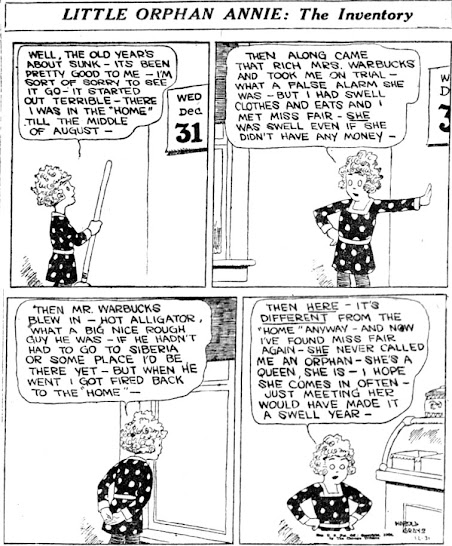
"Little Orphan Annie" by Harold Gray for Chicago Tribune, Dec. 31, 1924

Harold Gray paused Little Orphan Annie's story to recap the year — perhaps as a favor to any newspapers taking the day off or picking up the strip anew. The day's installment serves as a reminder that there was a Mrs. Daddy Warbucks.

"Little Orphan Annie" debuted on August 5, 1924; and yes, it was Mrs. Warbucks who first brought Annie home from the orphanage — but with no intention of letting her stay at the Warbucks estate. Mrs. Warbucks sent Annie back to the orphanage or simply kicked her out onto the street several times in the early years of the strip, only to have her husband retrieve or rescue the girl after returning from his frequent business trips.

"Gasoline Alley" by Frank King for Chicago Tribune, Dec. 31, 1924

"Little Orphan Alley" wrapped up its 86-year run in 2010; but "Gasoline Alley" is still with us, as is 130-something-year-old Walt Wallet, heading his five-generation family. Its present cartoonist, Jim Scancarelli, gave fans a start earlier this year when he introduced a plot line that seemed to portend the end of the strip. It turned out instead that politicians at city hall within the strip planned to update the name of Gasoline Alley, and the extended Wallet clan banded together to stop the change.

At the end of 1924, Walt was the single father of a three-year-old who had been abandoned on his doorstep, so I don't know whether he had been invited to Mr. Wicker's New Year's Eve party. Little Skeezix had a nursemaid, Rachel Brown, a Black woman who presumably had no personal life outside of the Wallet household; thus I assume Walt would have been free to go ring in the new year with the boys.

Or perhaps he was overjoyed to stay home with the boy.

After all, he had already taken him to another party in Sunday's comic.

"'Cap' Stubbs" by Edwina Dunn for George Matthew Adams Service, Dec. 31, 1924

"Cap" Stubbs and his buddies joined in the noisemaking in Edwina Dunn's strip. Do you think Grandma actually let him run loose on the streets at midnight?

I'll close out our farewell to 1924 with Winsor McCay's final Sunday episode for the year of Little Nemo in Slumberland — with my apologies that I can't present it to you in the size Mr. McCay intended for it, or in color. I invite you to embiggen these as your device will allow, and imagine the colors as best you can.


"Little Nemo in Slumberland" by Winsor McCay for New York Tribune, Dec. 28, 1924