Showing posts with label Minneapolis. Show all posts

Thursday, February 12, 2026

Q Toon: Minnesota ICE

I wish I had come across this quotation by Rev. Martin Luther King, Jr. in time to send this cartoon out for publication by the federal holiday (yes, it still is a federal holiday, in spite of the racist Trump regime's refusal to respect it). Instead, it goes public during Black History Month (not a federal holiday, but another observance repudiated by the white supremacists in the White House).

The quotation is certainly not aimed at the good people of the Twin Cities who have literally risked their lives to stand up, speak out, video, and blow whistles against the wicked people and the wicked government that sent them there. We are all, however, at a Which Side Are You On moment in history.

There are still plenty of people who support, defend, and excuse what this government and its hired storm troopers are doing. Many such people are beyond any cartoon's powers of persuasion. (But we keep on trying.) This cartoon is directed to what I believe is the dwindling middle ground of Americans who are yet to face the musical warning of the late Neil Peart that, "If you choose not to decide, you still have made a choice."

I had most of this cartoon inked before leaving on vacation last month, leaving a few spaces in case I needed to acknowledge outrages in addition to ICE's murder of Renée Nicole Good and the dogged persecution of brown-skinned detainees, including those who happen to be LGBTQ, such as Kilmar Abrego Garcia, Elias Perez Zuazo, and Jose Nuñez.

We weren't watching the news down in South America, but our Facebook feeds were flooded with reports and videos of the summary execution of Alex Pretti. I have a lot of college friends who live in the Twin Cities area, including one couple who live on the same block as Pretti's home.

Including Good and Pretti, 40 people have died in ICE custody or at ICE's hands in this first year of the Lawless Trump Regime's ethnic cleansing campaign. 32 in 2025. Eight in the first month of 2026.

So you will excuse me if I don't give a flying frock that somebody couldn't understand the words of Bad Bunny's halftime performance. 

Thursday, January 15, 2026

Q Toon: Besmirching Her Good Name


Watching Homeland Security Secretary Cosplay Kristi Noem's press announcement defending her ICE agent killing a woman in Minneapolis as she attempted to drive away from him — and her and Border Czar Tom Homan's appearances on the Sunday morning news programs — I couldn't get over the cognitive dissonance between their talking point that people need to cool their "overheated rhetoric," and all the overheated rhetoric making up the rest of their talking points.

We've all seen the videos of what really happened, but Noem, Homan, and the rest of the Lawless Trump Regime continue to push a fantasy narrative in which the shooting victim, Renee Macklin Good, was a radical left-wing domestic terrorist who charged her minivan directly at ICE agent Jonathan Ross with intent to kill.

Vice President J.D. Vance has argued that Ross shot Good because he had been struck once before by a vehicle driven by a suspect. But that only demonstrates that Ross uses the foolhardy but common border patrol tactic of getting in front of a moving vehicle in order to justify shooting at its driver.

You may wonder why I have drawn for the LGBTQ+ press a cartoon about this story, or why I inserted "with her lesbian co-conspirator" in the first panel.

Initial reporting stated that the youngest of Renee Macklin Good's children, a six-year-old boy, has been left without parents (his father having died in 2023). Most media and other editorial cartoonists have accepted that as fact, but Advocate and other LGBTQ+ publications, followed by local newsmedia and NPR, have reported that the woman with Renee Good when she was shot was her wife, Becca Good.

I certainly feel terrible for the boy, but at least he still has a step-mother. I hope that she and the boy's grandparents (who, I gather, are not Minnesotans) can remain on amicable terms while working out custody and visitation rights, so as not to make his tragedy even worse than it already is.

Out-of-state politicians and the mainstream media had been glossing over Renee and Becca's relationship, even though Becca was right there when Ross murdered her wife. Trump called Becca Good her wife’s “friend"; even John Stewart called Renee “a single woman” on Monday night’s Daily Show.

On the other hand, the Lawless Trump Regime's ironically-called Department of Justice has reportedly launched a criminal investigation of Renee Good's widow, which has prompted six federal prosecutors in Minnesota to resign in protest. (They include the lead prosecutor in that Minnesota day care fraud case Republicans would much rather talk about.)

Matt Sepic, Minnesota Public Radio: "In a statement, Assistant Attorney General Todd Blanche says, quote, 'There is currently no basis for a criminal civil rights investigation.' The DOJ says ICE has its own internal investigation underway that runs parallel to, quote, 'any FBI investigation.' But the same source we mentioned earlier, who's not authorized to speak on the record, tells me that this is untrue and that there is no internal ICE investigation of the shooting."

Minneapolis Mayor Jacob Frey posted on social media that, "The people pushing to prosecute Renee's widow are monsters"; Senator Amy Klobuchar (D-MN) added, "The family and loved ones of Renee Good deserve justice, not political attacks."

Sadly, justice is not a priority of the Lawless Trump Regime, and political attacks are.

Thursday, September 4, 2025

Q Toon: A Familiar Target


My apologies for such a verbose cartoon this week. I might not have needed to include the explanation that the Republicans in the cartoon are discussing a response to the mass shooting of children attending mass at a Catholic private school in Minneapolis last week.

Except for the possibility that there would be another mass shooting by the time this cartoon reached the newsstands.

Right-wing media and politicians quickly latched onto reports that the gunman was an MtF transgender person. (I do not know the shooter's preferred pronouns; I will use feminine ones to refer to her, but use the word "gunman" as if it were gender-neutral.) Firing hundreds of rounds through the stained glass windows into Annunciation Catholic Church, the shooter then took her own life.

What relevance, if any, the gunman's gender identity had to do with the shooting one can only speculate, so speculate the right-wing media promptly did. 

What is clear is that she was a former student of the Catholic school, and that her mother once worked at the parish. The shooter left behind a some sort of  manifesto and numerous threats on line, including threats to do exactly what she did. 

“This is not a church or religion attack, that is not the message,” according to the killer's manifesto. “The message is there is no message.” 

The shooter's previous online posts evince a festering hatred of virtually everybody and everything — with the exception of mass murderers. Them she admired.

But transgender persons are Republicans' go-to scapegoat for murders these days (at least when the killer is white). Trumpster Obergruppenführer Sebastian Gorka was on CNN over the weekend pushing inflated numbers for transgender shooters in these mass shootings, mischaracterizing some specific gunmen as trans to do so.

House Majority Whip Tom Emmer (R-MN) used the occasion to call on the state of Minnesota to repeal its transgender refuge law (which affords protections to caregivers and persons undergoing transgender therapy who might be threatened to extradition to a state where transgender therapy is illegal). Congressloon Emmer failed to explain how that law is relevant to the Annunciation shootings; the gunman did not flee to Minnesota from some red state Cisberry R.F.D. 

By the way, do you remember the white guy who assassinated a Minnesota legislator and her husband? Slimy Don Jr. went on TV to point the blame at transgender community despite the killer having publicly railed against the  LGBTQ+ community — transgender persons in particular. 

Well, at least Republicans haven't gotten around to blaming transgender people for measles outbreaks and forest fires. Those are still the fault of midichlorians and Jewish space lasers, last time I checked.

Saturday, July 26, 2025

Traffic Report

Detail from "Smitty" by Walter Berndt, distributed by Chicago Tribune July, 19, 1925

It's time to buckle your seat belts, because today's Graphical History Tour destination is July, 1925. Let's hit the road, shall we?

"Right of Might" by Winsor McCay in New York Herald Tribune, ca. July 18, 1925

The automobile had gone from novelty to everyday life in the space of a single generation, wresting  roadway dominance from horses and pedestrians. Once upon a time, if a pedestrian's destination were directly across the street, one crossed then and there. Children played in rural roadways and city streets. Horses, unless they were at full gallop, easily went around them.

Carriages, horsed and horseless, couldn't maneuver quite so easily. With the ubiquity of the automobile came a nationwide push for laws against what was now called "jay walking": crossing the street anywhere other than at a controlled intersection.

"Will It Come to This" by Orville P. Williams in New York American, July 14, 1925

Nor were the new regulations of pedestrian traffic a strictly American feature:

"Ein Zukunftsbild" by Arthur Johnson in Kladderadatsch, Berlin, July 12, 1925

Besides pedestrians, cross-country motorists had to contend with a patchwork of local roadway systems. U.S. numbered highways did not yet exist. Anyone with the time and sufficient buckets of paint could mark "auto trails" on power poles and name them whatever they wanted. Some, like the Lincoln Trail and Dixie Highway, actually crossed country; others were local, like the Three C Highway, which connected Cleveland to Cincinnati. A transcontinental highway might follow an old wagon trail, such as the Oregon Trail route, or a railroad, as the Union Pacific Highway for example.

Upkeep of the auto trails was largely up to the localities they passed through. A trail set up by some entrepreneur hoping to lure travelers to his tourist trap, on the other hand, might turn out to be a deeply rutted dirt road taking you through creeks instead of over them.

"Let's Build These Highways" by Orville P. Williams in New York American, ca. July 30, 1925

In 1925, the Joint Board on Interstate Highways, in cooperation with the American Association of State Highway Officials (founded in 1914), began work on creating a national numbering system for what would become U.S. Highways. Implementation of their project began within two years.

"Another Badly Needed Road" by Winsor McCay, ca. July 21, 1925

The super highways envisioned by Orville Williams on behalf of eager motorists would still be several years in the future. In the meantime, Winsor McCay offered another recommendation of a needed road. (Note the hat impaled on this guy's fender.) 

"Read Them And Weep" by Denis McCarthy, ca. July 12, 1925

Driving the point home, Denis McCarthy drew a cemetery shared by reckless drivers and careless pedestrians.

(When I last posted cartoons by Denis McCarthy, he seemed to have begun working at the Fort Worth Record after leaving the New Orleans Times Picayune; but his work wasn't appearing in either newspaper by the summer of 1925. I find his cartoons in newspapers that also ran the work of Hearst cartoonists, so I surmise he may have joined Hearst's syndicate.)

"Out Where the Worst Begins" by Tom Foley in Minneapolis Star, July 3, 1925

On the more automobile-friendly side, Tom Foley observes that roads do not remain in pristine condition very long, which is especially true in the land of ice and snow. Why Minnetonka Boulevard had more or deeper potholes than, say, Hennepin Avenue or Lake Street I don't know; perhaps it just happened to be the route Foley took to and from work every day.

"First Impressions Are Lasting" by Arthur G. Racey in Montreal Daily Star, July 28, 1925

Old-fashioned cobblestone streets, while picturesque, are not very automobile-friendly. (I doubt that they got along all that well with horses, either.) Say what you will about them, however, they were probably more effective at depressing traffic than stop signs on every block, roundabouts, or those "Your Speed" monitors, which explains why speed bumps are becoming so popular with urban planners these days.

"Sing Ho, for the Wide Open Spaces" by Denis McCarthy, ca. July 19, 1925

If pedestrians were confounded by ordinances telling them how to cross a street, Denis McCarthy spared some sympathy for motorists baffled by restrictions on how and where to park their car.

🚗

I can't leave today's topic without first checking what was going on in the quintessential autophile newspaper cartoon, "Gasoline Alley" 100 years ago today:


"Gasoline Alley" by Frank King in Chicago Tribune, July 26, 1925

Alas, the gang wasn't gathered around their cars that particular Sunday. Instead, Walt Willet was wandering the great wide open spaces with his foundling son, Skeezix, on foot.

🚙

P.S.: Yes, I know that seat belts were not a thing until 1959.

Saturday, June 7, 2025

June Toons, Goons, and Honeymoons

Today's Graphical History Tour whisks us through four decades worth of my editorial cartoons in Junes.

Bergetoons.com Exclusive! June, 1985

Since I was drawing exclusively for the UW-Parkside Ranger in 1985, and they didn't publish during the summer, it appears that this is the the one and only cartoon I committed to bristol board in the first month of their summer vacation.

I had taken a second-shift job to pay the bills, but it didn't pay enough for me to afford a vacation myself. For that matter, it wasn't great at paying the bills, either.

At any rate, for the benefit of any editor and publisher types who have difficulty understanding editorial cartoons, I was commenting on the impotence of the U.S. nuclear arsenal when faced with a terrorist action — in this case, the hijacking of TWA flight 847.

On June 14, Shi'ite terrorists hijacked the Cairo-to-San Diego flight during its Athens-to-Rome leg, forcing it to land in Beirut. They held passengers and crew hostage for 17 days, while forcing the plane to fly back and forth from there to Algiers. The hijackers separated hostages with Jewish-sounding names and sent them to a Shia-controlled prison in Beirut. They also executed U.S. Navy diver Robert Stethem, throwing his body onto the tarmac and shooting his corpse some more.

The ordeal was immensely frustrating for the Ronald Reagan administration, which had come to office largely thanks to portraying Jimmy Carter's response to the Iran hostage crisis as ineffective. The crisis ended only after Israel agreed to release some Lebanese prisoners.

One of the hijackers, Mohammed ali Hammadi, was arrested in West Germany two years later, tried, and sentenced to life in prison, but released on parole in 2005. He was fatally shot outside his home in the Beqaa Valley by unknown gunmen this past January. The remaining hijackers have been at large for the past four decades.

✍

Jumping ahead to June of 1995, I feel like the local newscaster tasked with segueing from a tragic news story of death and destruction to a feel-good feature item about cute puppies delighting residents of an assisted living home. 

But it is Pride Month, after all.

"Consider the Source" in Lavender Lifestyles, Minneapolis, June 27, 1995

My very dear friend from college days, Jeff, asked me to draw this illustration in June of 1995. His friend Julie Daffyd wrote a regular gossip/dish/advice/humor column, "Consider the Source," in one of the Twin Cities' LGBTQ+ publications; if I recall correctly, she wanted a caricature of herself on the publication's Pride float surrounded by a bevy of pulchritudinous hunks.

Commissioning for a caricature of yourself is a risky move, especially for publication. She must not have been terribly upset at how I drew her, however, as she had Jeff ask me for one more later on. But only once more.

✍

Setting the WABAC machine for June of  2005:

in Business Journal of Greater Milwaukee, June 17, 2005

Here's one I have always been pleased with, mostly on account of how the light and shade worked out.

The Northridge Mall was a failed shopping center on Milwaukee's far north side; and what is astonishing here is that, in spite of becoming a target for graffiti, drug use, and arson, it has taken twenty more years after I drew this cartoon to get Northridge Mall torn down. It closed for good in 2003; a home goods store and a grocery store opened on the property for a while, but proposals to revitalize the mall itself went nowhere.

The mall was bought in 2014 by an investment company in China, U.S. Black Spruce Enterprise Group, which then spent years fighting the City of Milwaukee's efforts to condemn the building (and has refused to pay for Milwaukee Fire Department responses to arson fires there). In 2023, Governor Tony Evers authorized a $15 million grant to the city for Northridge's demolition, which is scheduled to be completed by the end of this year.

✍

Last but not least, our Tour makes one of  our most popular stops, June of 2015.

for Q Syndicate and on Fusion.net, June/July, 2015

On June 26, the U.S. Supreme Court ruled 5-4 in favor of marriage equality in the landmark case Obergefell v. Hodges. Each of the four dissenting justices, pictured in my cartoon, published his own dissenting opinion, a rather unusual move. While it is not uncommon for a justice to issue a concurring or a separate dissenting opinion, seldom have we ever seen four dissenting opinions on the same case.

Justices John Roberts, Antonin Scalia, Clarence Thomas, and Samuel Alito basically agreed in their contention that the Court majority was overstepping jurisprudence because the U.S. Constitution does not specifically mention a right to marry one's sweetheart. Scalia, citing the precedent of Jiggery v. Pokery, and Alito protested that defining marriage is the purview of state legislatures, not the federal government. Thomas wrote that marriage equality for same-sex couples violated homophobes' First Amendment right of religious freedom.

This serves as a reminder that there is a right-wing Republican supermajority on the Court now, and this is the month to expect a flurry of rulings on everything from health care for transgender youth, to religious liberties, to voting rights, to gun control, to environmental protection. The three Justices elevated by the Blatantly Corrupt Trump Maladministration since I drew this cartoon have moved the Court so far to the right that Amy Comey Barrett passes for the Court's "swing vote."

Under cover of the daily Trumpster fire these days, who knows what draconian, puritan mischief the current Supreme Court will be able to get away with?

Saturday, October 19, 2024

October Jest

Next stop on our Graphical History Tour: October cartoons up from the spooky basement! Ghosts? Goblins? Werewolves and vampires?

No! Worse! Presidential politics!

in UW-Parkside Ranger, Somers Wis., Oct. 11, 1984

We were at the height of the political campaign season forty Octobers ago, so naturally, my cartoons were all about the candidates' debates.

President Ronald Reagan put in a poor performance during his first debate appearance with Democratic nominee Walter "Fritz" Mondale. Unlike President Joe Biden's poor performance this past June, it didn't result in hand-wringing from his side of the aisle urging him to pull out and let his Vice President take the wheel.

in UW-Parkside Ranger, Somers Wis., Oct. 18, 1984

And it barely moved his poll numbers.

Walter Mondale tried to spook voters with the zinger, "'Let's tell the truth. Mr. Reagan will raise taxes, and so will I. He won't tell you. I just did."

But Reagan had the mic drop moment with "I want you to know also I will not make age an issue of this campaign. I am not going to exploit for political purposes my opponent's youth and inexperience."

✍

in UW-M Post, Milwaukee, Nov. 3, 1994

I drew this cartoon for the Hallowe'en day edition of the student newspaper at the University of Milwaukee in 1994, but their October 31 edition had no editorial page — the entire issue being devoted to campus sports. So they held it for the Thursday issue, after Hallowe'en was past. At least Election Day was still to come.

The incumbent Congressman in my district, Democrat Peter Barca, would be defeated in that year's Republican wave. He's running for that same seat again this year, and the campaign of the current incumbent, Republican Bryan Steil, has one television ad out now featuring a group of veterans complaining about a vote Barca made in favor of cutting veterans' benefits.

One of those veterans, from the look of him, wasn't even born when Barca cast that vote. The tiny print footnote during the ad disappears quickly and refers only to the House Bill Number. I doubt anyone is going to look up whether it was a procedural vote, an omnibus bill, or an amendment. I don't see Politifact weighing in on it.

✍

In 2004, I was asked to draw a series of sketches about that year's presidential election for Lavender Magazine in Minneapolis. This was the cover drawing for their October issue:

in Lavender Magazine, Minneapolis, October, 2004

I had done color cartoons for the Milwaukee Business Journal the year before, but the cartoons I sent to Lavender Magazine were black-and-white images for their own people to colorize. I somehow don't have a copy of the published magazine, or even a downloaded image of the cover, and their on-line archive doesn't date back to 2004; so the above is how I colored it myself this week.

I'm fairly sure that I did see the published magazine. I just don't know whether I simply can't find it, or if it was among the stuff that had to be thrown out after our basement flooded several years ago.

in Lavender Magazine, Minneapolis, October, 2004

In any event, this is an example of what I sent them, and my recollection is that the illustrations like this one to accompany text of the cover articles appeared in color.

The editors asked for eight illustrations, in each case spelling out what sort of scenario they had in mind for each one.

in Lavender Magazine, Minneapolis, October, 2004

This is my colorization, from an earlier post, of another of the Lavender spot illustrations, of John Kerry getting a make-over from the original Queer Eye for the Straight Guy crew.

✍

Well, that's enough politics for a Saturday, so I'll close with one of my most popular efforts, from October of 2014, after the U.S. Supreme Court decided not to overrule lower court rulings finding marriage inequality unconstitutional.

for Q Syndicate, October, 2014

The Court's ruling in Obergefell v. Hodges making marriage equality the law of the land would come down the next year.

Three of its dissenting Justices are still on the bench, and share with the three Trump appointees who have since joined them a marked disdain for stare decisis.

Saturday, September 23, 2023

You May Ask Yourself, My God! What Have I Drawn?

At least once a month, this Graphical History Tour dredges up some of my old cartoons at decade intervals, and today we start with September of 1983.

in University of Wisconsin Parkside Ranger, October 13, 1983

This is one of less than a handful of cartoons I drew using gesso and an artist's blade. The technique involves coating the drawing surface with a white plaster called gesso (it is available in other colors), then painting over that with ink. Once that is dry, you cut away at the ink to reveal the gesso beneath. The resulting heavy shadows can be striking.

You don't have to completely cover the gesso with ink; I've seen cartoons and other artwork where the creator drew the scene on top of the gesso, then continued by cutting away some of the ink in order to lessen shading — the result resembling a woodcut.

My cartoon here came in response to a drunk driving crash in which the president of the student government was critically injured. Although I had made no attempt whatsoever to make anyone in the cartoon a caricature of him, my editors worried that some readers would find it in bad taste.

Well, not every cartoon is meant to be funny, and a cartoon of the student mascot crying would have been trite. To their credit, the Ranger editors held the cartoon to include it in a four-page feature section on drunk driving a few weeks later.

✍

in Gaze Magazine, Minneapolis, 1993

Some cartoons are meant to be totally serious. Other cartoons are meant to be utterly silly.

In 1993, it was hard to avoid Barney the purple dinosaur, whether you had small children in the house or not; there were various cartoons and late-night comedy sketches around riffing on his "I Like You, You Like Me" song and that dopey voice of his. 

Years later, I saw that some other cartoonist had gotten around to drawing pretty much the same idea that I had. Or maybe it was a meme. Or quite possibly both.

Puns are low-hanging fruit in the cartooning biz, and yours would have to be extremely elaborate and exquisite before you'd have any right to claim, "Hey! That's my idea!"

✍

2003 marked Harley Davidson's centennial celebration in Milwaukee, and the people putting the big 100th anniversary party together thought it would be a great idea to keep everyone guessing what the big-name entertainer they had hired for the big concert at the Marcus Ampitheater.

Rumors flew that they were bringing in Steppenwolf, whose "Born to Be Wild" is a biker anthem, but who had broken up in 1972. Or perhaps the Allman Brothers, or George Thorogood, or Judas Priest. Or maybe even the Rolling Stones!

in Business Journal of Greater Milwaukee, Sept. 5, 2003

So fans of those bands were disappointed and upset when the mystery headliner was revealed to be Elton John.

Make no mistake: everyone recognized that Elton John was and is a star performer. But he doesn't have that biker vibe one generally associates with riding on a Hog.

Front or back seat.

✍

for Q Syndicate, September, 2013

One of my favorite things to do in a cartoon is to take a cliché and turn it on its head. The occasion for this cartoon was actually how little opposition arose when six counties in New Mexico began granting marriage licenses to same-sex couples.

The counties had responded proactively to an American Civil Liberties Union lawsuit on behalf of same-sex couples in the state. The New Mexico State Supreme Court would rule unanimously in favor of marriage equality in December, extending marriage rights into the more hesitant 27 counties.

A year and a half later, the Supreme Court granted those rights to the rest of the nation, and opposition has proven to be nowhere near "fever pitch."

Except in the case of a few county clerks and a couple of ethically challenged Supreme Court Justices.

Saturday, June 3, 2023

The Great Northern Migration

The 1920's were a high-water mark for conservative movements in the U.S.A., and that includes the Ku Klux Klan.

"The South Will Soon Be Demanding Restriction of Migration of Its Labor" by John McCutcheon in Chicago Tribune, May 10, 1923

The differential in wages was certainly a contributing factor, but Klan activity in the South, where it had thoroughly permeated local and state government and law enforcement, was a significant impetus compelling the Great Migration of Black Americans north. Time magazine reported (May 5, 1923) that 32,000 Blacks had left Georgia, 22,750 had quit South Carolina, and 20,000 fled Alabama, an exodus that "almost rivals the phenomenal movement of 1915-16, when the best authorities estimate that 250,000 went North."

Contrary to John McCutcheon's cartoon, southern governments do not appear to have been alarmed by the exodus. Race-based and church groups up north, on the other hand, often had their hands full dealing with the newcomers.

Hauling livestock and whatever else they could from their farms, Blacks arrived at Penn Station every weekend. The new arrivals faced many of the same attitudes repeated in the "immigration crisis" of today (yet were not bused back south to Florida or Texas). 

Crusader News Service quoted a New York City spokesperson for Travelers Aid Society on June 20, 1923:

"It is argued that we get the bad element, the undesirables. This is true only relatively. We get some good and we get some bad. The good we get need a chance and opportunity if they are to remain good. The bad must have a chance, an opportunity, some instructions, some help if they are to become good.

"Before we hasten to discourage the brother whose flight from the South is just a little later than our own, let us give him a chance, a man's chance. Strangers are suspicious of other strangers, and naturally so. It is our duty to offer the welcome, and they will accept it in the spirit given.

"We have little reason to point out their faults, their awkwardness, their crude customs, their revolvers, and their lack of decorum, until we are sure they have been taught by us in all the things known to our community life."

Crusader News Service didn't identify that spokesperson, but I think you can probably guess the color of his or her skin.

Migrants north arrived to find that the Klan was already here. The Klan became an issue in the mayoral contest in Minneapolis in the spring of 1923, after their local publication there, The Voice of the Knights of the Ku Klux Klan, published allegations against incumbent Mayor, George Leach.
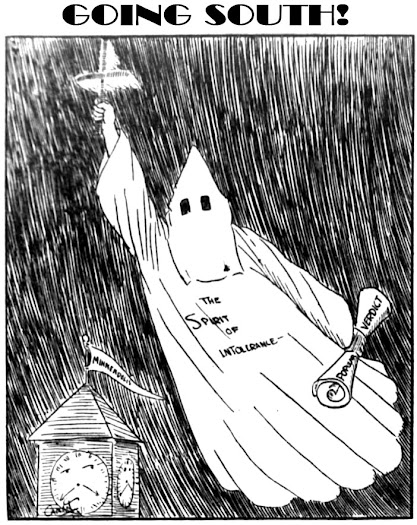
"Going South" by Wilfred Canan in Minneapolis Daily Star May 19, 1923

The Voice had published an accusation by one Gladys Kennedy that Mayor Leach had visited her gambling house for "wild parties" and had carried on an affair with her. Leach fought back, taking five Klan members to court. They included Klan "Exalted Cyclops" Roy H. Miner, who was running against Leach for mayor, editor and publisher of Hennepin County Enterprise George Silk, and suspended deputy sheriff Thomas Sullivan.

In May, a Minneapolis jury found the five guilty of libel. Kennedy recanted her allegations, but she and Miner were sentenced to 90 days at a workhouse. Silk and Sullivan received 60-day sentences; and Shirley Reichert, a University of Minnesota student who as a notary public received the Kennedy affidavit, was fined $50.

"The Usurper" by William F. Canan in Minneapolis Daily Star, June 9, 1923

Miner withdrew from the mayoral race. In June, the Minneapolis Daily Star reported that the mayoral candidate replacing Miner, State Senator William A. Campbell, was under investigation for being a leader in the Minnesota Klan. Campbell had supposedly written a number of articles for the Voice alleging malfeasance by various city council members.

Leach would be reelected by a hefty margin.

"Tearing Off the Sheet" by Rollin Kirby in New York World, ca. May 29, 1923

In New York and New Jersey, the Klan staged mass protests against an amendment proposed by State Senator (later Mayor of New York City) Jimmy Walker to New York's Civil Rights Law compelling unmasking of KKK members. 

Signed into law by Governor Al Smith, the Walker Amendment didn't mention the Klan by name, instead requiring "every existing corporation and every existing unincorporated association having a membership of 20 or more person, which incorporation or association requires an oath as a prerequisite or precondition of membership, other than a labor union or a benevolent order mentioned in the Benevolent Orders Law... [to] file with the Secretary of State a sworn copy of its constitution, by-laws, rules, regulations, and oath of membership, together with a roster of its membership and list of its officers for the current year."

New York Daily News, May 28, 1923

The New York Daily News reported that 8,000 klansmen gathered at Eastport, Long Island; the newspaper's photographers were at a simultaneous rally in Pompton Lakes, New Jersey. Further demonstrations were reported in Syracuse, Buffalo, Schenectady, and Binghamton.

"Civilization, 1923" by Nelson Harding in Brooklyn Daily Eagle, May 31, 1923

A hooded speaker identified as the King Kleagle swore to the Pompton Lakes mob, "Al Smith by signing that bill barred himself forever from the presidency of the United States." 

Given that Smith was Roman Catholic by faith, the Klan was already predisposed against his presidential aspirations. By the time he was the Democratic nominee in 1928, the Klan's "whispering campaign" attacking him was well-established.

Klan opposition would have nothing to do with Mayor Walker's eventual downfall, however.

Constitutionality of the Walker Law would ultimately be upheld by the New York and United States Supreme Courts in a case brought by Buffalo Klansman George C. Bryant, who argued that it violated the Equal Protection clause of the Constitution. 

In the U.S. Supreme Court's decision, Justice Willis Van Devanter wrote the Walker Law could legally single out the Klan, given that

"it was conducting a crusade against Catholics, Jews, and negroes, and stimulating hurtful religious and race prejudices; that it was striving for political power, and assuming a sort of guardianship over the administration of local, state, and national affairs, and that at times it was taking into its own hands the punishment of what some of its members conceived to be crimes.
"We think it plain that the action of the courts below in holding that there was a real and substantial basis for the distinction made between the two sets of associations or orders was right, and should not be disturbed."

Saturday, May 27, 2023

Fighting Bob LaFollette

There are several noteworthy events in May of 1923 that I haven't gotten around to highlighting in these Saturday History Tours, so it wasn't easy picking which one to end the month with today. I've decided that it's time to start paying attention to Wisconsin Senator Robert "Fighting Bob" LaFollette.

"That Kid from Wisconsin Again" by Dorman H. Smith for Newspaper Enterprise Assn., ca. May 16, 1923

LaFollette still holds a place of honor here in his home state. There are streets and schools named for him all over the place here. Save for a COVID hiatus, Madison progressives have held Fighting Bob Fest every fall since 2002 (although its website appears to have been taken over by some unrelated commercial venture these days). 

His son Robert Jr. succeeded him in the Senate; his other son, Philip, served three terms as Wisconsin Governor in the 1930's. Grandson Bronson LaFollette was elected Wisconsin Attorney General from 1965 to 1969 and again from 1975 to 1987. A great-grandson and distant cousin of Bronson, Douglas LaFollette, recently resigned as Wisconsin Secretary of State, an elected post he had held since 1974.

But you don't find a lot of love for Senator LaFollette in the editorial cartoons of a century ago. Republican partisans did not care for his open rivalry with his fellow Republican in the White House, President Warren G. Harding. Democrats remembered his opposition to Woodrow Wilson's foreign policy leading up to and during World War I.

"Valuing an Old Masterpiece" by John T. McCutcheon in Chicago Tribune, May 26, 1923

Regarding these cartoons, Senator LaFollette had for ten years charged that U.S. railroads were overvalued, allowing them to overcharge for passenger and freight travel. Following Progressives' gains in the 1922 election, his charges finally had to be taken seriously by Senate leadership, which promised to have the Senate's Interstate Commerce Commission hold hearings.

"Shoe the Old Horse..." by J.N. "Ding" Darling in Des Moines Register, May 31, 1923

LaFollette protested that those hearings would be against Senate rules, in that the 68th Congress had still not been called into session — and would not be called into session for months to come. Four seats on the commission were left vacant at the end of the 67th Congress. Progressives wanted a greater say on the commission, but the Senate couldn't seat new members before being called into session. At May's end, it appeared that no hearings would be held, and no legislation offered.

The other Senator in Darling's cartoon is Smith Brookhart (R-IA).

"Making Progress" by William C. Morris for George Matthew Adams Service, ca. May 13, 1923

The Progressive bloc of Republicans in the House and Senate, LaFollette included, were isolationists. So was conservative President Harding, until convinced by his Secretary of State, Charles Evans Hughes, to support a proposal for a World Court to adjudicate international disputes before they could break into open warfare.

The other Republicans in William Morris's cartoon are Senators William Borah (R-ID), George Moses (R-NH), Hiram Johnson (R-CA) and Henry Cabot Lodge (R-MA). Lodge was not one of the Progressives, but had found isolationism useful against the Wilson administration in 1918 and 1920.

"The Move that Will Settle the Argument" by Edward Gale in Los Angeles Times, May 19, 1923

LaFollette had turned down the idea of running for president on the Farmer-Labor Party ticket in 1920, but was now entertaining serious talk of running on the Progressive Party ticket in 1924. Sitting atop the elephant's rump in Gale's cartoon, Senator Hiram Johnson (R-CA, Teddy Roosevelt's running mate in 1912) would eventually challenge Calvin Coolidge for the 1924 Republican presidential nomination.

Meanwhile, President Harding announced what would be a fateful speaking tour of the American West from Alaska to California in the coming summer.

"Ready to Follow the President..." by Wm. A. Ceperley in Davenport Democrat, May 27, 1923

My thanks to D.D. Degg at Daily Cartoonist for identifying "CEP" for me. I was running into a lot of dead ends trying to identify the Davenport Democrat's cartoonist. (It didn't help that Davenport was the name of a much more famous cartoonist.) There is no mention of CEP in this "Our Iowa Heritage" article on Iowa cartoonists, in spite of its having a contributor from the Democrat's successor newspaper, the Quad City Times, or in "Iowa Artists of the First Hundred Years," including its list of cartoonists on page 246.

Not so much in this particular cartoon, but Ceperley's style is often reminiscent of that of fellow Iowan J.N. "Ding" Darling. Yet where Ding was generally Republican, Ceperley leaned Democratic. His last cartoon in the Davenport Democrat ran on January 1, 1933 but he continued as City Editor of the paper until 1937; he died in 1956.

"In an Open Field" by William F. "Wilfred" Canan in Minneapolis Daily Star, May 23, 1923

This cartoon by Wilfred Canan (pen name Billican) may be the closest thing I'll find to one sympathetic to Senator LaFollette. Canan (1889-1929) began his cartooning career drawing for publications associated with the Nonpartisan League in North Dakota, a leftist political organization that gave rise to the Farmer-Labor Party in Minnesota. 

Harding in this cartoon is singing an 1850 hymn by Emily Oakley based on the parable of the sower:

Sowing the seed by the wayside high,
Sowing the seed on the rocks to die,
Sowing the seed where the thorns will spoil,
Sowing the seed in the fertile soil:
O what shall the harvest be?

Given 100 years worth of hindsight, the parable of the rich fool also comes to mind.