Showing posts with label Ted Brown. Show all posts

Saturday, September 26, 2026

Government v. Press

This week's Graphical History Tour bravely sallies forth against censorship of newsmedia in the United States.

As a political cartoonist who has just been among a few dozen other political cartoonists, Your Humble Scribbler has a vested interest against censorship of editorial cartoons in particular. 

During the First Golden Age of my profession, in the late 18th Century and into the next, newspaper publishers saw the popularity and influence of the Thomas Nasts and Johannes Kepplers drawing for the national weeklies, and hired some of the best editorial cartoonists to grace their newspapers' front pages. And not incidentally, to push the publishers' political agendas.

"No Honest Man Need Fear Cartoons" by Homer Davenport in New York Journal, Apr. 22, 1897

Local politicians did not take kindly to being lampooned on those front pages. Upset by Homer Davenport's cartoons of influential Republican Mark Hanna, New York political boss Senator Thomas Platt, pushed a bill in the state assembly to ban cartoon depictions of real persons without their consent.

Davenport drew the parallel with Platt's predecessor, William Tweed, who had famously complained that although his constituents didn't read the papers, they saw "them damn pictures." Platt's bill failed to pass, but that didn't stop similar bills from cropping up elsewhere.

"The Governor Has His Revenge" by Robert Edgren in San Francisco Examiner, Feb. 25, 1899

A copycat bill by California Republicans failed to pass on its first go-around, but was passed during the next legislative session and signed by newly elected Republican Governor Henry Tifft Gage. As in New York, the partisan Democratic cartoons in Hearst newspapers were a major impetus for the bill; specifically, a cartoon of Gage being led on a leash by railroad magnate C.P. Huntington.

Having been signed into law, California's anti-cartoon bill was laughed — and ignored — into obscurity. Hearst cartoonist Robert Edgren offered an unusual motive for Governor Gage to sign the anti-cartoon bill: that the cartoonists were not drawing him any more.

Frankly, the man was a caricaturist's dream. Too bad he was voted out of office after one term.

by Walter McDougall in North American, Philadelphia, Jan. 30, 1903

Responding to daily cartoons in Philadelphia's North American by Charles Nelan depicting gubernatorial candidate Samuel Pennypacker as the pet parrot of Republican Party boss Senator Matthew Quay, Pennypacker's inaugural address demanded censorship of the "disreputable" North American. Obligingly, State Representative Frederick Pusey introduced a bill outlawing publication of any cartoon 

"portraying, describing, or representing any person, either by distortion, innuendo, or otherwise, in the form or likeness of beast, bird, fish, insect, or other unhuman animal, thereby tending to expose such person to public hatred, contempt, or ridicule."

The North American's other editorial cartoonist, Walt McDougall, responded with a cartoon stretched across the top of the front page depicting Quay, Pusey, and Pennypacker as a series of inanimate objects. (I have folded his cartoon to fit into a square format.) In an accompanying editorial, McDougall exhorted his fellow cartoonists, "Every cartoonist has a Noah's Ark full of worn, broken, and decrepit animals, bugs, and such, but the fresh vegetable field is untouched."

Pusey's bill nevertheless passed the Pennsylvania legislature and Pennypacker signed it into law. It was promptly repealed after Pennypacker was defeated in the next election.

by Frank Spangler in Montgomery [Ala.] Advertiser, Feb. 3, 1915 

As part of a package of election regulation laws, the Alabama legislature entertained a bill sponsored by Samuel D. Weakly prohibiting the caricature of any "prominent" man or politician. "It will make the average newspaper reader smile," the Advertiser editorialized, 

"that a sacred class is to be made of officeholders and office seekers, for they are the bulk of prominent people whom newspapers cartoon. A cartoon is a semi-editorial expression, and a powerful method of reaching public opinion, because ridicule and sarcasm are vividly presented to the eye. Both weapons are enormously effective on the stump, and there is no reason why the press should be deprived of their use. In fact, such a bill is a distinct effort to muzzle the press, and is an infringement of its constitutional powers."

As far as I have been able to determine, Weakly's proposal did not make it into the final bill. The Act (#171, § 11) did require cartoons expressing an opinion on any candidate or election issue to include "upon its face" the name of the newspaper's owner or the chief executive of its corporation.

"The Light that Must Not Fail" by Harry Murphy ca. May 5, 1917

U.S. entry into World War I opened the doors for government censorship of newspapers, and not just for their cartoons.

The Espionage Act of 1917 made it a crime to publish with intent to interfere with the operation or success of the armed forces of the United States or to promote the success of its enemies during wartime; to cause or attempt to cause insubordination, disloyalty, mutiny, refusal of duty, in the military or naval forces of the United States; or to willfully obstruct military recruiting or enlistment.  The Act also gave the Postmaster General authority to impound publications that he determined to be in violation of the Act.

"That Wooden One" by Nelson Harding in Brooklyn Daily Eagle, May 5, 1917

The U.S. was drawn into Europe's war due in part to the sinking of the R.M.S. Lusitania by a German U-boat. Nelson Harding, in a single-column cartoon on the Brooklyn Eagle's front page, turned the incident back against advocates for press censorship.

"Is This Somewhere in Germany or Somewhere in America" by Beaumont Fairbank in Brooklyn Sunday Eagle, May 5, 1918

In the same newspaper on the same day, Beaumont Fairbank drew his cartoon in support of an amendment to the 1917 Espionage Act by Sen. Henry Cabot Lodge (R-MA) stating, 

"The use of the mails should not be permitted to any newspaper, magazine, periodical, circulars or pamphlets which are printed in whole or in part in the German language." 

Fairbank was by no means alone in advocating governmental censorship of the foreign language press. While that amendment had failed to be included in the final bill, local officials outlawed German-language newspapers in several cities in New Jersey and Long Island.

"Wenn Uns Jetzt Unsere Vorväter Sehen Könnten" by John Lenz in Vorbote, Chicago, Oct. 31, 1917

Protest against this censorship was almost exclusively limited to the foreign language newspapers themselves. The banner behind Congress in John Lenz's cartoon translates to "Freedom of Speech, Press Freedom, Right of Assembly." The rolled parchments beneath George Washington represent the Constitution and First Amendment.

"O Sorry Plight" by Arthur Young in Masses, New York, September, 1917

The Creel Commission also employed the U.S. Post Office to censor publication of material counter to the official line. Art Young's cartoon above appeared in the September issue of  the marxist, antiwar Masses after Burleson's USPS had declared the August issue "unmailable under the Act of June 15, 1917."

"A Convenient Perch" by Ted Brown in Chicago Daily News, May, 1918

If Art Young expected other publications to rally in solidarity with Masses, he would be sadly mistaken. The Committee on Public Information headed by George Creel created a Bureau of Cartoons, which produced a weekly bulletin for cartoonists to direct their attention to matters the Wilson administration wanted them to draw about. By and large, cartoonists and their publishers fell right in line.

Masses ceased publication after its November/December issue.

"It's Nothing Important" by Bill Sanders in Milwaukee Journal, Dec. 20, 1972

Jumping ahead over half a century, President Richard Nixon tried very hard to force newsmedia to slant the news the way he wanted it reported. His administration enlisted the Federal Communications Commission to pressure television networks, cut funding to public broadcasting, and took newspapers to court. He was stymied, however, without a cooperative Congress or courts.

Instead, his communications team went on to found Fox News.

"Ask Me Anything" by Pat Oliphant in Denver Post, Nov. 15, 1973

In the meantime, we learned that President Richard Nixon kept an "enemies list" of critics of his administration, including many journalists. Nixon had always had a testy relationship with the media well before being elected president. As the Watergate scandal unfolded, it was revealed that he used the Justice Department, FBI, and Internal Revenue Service to open investigations against individuals on that list — although at least he never barred Jack Anderson, Daniel Schorr, or Mary McGrory from White House press briefings. 

for Bergetoons blog, August, 2018

There has been no assault on the media and the facts to rival the Absolutely Corrupt Donald Trump Regime's campaign to quash any reportage that doesn't fawn upon Dear Misleader. The two terms of his presidency have seen government websites erased, responsible reporters banned first from the Pentagon and now the White House, and weaponization against the media of both the Justice Department and the Federal Communications Commission, this time with general compliance on the part of Congress and the Supreme Court.

for Q Syndicate, February, 2025

Unless approved by Trump himself, it's all just fake news.

"They give me only bad publicity, press. I mean, they’re getting a license. I would think maybe their license should be taken away, ... That’s all they do. If you go back, I guess they haven’t had a conservative on in years or something, somebody said. But when you go back, take a look, all they do is hit Trump. They're giving me all this bad press, and they're getting a license. When you have a network and they have evening shows and all they do is hit Trump, that's all they do — that license, they're not allowed to do that!" — Donald Joffrey Trump, September 16, 2025

Saturday, September 27, 2025

Robert Junior Steps Into Dad's Shoes

The star of this week's Graphical History Tour is Robert Jr., the son and namesake of a famous father, following in Daddy's footsteps all the way to Washington, D.C.

Detail from "Politics Again Attracts Attention" by John McCutcheon in Chicago Tribune, Sept. 15, 1925

Not a Kennedy.

Robert M. La Follette Jr. was 30 years old when he declared candidacy for the Senate seat of his late father, "Fighting Bob" La Follette. Called "Young Bob" to distinguish him from his namesake, he was just old enough to qualify for the Senate under the U.S. Constitution.

"Practicing Those 'Thunderous Footfalls'" by J.P. Alley in Memphis Commercial Appeal, Sept. 20, 1925

Skeptical political cartoonists naturally questioned the young man's qualifications to fill his father's shoes, even if they weren't fans of the elder La Follette when he was alive. I will give J.P. Alley (whose editorial cartooning shoes at the Commercial Appeal would later be filled by his son, Cal Alley) credit for the unique and unorthodox observation that "Radicals" had cause for concern.

"On to Washington" by Jesse Cargill for Central Press Assn., ca. Oct. 3, 1925

Outlook magazine expressed the more conventional view that

"During [Robert La Follette Sr.']s lifetime, he found an able lieutenant in his son, Robert M. La Follette, Jr.; and now that La Follette is regarded as his successor. This is partly because the younger La Follette has explicitly subscribed to the political beliefs of his father, but in no small measure because he has an engaging personality of his own."

"Young Independence Is On His Way" by (Louis T.?) Merrill in Beloit Daily News, Sept. 8, 1925

It wasn't just the senior La Follette's shoes that were too big for his son, according to this Wisconsin cartoonist; so were his reputation and his hat. Blaine, whose collar Merrill drew chained around Young Bob's neck, was Governor John J. Blaine, a Progressive Republican.

I haven't come across any other cartoons by Merrill; this cartoon originally appeared in the Beloit Daily News and was reprinted in a few other newspapers around the state. Louis Taylor Merrill was on the Daily News masthead as the newspaper's Editorial Writer, so my guess is that this cartoon was drawn by him or someone in his household. 

Maybe his son.

"It's The Old Familiar Touch" by Guy R. Spencer in Omaha World Herald, Sept. 17, 1925

Footwear notwithstanding, La Follette decisively won the September 15 primary over Roy P. Wilcox of Eau Claire, the Coolidge Republican candidate, and half a dozen other candidates.

"Where It Fades Out" by Daniel Fitzpatrick in St. Louis Post-Dispatch, Sept. 19, 1925

The general election two weeks later was universally expected to merely ratify the primary election results. La Follette received more votes in the open primary than all the other candidates put together. The Democratic candidate, William George Bruce, ran so poorly in the primary that under state election rules, he didn’t even qualify to appear on the September 29 ballot.

"La Follettes All Look Alike to Him" by Edmund Duffy in Baltimore Sun, Sept. 18, 1925

Head of the Republican National Committee Senator William Butler (R-MA) called upon Wisconsin Republicans not to back Young Bob.

"Regardless of the fact that Mr. La Follette is running under the Republican machinery, he supported a candidate and platform in the last national election opposed to the candidate and platform of the Cleveland convention, [Calvin Coolidge,] and the Republican committee will not support him in any event. I cannot look upon a man who opposes the candidate of a party and the principles of a convention as a Republican, whether he runs under the Republican machinery or not."

"Sort of a Beauty Spot to Her" by Chas Kuhn in Indianapolis News, Sept. 18, 1925

Following Senator Butler's lead, the Wisconsin Republican Party met to endorse an alternative to La Follette. Wilcox yielded to pressure from party leaders to withdraw in favor of former Lt. Governor Edward Dithmar of Baraboo. A telegram from Sen. Irvine Lenroot (R-WA) urged "Wilcox  should let Dithmar try in view of his poor showing in the primary" — in which Dithmar had not been a candidate.

"Weather Report" by Tom Foley in Minneapolis Daily Star, Sept. 29, 1925

The general election results were so pre-ordained that over the state line in Minneapolis, Tom Foley could confidently draw the above cartoon for the day of the vote. Young Bob La Follette carried every county in the state except for Rock County (which happens to include Beloit).

"The La Follette Estate" by Roy James in St. Louis Star, Oct. 1, 1925

Running nominally as an Independent, Dithmar finished a distant second to La Follette. Socialist John M. Work came in third, largely due to votes from Milwaukee (yet underperforming previous Socialist candidates there); Democrat Bruce, waging a write-in campaign, placed fourth.

Unsigned cartoon in Capital Times, Madison, Sept. 30, 1925

If there was a signature on this cartoon, the Cap Times cropped it out. Whoever drew it included Senators Butler and Lenroot among the "old guard" bowled over backward by "Young Fighting Bob" striding toward Progress — in reasonably sized shoes.

"Seeing Things in Wisconsin" by Ted Brown in Chicago Daily News, ca. Oct. 7, 1925

Editorial cartoonists never quite agreed on what animal should represent the Progressive Party. Some drew it as a goat, while others, seizing on the La Follettes' first name, drew it as a bobcat. Use of the Bull Moose to represent the Progressive Party had ended with the death of Theodore Roosevelt.

Robert M. La Follette Jr. may have run as a Republican, but Ted Brown agreed with the Stand Pat Republicans that La Follette was not purebred GOP.

"Don't I Look Like Dad" by Edward G. McCandlish in Washington Post, Oct. 5, 1925

Actually, doesn't he kind of look like a young Marlon Brando?

Cartoonist Edward McCandlish (1887-1946) had a varied career, authoring 21 children's books and designing toys; during World War I, he painted camouflage markings on military uniforms, that being how it was done back then. He was perhaps best known for his "Bootlegger's Map of the United States," which first appeared as a two-page spread in Washington Post on March 14, 1926. (News reports at his death state that the map first appeared in the Detroit Free Press, but I don't find it printed there until 1930, and then much smaller.) 

"It's Sink or Swim for Young Bob Now" by Dorman H. Smith for Newspaper Enterprise Assn., ca. Oct. 5, 1925

Young Bob would win reelection to the Senate as a Republican in 1928, and as a Progressive in 1934 and 1940, championing organized labor and supporting much of Franklin Roosevelt's New Deal, but also advocating isolationist foreign policies. He was defeated for reelection to a fourth full term in 1946 by a Wisconsin Republican you might have heard of.

Joseph R. McCarthy.

Saturday, September 30, 2023

Portrait vs. Landscape

Seems that there is one more Saturday in September than I thought there was, so here's one more September to Remember post.

in Gaze Magazine, Minneapolis, MN, Oct. 15, 1993

Very few of my cartoons here are like this one in portrait orientation, but that is how the layout editors of Gaze Magazine wanted them. My cartoons shared a page with three other panel cartoons, all drawn to approximately the same dimensions.

I drew pretty much the same cartoon for the UWM Post — the  Post version drawn second, but published first. In accordance with the Post editorial page's layout, I drew the second version in landscape orientation. (Post editors in 1989 had asked me to draw my cartoons in portrait orientation for the three summer issues, but we reverted to landscape that fall.)

in UWM Post, Milwaukee, Wis., Sept. 20, 1993

Which version do you think is more effective?

100 years ago, nearly all newspaper editorial cartoons appeared in portrait orientation. In some cases, the cartoon was nearly square (Daniel Fitzpatrick, for example), but portrait orientation dominated the medium for the first half of the 20th Century.

There were notable exceptions: Luther Bradley and his successor at the Chicago Daily News, Ted Brown, drew their cartoons in landscape orientation.

"It Was Important, Too" by Ted Brown in Chicago Daily News, Sept., 1923

"The Royal Feast of Belshazzar Blaine" by Walt McDougall and Valerian Gribayedoff stretched across the front page of Joseph Pulitzer's New York World is another remarkable exception, as are the weekly cartoons Winsor McCay would produce to run atop William Randolph Hearst's syndicated Sunday sermons.

"The Royal Feast of Belshazzar Blaine" by Walt McDougall & Valerian Gribayedoff in New York World,  Oct. 31, 1884
"For Good Reasons They Fear Him" by Winsor McCay for International Feature Service, Sept. 30, 1923

John "Ding" Darling's cartoons for the Des Moines Register and New York Tribune hewed to the portrait standard...

"Strange How Different She Looks" by J.N. "Ding" Darling in Des Moines Register, Sept. 25, 1923

...but he oriented his cartoons for Colliers Weekly landscapewise.

"Ellis Island Hotel" by J.N. "Ding" Darling in Colliers Weekly, Oct. 6, 1923

When weekly magazines were the primary outlet for editorial cartoonists, the likes of Nast, Keppler, and Dalrymple would have a cartoon in portrait orientation on the front page and an epic two-page landscape cartoon as the centerfold. With a whole week to work on each cartoon, why not?

"In the Democratic Bowling-Alley" by Victor Gillam in Judge, Sept. 30, 1893

Daily newspapers began to employ editorial cartoonists late in the 19th Century, fitting the cartoon in among multiple columns — breaking up the page rather than headlining it. Whether it was the shorter deadlines, the less sophisticated printing process, or just artistic preference, landscape orientation would remain relatively rare until the 1960's and '70's, with the rise of Gene Basset, Pat Oliphant, Jeff MacNelly, Don Wright, Mike Peters, (oh, I could go on and on), and those of us inspired by them.

As conglomerate newspaper management these days fails to see profit in printing editorial cartoons, the medium may have to return to portrait mode to accommodate editorial cartooning's future — the thing you are probably holding in your hand as you read this.

✍

Oh, by the way, since I asked: even though I still favor landscape mode for my own cartoons (and it's what my remaining editors expect of me), personally, I think the portrait oriented version of my Cuban MiG cartoon  is the more visually satisfying.

Saturday, October 16, 2021

October Affairs: Domestic

Hey, kids! It's time to catch up on all the domestic national news from October, 1921!

We'll start with something that seems as relevant today as ever, because, like the weather, everybody talks about it but nobody ever does anything about it.

"Rather Late Canning Time..." by Clifford Berryman in Washington (DC) Evening Star, Oct. 13, 1921

It was Republicans who had complete control of the White House and both houses of Congress in 1921. But the filibuster was a favorite tactic of senators from southern states — Democrats in those days — who would thwart an anti-lynching bill throughout the entire 67th Congress. 

Other legislation killed by filibusters from both parties during that congressional session included the Harding administration's ship subsidy bill, a Railroad Refunding bill, the Rogers Foreign Service bill, the "Blue Sky" securities regulation bill, the Radio Regulation bill, and a Statute Codification bill.

"So Near, And Yet" by Bill Sykes in Philadelphia Public Ledger, Oct. 10, 1921

If getting legislation passed was easier said than done, so was breaking Americans' alcohol habit. Prohibition was in its second year, and not only were folks learning how to brew hooch in their private basements, but since not every home has its own basement, a thriving black market in liquor had sprouted up across the country in major cities and small towns.

"Autumn Leaves..." by Ted Brown in Chicago Daily News, by Oct. 27, 1921

Ted Brown's consumers look mighty happy with their crop, for now. Who that fellow is back there saying "Never again," I'm afraid I can't tell.

"Is He Worth It?" by John Cassel in New York Evening World, Oct. 19, 1921

The major national story of October was a threatened strike by railroad workers for better pay and working conditions. This was three decades before the interstate highway system; trains, not trucks, were primarily responsible for transporting goods across the country, as well as for passenger travel and mail delivery.  

"There's a Limit to All Things" by Albert Levering in New York Tribune, Oct. 23, 1921

Railroad corporations demanded significant cuts in wages and benefits to their workers in 1921, and also increased farming out work to non-union sub-contractors. Five major unions indicated they were all set to go out on strike, but the Railroad Labor Board ordered union leaders to keep their workers on the job. After the Board consented to delay Interstate Commerce Commission orders to slash half of the increases workers had enjoyed during World War I, union members voted to cancel the strike.

It was only a temporary peace, kicking the can down the railroad; the unions would go on strike within a year when that pay cut delay ended.

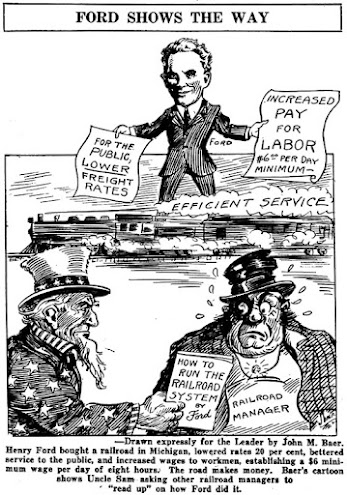
"Ford Shows the Way" by John Baer in Nonpartisan Leader, Fargo ND, Oct. 31, 1921

As peculiar bedfellows as they may have been, leftist former Congressman John Baer (Nonpartisan League-ND) here holds up right-wing Republican Henry Ford as an example for how to run a railroad. Baer cartooned for the National Railroad Union newspaper Labor as well as the Nonpartisan League's official paper (which was published in Minneapolis as the National Leader after the October 31, 1921 issue).

Looking to improve supply and distribution lines for his auto plant in Dearborn, Ford bought the Detroit, Toledo and Ironton Railroad in 1920, modernizing and transforming it, in the words of railroad historian William Pletz, "from a streak of rust into an extremely efficient and profitable operation, the likes of which has or will seldom be seen in this country." 

Under Ford, DT&I employees made higher wages than others in the industry. He also launched an electrification program for the railway, which was, however, abandoned after he sold the DT&I (at a hefty profit) to a subsidiary of the Pennsylvania Railroad in 1929.

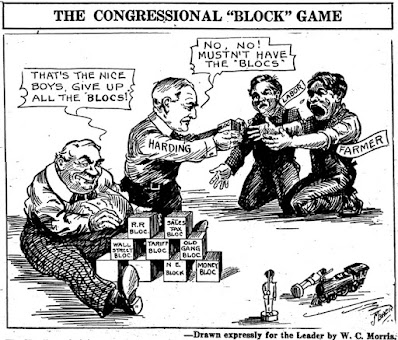
John Baer in Nonpartisan Leader, Fargo, Oct. 31, 1921
Baer (not William Morris) here accuses President Harding of trying to break up the Nonpartisan League's alliance between farmers and laborers, Minnesota's Democratic-Farmer-Labor Party being the last vestige of the movement. Republican efforts to gin up farmers' resentment of organized labor have been remarkably successful, even in ostensibly Democratic Minnesota.

"Th' Hog" by William Sykes in Philadelphia Public Ledger, Oct. 3, 1921

Oh, and the World Series was held in October, but it was the New York Yankees vs. the New York Giants, so nobody beyond the outer boroughs really cared all that much.

(Just kidding. Even game 4 getting rained out made banner headlines across the country. And the Giants took the series five games to three.) 

Saturday, May 1, 2021

Something Moral, Something Blue

Orville Williams in New York Journal, ca. April 5, 1921

I had intended to run this last week in time for the Oscars, but these cartoons have waited an entire century. What difference is seven more days going to make?

100 years ago, the films playing at your great-grandparents' local Odeon might feature sexual promiscuity, swearing, disrespectful depictions of clergy, and even partial nudity. Your great-grandmother was shocked at the stuff great-grandfather took the family to see. On Sunday, no less!

1921 saw a flurry of legislation to censor the movies — somewhere around 100 bills in 37 states. New York created the first official censorship board that year, six years after The Supreme Court had ruled unanimously that motion pictures had no First Amendment rights.

"No Chance to Go Wrong" by Albert Reid in New York Evening Mail, April 1921

Given how the Christianist Right came to be synonymous with the Republican Party in recent decades, you might be surprised to see a staunch Republican like Albert Reid ridiculing prudish censorship. Issues cut across party lines much more a century ago than they do today, however, and the call to clean up the movies was then viewed as a progressive cause. 

It arose from the same social activism that gave the nation Prohibition, and was expanding its purview toward bans on tobacco smoking and chewing. Reid's cartoon above, and this one by Craig Fox, suggest that their successes would not have been possible without female suffrage (which, by the way, Reid strongly supported).

"No Wonder Willie Weeps" by Craig Fox in Rochester Democrat and Chronicle, April, 1921

Women were only one of the liberal groups behind these moves to improve society. Consider that Blue Laws, prohibiting a wide swath of activities on Sundays, were supported by unions as one way of ensuring that their members got that day off from work.

"Tying the 'Nots'" by Harold J. Wahl in Sacramento Bee, April, 1921

But there's the rub. If you mandated Sundays off for all those movie projectionists, baseball players, popcorn hawkers, and the rest, what were Grandpa and the family supposed to do with their day off?

Well, the social reformers had a ready answer for that, too.

"The First Blue Sunday" by Alfred G. "Zere" Ablitzere in New York Evening Post, May, 1921


Alfred Ablitzere made a whole series of these "First Blue Sunday" cartoons in which his Blue Law Officer waged a valiant battle against all sorts of sacrilegious Sabbath activity. 

"The First Blue Sunday" by "Zere" Ablitzere in NY Evening Post, June, 1921

You will notice that some of these activities would not have required any employees to have shown up for work.
"The First Blue Sunday" by "Zere" Ablitzere in NY Evening Post, July, 1921 

But I guess Officer Blue Law's tireless efforts were appreciated by those workers such as this noble lifeguard who were able to take the Lord's Day off. The officer's was not a completely thankless job.

"The First Blue Sunday" by Alfred G. "Zere"Ablitzere in NY Evening Post, April, 1921
And thus, having successfully reformed everyone in this country, the social justice warriors of 1921 were eager to expand globally.
"Keeping Up with the Neighbors" by Ted Brown in Chicago Daily News, April, 1921

And heck (if you will pardon such strong language), why even stop there?
"The Futurist Saturday Sunset" by Edward Gale in Los Angeles Times, March, 1921