Showing posts with label Minnesota. Show all posts

Thursday, February 12, 2026

Q Toon: Minnesota ICE

I wish I had come across this quotation by Rev. Martin Luther King, Jr. in time to send this cartoon out for publication by the federal holiday (yes, it still is a federal holiday, in spite of the racist Trump regime's refusal to respect it). Instead, it goes public during Black History Month (not a federal holiday, but another observance repudiated by the white supremacists in the White House).

The quotation is certainly not aimed at the good people of the Twin Cities who have literally risked their lives to stand up, speak out, video, and blow whistles against the wicked people and the wicked government that sent them there. We are all, however, at a Which Side Are You On moment in history.

There are still plenty of people who support, defend, and excuse what this government and its hired storm troopers are doing. Many such people are beyond any cartoon's powers of persuasion. (But we keep on trying.) This cartoon is directed to what I believe is the dwindling middle ground of Americans who are yet to face the musical warning of the late Neil Peart that, "If you choose not to decide, you still have made a choice."

I had most of this cartoon inked before leaving on vacation last month, leaving a few spaces in case I needed to acknowledge outrages in addition to ICE's murder of Renée Nicole Good and the dogged persecution of brown-skinned detainees, including those who happen to be LGBTQ, such as Kilmar Abrego Garcia, Elias Perez Zuazo, and Jose Nuñez.

We weren't watching the news down in South America, but our Facebook feeds were flooded with reports and videos of the summary execution of Alex Pretti. I have a lot of college friends who live in the Twin Cities area, including one couple who live on the same block as Pretti's home.

Including Good and Pretti, 40 people have died in ICE custody or at ICE's hands in this first year of the Lawless Trump Regime's ethnic cleansing campaign. 32 in 2025. Eight in the first month of 2026.

So you will excuse me if I don't give a flying frock that somebody couldn't understand the words of Bad Bunny's halftime performance. 

Thursday, January 15, 2026

Q Toon: Besmirching Her Good Name


Watching Homeland Security Secretary Cosplay Kristi Noem's press announcement defending her ICE agent killing a woman in Minneapolis as she attempted to drive away from him — and her and Border Czar Tom Homan's appearances on the Sunday morning news programs — I couldn't get over the cognitive dissonance between their talking point that people need to cool their "overheated rhetoric," and all the overheated rhetoric making up the rest of their talking points.

We've all seen the videos of what really happened, but Noem, Homan, and the rest of the Lawless Trump Regime continue to push a fantasy narrative in which the shooting victim, Renee Macklin Good, was a radical left-wing domestic terrorist who charged her minivan directly at ICE agent Jonathan Ross with intent to kill.

Vice President J.D. Vance has argued that Ross shot Good because he had been struck once before by a vehicle driven by a suspect. But that only demonstrates that Ross uses the foolhardy but common border patrol tactic of getting in front of a moving vehicle in order to justify shooting at its driver.

You may wonder why I have drawn for the LGBTQ+ press a cartoon about this story, or why I inserted "with her lesbian co-conspirator" in the first panel.

Initial reporting stated that the youngest of Renee Macklin Good's children, a six-year-old boy, has been left without parents (his father having died in 2023). Most media and other editorial cartoonists have accepted that as fact, but Advocate and other LGBTQ+ publications, followed by local newsmedia and NPR, have reported that the woman with Renee Good when she was shot was her wife, Becca Good.

I certainly feel terrible for the boy, but at least he still has a step-mother. I hope that she and the boy's grandparents (who, I gather, are not Minnesotans) can remain on amicable terms while working out custody and visitation rights, so as not to make his tragedy even worse than it already is.

Out-of-state politicians and the mainstream media had been glossing over Renee and Becca's relationship, even though Becca was right there when Ross murdered her wife. Trump called Becca Good her wife’s “friend"; even John Stewart called Renee “a single woman” on Monday night’s Daily Show.

On the other hand, the Lawless Trump Regime's ironically-called Department of Justice has reportedly launched a criminal investigation of Renee Good's widow, which has prompted six federal prosecutors in Minnesota to resign in protest. (They include the lead prosecutor in that Minnesota day care fraud case Republicans would much rather talk about.)

Matt Sepic, Minnesota Public Radio: "In a statement, Assistant Attorney General Todd Blanche says, quote, 'There is currently no basis for a criminal civil rights investigation.' The DOJ says ICE has its own internal investigation underway that runs parallel to, quote, 'any FBI investigation.' But the same source we mentioned earlier, who's not authorized to speak on the record, tells me that this is untrue and that there is no internal ICE investigation of the shooting."

Minneapolis Mayor Jacob Frey posted on social media that, "The people pushing to prosecute Renee's widow are monsters"; Senator Amy Klobuchar (D-MN) added, "The family and loved ones of Renee Good deserve justice, not political attacks."

Sadly, justice is not a priority of the Lawless Trump Regime, and political attacks are.

Thursday, September 4, 2025

Q Toon: A Familiar Target


My apologies for such a verbose cartoon this week. I might not have needed to include the explanation that the Republicans in the cartoon are discussing a response to the mass shooting of children attending mass at a Catholic private school in Minneapolis last week.

Except for the possibility that there would be another mass shooting by the time this cartoon reached the newsstands.

Right-wing media and politicians quickly latched onto reports that the gunman was an MtF transgender person. (I do not know the shooter's preferred pronouns; I will use feminine ones to refer to her, but use the word "gunman" as if it were gender-neutral.) Firing hundreds of rounds through the stained glass windows into Annunciation Catholic Church, the shooter then took her own life.

What relevance, if any, the gunman's gender identity had to do with the shooting one can only speculate, so speculate the right-wing media promptly did. 

What is clear is that she was a former student of the Catholic school, and that her mother once worked at the parish. The shooter left behind a some sort of  manifesto and numerous threats on line, including threats to do exactly what she did. 

“This is not a church or religion attack, that is not the message,” according to the killer's manifesto. “The message is there is no message.” 

The shooter's previous online posts evince a festering hatred of virtually everybody and everything — with the exception of mass murderers. Them she admired.

But transgender persons are Republicans' go-to scapegoat for murders these days (at least when the killer is white). Trumpster Obergruppenführer Sebastian Gorka was on CNN over the weekend pushing inflated numbers for transgender shooters in these mass shootings, mischaracterizing some specific gunmen as trans to do so.

House Majority Whip Tom Emmer (R-MN) used the occasion to call on the state of Minnesota to repeal its transgender refuge law (which affords protections to caregivers and persons undergoing transgender therapy who might be threatened to extradition to a state where transgender therapy is illegal). Congressloon Emmer failed to explain how that law is relevant to the Annunciation shootings; the gunman did not flee to Minnesota from some red state Cisberry R.F.D. 

By the way, do you remember the white guy who assassinated a Minnesota legislator and her husband? Slimy Don Jr. went on TV to point the blame at transgender community despite the killer having publicly railed against the  LGBTQ+ community — transgender persons in particular. 

Well, at least Republicans haven't gotten around to blaming transgender people for measles outbreaks and forest fires. Those are still the fault of midichlorians and Jewish space lasers, last time I checked.

Monday, October 14, 2024

This Week's Sneak Peek

 I tasked myself with another outdoor setting at night this week:

That works really well in grayscale; I know of just one publication that prints my cartoons that way. It poses a challenge in colorizing the cartoon, as the Moody Blues said:

Cold-hearted orb that rules the night
Removes the colors from our sight
Red is gray, and yellow white
But we decide which is right
And which is an illusion

✍

I learned this weekend of the death of Jerry Fearing, 94, editorial cartoonist for the St. Paul Pioneer Press Dispatch, and the papers that merged into it, from about 1957 to 1994. In his memory, here is the cartoon he drew after the death of Senator Hubert Humphrey in 1978:


Thursday, August 15, 2024

Q Toon: Is This a Dad Joke?


The buzz around Minnesota Governor Tim Walz, now that he's been tapped by Vice President Kamala Harris to take over her job in 2025, is that he has that "Midwestern Dad Vibe."

For the last few days, those who know him personally have been sharing their stories, including how helpful he’s been with fixing other people’s cars, how much of a delight he was in a decade-long group chat called “Sports Buddies,” and how inspiring he was as a teacher and coach. One former coworker told a story to the Washington Post in which they tried to prank him by giving Walz a fake gift certificate for a free turkey at the local grocery store, and that Walz managed to still leave with a free turkey. “That’s just Tim Walz,” she said.

At the turn of the millennium, Walz and his wife, Gwen, were faculty advisers to the Gay-Straight Student Alliance at Mankato West High School in south central Minnesota. The future Congressman and Governor has said — I'm paraphrasing here — that he felt called to bring his straight-cred as the coach of the football team to the group.

As one former student put it, "Dare I say, there's a lot of toxic masculinity in the whole football team. And to see someone who was a football coach, but also saying, 'Hey, we're going to respect everyone. And I absolutely won't put up with any of that crap' — that was really bold."

Contrast that attitude with that of the Republican Veep-Wannabe, J.D. Vance. You might catch him in a dress; but that wasn't solidarity, it was cultural appropriation.

The Ohio senator opposed the 2022 Respect for Marriage Act, which codified same-sex marriage as the law of the land, and introduced legislation that would have banned gender-affirming care for trans youth at a federal level. He has also endorsed the notion that the existence of queer and trans people in public life is inherently predatory, writing on Twitter, now X, in 2022: “I’ll stop calling people ‘groomers’ when they stop freaking out about bills that prevent the sexualization of my children.”

Republicans are trying to attack Walz for signing a Minnesota bill guaranteeing families of transgender youth the right to pursue gender-affirming care. Their epithet for him, "Tampon Tim" for signing a bill okaying (not, it must be pointed out, mandating) feminine hygiene dispensers in boys' bathrooms, was meant as an insult, but Walz has embraced it as a badge of honor. 

Because, really now. If you are asked to think of all the dangerous things we need our kids protected from in public schools, tampons are way, way down the list.

Saturday, July 15, 2023

Tales from the North

Continuing last Saturday's Graphical History Tour, we've got some century-late-breaking news out of Minnesota!

In a special election to fill the U.S. Senate seat of the late Cushman Davis, Minnesota elected Farmer-Labor candidate Magnus Johnson.

"Way Up in Alaska" by Harold J. Wahl in Sacramento Bee, July 19, 1923

The Senate seat won by Johnson had been held by Republicans since 1859. Fellow Farmer-Laborite Henrik Shipstead had been elected to Minnesota's other Senate seat in 1922 — a seat that had been held by Republicans almost as long, except for Charles Towne's 54-day term in 1900-1901.

"I've Seen 'Em Come..." by Edward Gale in Los Angeles Times, July 19, 1923

Edward Gale's Third Party Graveyard fails to include the Prohibition Party. By 1923, the Prohibition Party's principal campaign plank had been hammered by both major political parties into the U.S. Constitution. (That the 18th Amendment would eventually be negated by the 21st was still a decade into the future.)

The Greenback and Populist Party platforms of looser monetary policy and abandonment of the gold standard would eventually be adopted and passed by the Progressives and Democrats. This is how third parties' success is truly measured: do their issues become adopted by either or both the Democrats or Republicans?

"Some Consolation for the GOP" by John T. McCutcheon in Chicago Tribune, July 19, 1923

Where Gale gets it wrong is that the Farmer-Labor Party was not the "third" party in the Minnesota Senate race. John McCutcheon correctly notes that the Democratic Party was scarcely a factor. Johnson won the election with a commanding 57.48% of the vote to Republican Governor Jacob Preuss's 38.69%. Democrat James Carley was sent home with a measly 3.83% of votes cast.

"Powerful Katrinka Loses Her Composure" by Harold Talburt for Scripps-Howard Newspapers, before July 26, 1923

The Farmer-Labor Party and the Democrats would eventually join forces in 1944, strengthening both. Minnesota's DFL is one of only two affiliates of the Democratic Party with a name different from the national party. (North Dakota's Democratic-Nonpartisan League is the other.)

Your humble blogger provided the backstory on Fontaine Fox's Powerful Katrinka back in April.

Alaska Daily Empire, July 10, 1923

Meanwhile, President Harding was on his western non-campaign swing, making the first presidential visit ever to Alaska before heading south again. 

"Cinderella and the Golden Galoshes" by Edward Gale in Los Angeles Times, July 12, 1923

His plans were to visit Vancouver, Canada and several cities on the U.S. west coast before sailing down to the Panama Canal and stopping at Puerto Rico on the way back to Washington, D.C.

"Somewhere in Alaska" by Daniel Fitzpatrick in St. Louis Post-Dispatch, July 16, 1923

Daniel Fitzpatrick, drawing from a city Harding had already left, used the occasion to accuse administration foreign policy as being adrift; but cartoonists in cities still on the president's itinerary rolled out the welcome mat. 

"Getting Ready for the President" by Frank Kettlewell in Oakland Tribune, July 23, 1923

I see a lot of similar editorial cartoons in this period — especially in summer months — welcoming visiting conventions of all kinds to town. Even the best and brightest pens and grease pencils of the day would let the Shriners and Tulip Fancier Society know how thrilled they were to play host to them.

"Just Watch Our Smoke" by O.C. Chopin in San Francisco Examiner, July 28, 1923

But Florence Harding took ill in Alaska, and her husband experienced abdominal pain after rushing through a speech at Washington State University. His doctors diagnosed recurrence of a previous heart problem, but falsely reported to the public that it was ptomaine poisoning due to copper-tainted clams.

Harding cancelled a stop in Portland, Oregon, arriving by train in San Francisco on July 29. Although he was visibly exhausted, he insisted on walking from the train to the car that took him to the Palace Hotel. The official announcement was that he was expected to fully recover and complete the trip.

But the next day, it was reported that Harding had developed pneumonia, and his condition was pronounced "grave."

"Renominate the President" by Gustavo Bronstrup in San Francisco Chronicle, July 31, 1923

The Chronicle nevertheless ran this Bronstrup cartoon on July 31 alongside an editorial in moderately large print advocating a second Harding term. A second editorial, below the first and in regular type, acknowledged Harding's illness and regretted that he was unable to complete his San Francisco event schedule.

I have to wonder whether Bronstrup drew this portrait in case the worst were to come to pass by the newspaper's deadline. It's rather dark for an All Hail! cartoon

On the other hand, the sketch by R. H. Sommer (obviously drawn from the same photograph) on the front page of the Alaska Empire three weeks earlier is similarly dark, and that was published while, as far as the public knew, Harding was in perfect health.

Saturday, June 3, 2023

The Great Northern Migration

The 1920's were a high-water mark for conservative movements in the U.S.A., and that includes the Ku Klux Klan.

"The South Will Soon Be Demanding Restriction of Migration of Its Labor" by John McCutcheon in Chicago Tribune, May 10, 1923

The differential in wages was certainly a contributing factor, but Klan activity in the South, where it had thoroughly permeated local and state government and law enforcement, was a significant impetus compelling the Great Migration of Black Americans north. Time magazine reported (May 5, 1923) that 32,000 Blacks had left Georgia, 22,750 had quit South Carolina, and 20,000 fled Alabama, an exodus that "almost rivals the phenomenal movement of 1915-16, when the best authorities estimate that 250,000 went North."

Contrary to John McCutcheon's cartoon, southern governments do not appear to have been alarmed by the exodus. Race-based and church groups up north, on the other hand, often had their hands full dealing with the newcomers.

Hauling livestock and whatever else they could from their farms, Blacks arrived at Penn Station every weekend. The new arrivals faced many of the same attitudes repeated in the "immigration crisis" of today (yet were not bused back south to Florida or Texas). 

Crusader News Service quoted a New York City spokesperson for Travelers Aid Society on June 20, 1923:

"It is argued that we get the bad element, the undesirables. This is true only relatively. We get some good and we get some bad. The good we get need a chance and opportunity if they are to remain good. The bad must have a chance, an opportunity, some instructions, some help if they are to become good.

"Before we hasten to discourage the brother whose flight from the South is just a little later than our own, let us give him a chance, a man's chance. Strangers are suspicious of other strangers, and naturally so. It is our duty to offer the welcome, and they will accept it in the spirit given.

"We have little reason to point out their faults, their awkwardness, their crude customs, their revolvers, and their lack of decorum, until we are sure they have been taught by us in all the things known to our community life."

Crusader News Service didn't identify that spokesperson, but I think you can probably guess the color of his or her skin.

Migrants north arrived to find that the Klan was already here. The Klan became an issue in the mayoral contest in Minneapolis in the spring of 1923, after their local publication there, The Voice of the Knights of the Ku Klux Klan, published allegations against incumbent Mayor, George Leach.
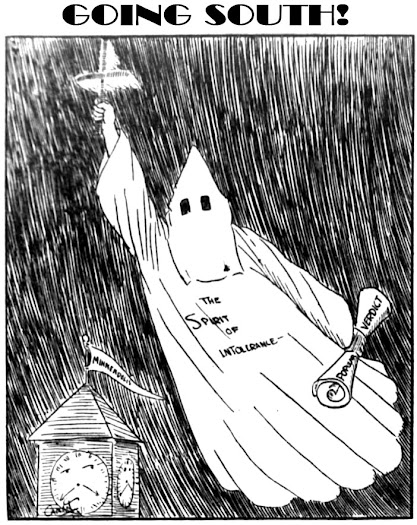
"Going South" by Wilfred Canan in Minneapolis Daily Star May 19, 1923

The Voice had published an accusation by one Gladys Kennedy that Mayor Leach had visited her gambling house for "wild parties" and had carried on an affair with her. Leach fought back, taking five Klan members to court. They included Klan "Exalted Cyclops" Roy H. Miner, who was running against Leach for mayor, editor and publisher of Hennepin County Enterprise George Silk, and suspended deputy sheriff Thomas Sullivan.

In May, a Minneapolis jury found the five guilty of libel. Kennedy recanted her allegations, but she and Miner were sentenced to 90 days at a workhouse. Silk and Sullivan received 60-day sentences; and Shirley Reichert, a University of Minnesota student who as a notary public received the Kennedy affidavit, was fined $50.

"The Usurper" by William F. Canan in Minneapolis Daily Star, June 9, 1923

Miner withdrew from the mayoral race. In June, the Minneapolis Daily Star reported that the mayoral candidate replacing Miner, State Senator William A. Campbell, was under investigation for being a leader in the Minnesota Klan. Campbell had supposedly written a number of articles for the Voice alleging malfeasance by various city council members.

Leach would be reelected by a hefty margin.

"Tearing Off the Sheet" by Rollin Kirby in New York World, ca. May 29, 1923

In New York and New Jersey, the Klan staged mass protests against an amendment proposed by State Senator (later Mayor of New York City) Jimmy Walker to New York's Civil Rights Law compelling unmasking of KKK members. 

Signed into law by Governor Al Smith, the Walker Amendment didn't mention the Klan by name, instead requiring "every existing corporation and every existing unincorporated association having a membership of 20 or more person, which incorporation or association requires an oath as a prerequisite or precondition of membership, other than a labor union or a benevolent order mentioned in the Benevolent Orders Law... [to] file with the Secretary of State a sworn copy of its constitution, by-laws, rules, regulations, and oath of membership, together with a roster of its membership and list of its officers for the current year."

New York Daily News, May 28, 1923

The New York Daily News reported that 8,000 klansmen gathered at Eastport, Long Island; the newspaper's photographers were at a simultaneous rally in Pompton Lakes, New Jersey. Further demonstrations were reported in Syracuse, Buffalo, Schenectady, and Binghamton.

"Civilization, 1923" by Nelson Harding in Brooklyn Daily Eagle, May 31, 1923

A hooded speaker identified as the King Kleagle swore to the Pompton Lakes mob, "Al Smith by signing that bill barred himself forever from the presidency of the United States." 

Given that Smith was Roman Catholic by faith, the Klan was already predisposed against his presidential aspirations. By the time he was the Democratic nominee in 1928, the Klan's "whispering campaign" attacking him was well-established.

Klan opposition would have nothing to do with Mayor Walker's eventual downfall, however.

Constitutionality of the Walker Law would ultimately be upheld by the New York and United States Supreme Courts in a case brought by Buffalo Klansman George C. Bryant, who argued that it violated the Equal Protection clause of the Constitution. 

In the U.S. Supreme Court's decision, Justice Willis Van Devanter wrote the Walker Law could legally single out the Klan, given that

"it was conducting a crusade against Catholics, Jews, and negroes, and stimulating hurtful religious and race prejudices; that it was striving for political power, and assuming a sort of guardianship over the administration of local, state, and national affairs, and that at times it was taking into its own hands the punishment of what some of its members conceived to be crimes.
"We think it plain that the action of the courts below in holding that there was a real and substantial basis for the distinction made between the two sets of associations or orders was right, and should not be disturbed."

Saturday, May 13, 2023

Practice, Practice, Practice

Drawing for student newspapers forty years ago, I had vacation time along with the undergrads come mid-May. What was an aspiring cartoonist to do (besides sending cold-mail applications to any newspaper around the country that didn't already have an editorial cartoonist on staff)?


Keep in practice, that's what. This cartoon was never published anywhere until this very morning; nor did I have any publication in mind when I drew it. If I had expected to get it into the last Parkside Ranger of the school year, or the Racine Journal Times, I would certainly have put the paper's name in the cartoon.

Some late night that month, I sketched some of the cast of SCTV, a Canadian export to U.S. television in the late '70's and early '80's.  Seen here, left to right, are Eugene Levy, Joe Flaherty, John Candy, Martin Short and Andrea Martin.

I drew everyone too large to fit Rick Moranis, Catherine O'Hara, Dave Thomas, or Harold Ramis on the page. I couldn't even get all of Eugene Levy's hair on it. 

Perhaps the other cast members didn't happen to be on the episode that ran that evening. At any rate, I never did get around to sketching the rest of them.


As the the top cartoon demonstrates, I needed to work on the human form, not just caricaturing human. The woman answering the phone didn't need to bend over to tie her shoes.

In this caricature of John Cougar Mellencamp, who probably appeared as the musical guest on SCTV that May, I was exploring the Big Head school of caricature. It's a good choice for someone whose body-drawing skills weren't the greatest. In spite of my trying to depict motion, his limbs are still stiff.


My Garrison Keillor looks more relaxed than my Mr. Mellencamp.

It doesn't show here with the drawing shrunk down to 100 dpi, but the page on which I drew Keillor bled considerably.

I kept a sketchbook (and still do) in addition to the drawings posted above; in it there are caricatures of friends from college, geometric designs, and idle doodles, all to keep my mind and hand in practice. Unlike these loose sheets, however, nothing in it is dated, so I don't remember when I drew what.

But just for gits and shiggles, here's a page of random faces to close out today's little exercise.

Now get out there and draw!

Saturday, November 26, 2022

Happy Centennial, Sparky Schulz!

If you picked up a newspaper today, first of all, thanks for keeping journalism alive for another day; second, you may have noticed a lot of Peanuts references in the comics page.

Today would be the 100th birthday of Charles Schulz, Peanuts' creator.

Schulz was probably the very first inspiration sparking (wink, wink) my urge to cartoon — as he was to so many of my contemporaries. As a child, I had all the Peanuts books, including The Gospel According to Peanuts and The Parables of Peanuts — the former, autographed by its author, Robert Short. Peanuts didn't run in my local paper, but my grandparents would clip and save Peanuts from the Sheboygan Press for me every day even into my college years.

The Gospel According to Peanuts, Bantam edition, 1968, must have been my sixth Peanuts book.

So how to join in the centennial celebration of such a towering figure in our field?

Just last June, I highlighted Schulz's reference in Peanuts to a cartoon drawn by a mentor of his, Frank Wing, in the wee decades of the 20th Century. Five years ago, I celebrated April Fools' Day by featuring some of the more obscure characters he drew in Peanuts.

But for today, I decided to rummage through my own archives in search of cartoons I've drawn with a nod to Mr. Schulz.

I was a bit surprised to come up with only three.

Well, reaching back to some of my juvenalia, four. But that old, old cartoon essentially stole an idea drawn by Tony Auth and stuck Charlie Brown and a few other additions into it. It was utterly unoriginal, and I don't feel like giving that cartoon new life on the internets.

But here are the three that I don't mind bringing back today.

March, 2017

There was this caricature of Scott Pruitt, an anti-environmental activist and the Corrupt Trump Administration's first head of the Environmental Protection Agency, as Pigpen, the hopelessly filthy member of the Peanuts gang who could raise a cloud of dust ice skating.

I had hoped to find an occasion to work this caricature into a fully realized cartoon, but that never came about in the less than 17 months Pruitt was in the cabinet. When he resigned in July of 2018, he was the target of at least 14 federal investigations.

in Business Journal of Greater Milwaukee, July 5, 2005

This one from 2005 takes a Peanuts trope that long ago became a cliché in editorial cartooning. Perhaps the only other Peanuts trope we have rehashed more often is the Great Pumpkin.

Q Syndicate, January, 2014

So when I went to that particular inkwell again in 2014, I attempted to find something fresh and new to do with it.

Chris Kluwe was a punter for the Minnesota Vikings, and a vocal supporter of LGBTQ+ causes, which he claimed led to his being cut from the team. A subsequent investigation found testimony to support some of Kluwe's charges, but after getting bogged down by uncooperative witnesses, ended quietly. The Vikings settled the case by promising to donate some undisclosed monetary amount to LGBTQ+ causes.

I suppose that since I draw primarily for LGBTQ+ publications, a cartoon about young angst-ridden children isn't, well, sexy. But then, you could say that about a lot of the topics I draw about.

Oh, sure, I could easily draw cartoons in which Marcie and Peppermint Patty take their relationship to the next level. And yet that seems like cartoon blasphemy somehow, akin to drawing Snoopy with rabies, Schroeder playing bagpipes, or Charlie Brown winning the World Series.

So I didn't add to the reams of cartoons of weeping Charlie Browns and Snoopys when Schulz died very shortly after retiring the strip; the topic didn't fit either Q Syndicate's or the Business Journal of Greater Milwaukee's needs that week.

Well, let's not end today's post there. 

I started this post talking about how Charles Schulz inspired me, and generations of other cartoonists, when we were youngsters. I'll leave you today with his very first published cartoon, in the nationally syndicated feature "Ripley's Believe It Or Not," when he was just fifteen years old.

"Ripley's Believe It or Not" by Robert Ripley, for King Features Syndicate, Feb. 22, 1937
"Peanuts" by Charles Schulz for United Features Syndicate, July 1, 1972


Saturday, November 19, 2022

Meanwhile, in Non-Gump Election News

"Keeping to the Main Highway" by Gustavo Bronstrup in San Francisco Chronicle, Nov. 9, 1922

I hope you enjoyed our recounting the past two Saturdays of Andy Gump's election to Congress and the recount that took his victory away. But it's time now to get serious and to catch up on what really happened in the off-year election of 1922.

Gustavo Bronstrup, with a nod to the initially victorious Mr. Gump, celebrates the Republican sweep in California that year. Friend Richardson was elected Governor and Hiram Johnson was reelected Senator, both by landslides. (Ironically, Richardson, supported by a Republican majority in the legislature, would proceed to undo several policies enacted when Johnson had been Governor.) 

The Proposition 19 straw man fallen off the back of the car represents a defeated constitutional amendment that would have granted the governor authority to create and fund a board to develop, distribute and fix rates for water and electrical energy.

"Nearly Everybody in the House Knew..." by John Knott in Galveston Daily News, Nov. 10, 1922

The California results ran counter to the national trend that year, however: Democrats gained 72 seats in House and a net gain of six seats in the Senate. 

"Shrinkage? It's a Washout" by Nelson Harding in Brooklyn Daily Eagle, Nov. 9, 1922

The Democrats' gain was not quite enough to regain the majority lost in the elections of 1918 and 1920, but was an impressive showing nonetheless, and set off a wave of prognostication as to where the Republican Party had gone wrong.

"Now We'll Hear the Specialists" by Edwin Marcus in New York Times, Nov. 12, 1922

One of Edwin Marcus's "specialists" is an "anti-prohibitionist" who doesn't look anything like the Mr. Dry used by every other cartoonist of the time (see John Cassel, below). That may well be because Mr. Dry looks more like an undertaker than a doctor; but it leaves me suspecting that Marcus had everything drawn before the election results were in but the labels and the elephant head.

"After the Downpour" by John Cassel in New York Evening World, Nov. 10, 1922

To the extent that Republicans were hurt by the "wet" vote, it was primarily because they happened to have more incumbents in office than the Democrats did in 1922. Prohibition sentiments pro and con crossed party lines; support for the 18th Amendment included both conservative Southern Democrats and northern progressive Republicans. Opponents included big-city Democrats and Republicans alike.

"Home Again" by John Knott in Galveston Daily News, Nov. 13, 1922

One of my disappointments in covering the 1922 election is that I was not able to turn up any cartoons by John Knott of the Dallas News and Galveston Daily News having anything substantial to say about the Klan candidate Texas elected to the U.S. Senate that year. Instead, he chose to celebrate Tennessee returning its governor's chair to the Democrats — and I do apologize for that character carrying Miss Tennessee's bags.

"The Retreat of the Lame-Duck Brigade" by John Baer, reprinted in National Leader (Minneapolis), December, 1922

Former Congressman John Baer cites a few of the ailments diagnosed in Edwin Marcus's cartoon and adds a few more: a proposed sales tax (to replace the income tax), an anti-strike bill, and a subsidy for shipbuilders.

What I was expecting to see in the National Leader was a celebration of Minnesotans' election to the Senate of the Farmer-Labor candidate, Henrik Shipstead, ousting Republican Senator Frank B. Kellogg, seated in the wheelchair in Baer's cartoon. (The Democrats' candidate, Anna Dickie Olesen, came in a distant third). The Farmer-Labor Party was the offspring of the Leader's "Non-Partisan League," after all, and the Leader had emblazoned a heroic sketch of Shipstead all over the front page of its November issue.

Front page of National Leader, Minneapolis, MN, November, 1922

Other than that, however, the Leader seems not to have found much to say about his campaign or his election.

Shipstead, a former and future Republican, would serve in the Senate until losing a GOP primary in 1947. An isolationist, anti-Semite, and conspiracy monger (Protocols of the Elders of Zion and all that crap), a senator described by the British Foreign office as "bigoted and crotchety," he is not remembered fondly these days.

"A Case for Careful Diagnosis" by J.N. "Ding" Darling in Des Moines Register, Nov. 13, 1922

But returning again to 1922: it must be noted that for all this talk of the Republican Party needing to find out where it had gone wrong, the 1920's would continue to be a solidly Republican decade in most of the United States.

"He Fits the Niche" by John Cassel in New York Evening World, Nov. 8, 1922

To wit: 1922 saw the election of one of the Democratic Party's enduring heroes, Alfred E. Smith, as Governor of New York. As the party's presidential nominee in 1928, he would lead the Democrats to their third consecutive landslide loss.

And lucky for him, too.