Showing posts with label Minneapolis Tribune. Show all posts

Saturday, December 24, 2022

Last Christmas

Rather than resurrect yuletide editorial cartoons from 1922 today, I thought I'd reach back 20 years further for the Christmas cartoons that would be Minneapolis Tribune cartoonist R.C. Bowman's last for the holiday.

Of course, Bowman couldn't have known it would be his last Christmas. His death the following June at age 32 would be an accident; he would be overcome by gas in his home.

Bowman's Christmas Eve cartoon concerns the chief foreign affairs news of the day. Seeking to force the Venezuelan government of Cipriano Castro to repay debts incurred prior to his country's 1892 civil war, Germany and Great Britain (joined by Italy) placed a naval blockade against Venezuela. Castro responded by arresting 200 German and British citizens in Caracas. Seeking to avoid having the U.S. navy come to Venezuela's defense, Britain invited the U.S. to arbitrate the dispute.

Bowman's Christmas Day cartoon refers to Rudyard Kipling's poetic screed against Great Britain allying its interests with Germany, "The Rowers," published in London Times Dec. 22. The actual poem is longer than I care to repeat here, but these stanzas show that Bowman's paraphrase didn't exaggerate its sentiment much:

"Our dead they mocked are scarcely cold,
  Our wounds are bleeding yet—
And you tell us now that our strength is sold
 To help them press for a debt!

"'Neath all the flags of all mankind
 That use upon the seas,
Was there no other fleet to find
 That you strike bands with these?"

🎄

Since Bowman's Christmas Day cartoon wasn't particularly Christmasy, let's check over at the Minneapolis Journal, where Charles "Bart" Bartholomew was taking a more festive approach to the holiday.

"An Old Fashioned Christmas" by Charles "Bart" Bartholomew in Minneapolis Journal, Dec. 24, 1902

Alert readers may recall that the Wright brothers had not yet flown their air-ship at Kitty Hawk as of Christmas Eve, 1902. Lighter-than-air balloons had been in use for half a century, however, and by this time had incorporated engines and steering mechanisms (and been involved in a fatal aeronautic accident). 

Like air-ships, automobiles were principally a plaything of the rich and indolent, although they were beginning to catch on with the general public. You'll find the more common modes of transportation referenced in Bartholomew's cartoon for Christmas Day:

"Papa's Christmas" by Charles "Bart" Bartholomew in Minneapolis Journal, Dec. 25, 1902

A third daily newspaper in town, the Daily Times, ran this front page cartoon beneath an editorial promising to publish "the names and addresses of any suffering poor in Minneapolis and St. Paul whose destitution is unknown to the general public."

"The Poor Ye Have Always with You," unsigned, in Minneapolis Daily Times, Dec. 24, 1902

By the way, I don't know what was meant by the "Don't Let This Happen to You" cut line. Surely the Daily Times wasn't advising its readers to pull the shades.

Anyway, the Daily Times, true to its word, printed the names and addresses of some two dozen destitute Minneapolitans (plus one from Minnetonka) "described by acquaintances or observers as needful of aid on this Christmas Day, it having been impossible to separately investigate the accuracy of the description in each case." I can't say how those people reacted to having their situation above the fold on page one, but the Times itself noted that only 5% of the total number of reports to them of destitution (in addition to those 25 there were others to whom the Times brought food and fuel) came from the destitute persons themselves.

"What Has He in the Pouch" by P.J. Carter in Minneapolis Daily Times,  December 25, 1902

P.J. Carter's Christmas Day cartoon for the Times again references the situation in Venezuela, while still keeping a Christmasy theme to his commentary. Carter favored pen and ink for his editorial cartoons, so I'm not prepared to conclude that the previous day's cartoon was his work.

"Sad News for the Trusts" by Tom Thurlby in St. Paul Globe, Dec. 24, 1902
Across the river in St. Paul, I had expected to find more cartoons by Frank Wing. Instead, I found these by a Tom Thurlby and O.C. Holt in the St. Paul Globe. Thurlby's Christmas Eve cartoon jumps past the present holiday to suggest to Mr. Consumer some new year's resolutions.
"When Yet a Farmer Boy" by O.C. Holt in St. Paul Globe, December 24, 1902
By the way, all four newspapers in today's post published on Christmas Day, 1902, a Thursday, although the December 25 Globe didn't happen to have any cartoons in it.

But there were two cartoons in the Christmas Eve edition; this poem and illustration hailing the true bringers of Christmas presents was on an inside page. You know it's hard work when you're sweating like that outdoors in St. Paul, Minnesota, on December the twenty-fourth.

At least someone was kind enough to gift the man a toy whatever-that-critter-is beneath his sack of goodies.

And with that, I wish you a merry little Christmas, eighth night of Hanukkah, Kwanzaa Eve, and any other holiday of your choice. 

Qapla'!

Saturday, October 15, 2022

Epitaph for R. C. Bowman

I wrapped up my post the other day about this year's AAEC convention by mentioning that I used the occasion to donate a 121-year-old book of editorial cartoons to the Billy Ireland Cartoon Library and Museum.

The cover of R.C. Bowman's book

Okay, it's not on the same level as Monte Wolverton donating a busload of his father's cartoon work to the BICL&M, but my Dad isn't a cartoonist. Although he was in a Vaughn Shoemaker cartoon once and has the original hanging in his office.

Outside of my own blog posts about the book, there isn't much on line about turn-of-the-century Minneapolis Tribune editorial cartoonist Rowland C. Bowman. Part of the reason for that is that he died quite young, overpowered by gas fumes at his home.

Report in Culver (IN) Citizen, June 4, 1903

Which is not to say that Bowman was either obscure or quickly forgotten. The Strand magazine was very impressed with him (and with Minneapolis Journal cartoonist Charles "Bart" Bartholomew) in a 1902 article about U.S. editorial cartoonists. And Syd Hoff included a pair of Bowman cartoons in his 1976 tome Editorial and Political Cartooning: From Earliest Times to the Present With Over 700 Examples from the Works of the World's Greatest Cartoonists.

"Royal Leap Frog" by R.C. Bowman in Minneapolis Tribune, May 30, 1903

Bowman's last editorial cartoon in the Minneapolis Tribune appeared on Saturday, May 30, 1903. Starting on Sunday, May 31, the Tribune began running cartoons by C.F. Naughton in Bowman's front-page spot.

"And When They Grow Up, They Would Not Put Away Childish Things" by C.F. Naughton in Minneapolis Tribune, May 31, 1903

Long-time followers of these Saturday history posts may remember that Naughton was editorial cartoonist at the Duluth Evening Herald in the 19-teens.

If any readers of the Minneapolis Tribune spotted that Bowman had been replaced at the bottom of Page One, they found the explanation on the bottom of Page Eight. I'll be charitable and attribute the Tribune's misspelling his name to the news room's collective grief.
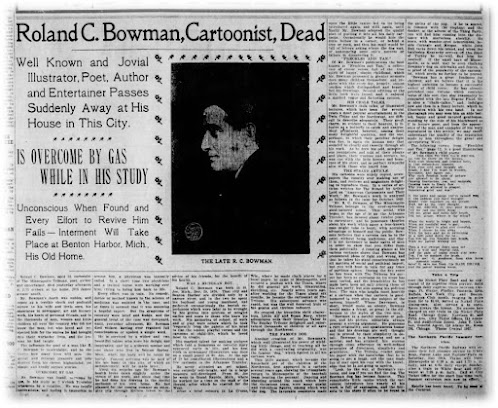
in Minneapolis Tribune, May 31, 1903

The remainder of today's post is the text verbatim of the Minneapolis Tribune article reporting Bowman's death. The Strand piece, which it quotes extensively, mentions cartoons accompanying it. The cartoons interspersed with my transcription of the Tribune's report are from Bowman's 1901 book, not the 1902 Strand article.

"Don't You Want to Buy a Dog"

Roland [sic] C. Bowman, aged 32, cartoonist at The Minneapolis Tribune, poet, author, and entertainer, died yesterday at his home, 2016 James avenue south.

Mr. Bowman's death was sudden, and comes as a terrible shock and profound sorrow to his wife and little ones, his associates in newspaper, art, and literary work, his hosts of personal friends, and to the thousands of men, women, and children all over the country who did not know the man, but loved and respected him for the smiles he had brought into their workaday lives, and the lessons he had taught.

The influence for good of a man like R.C. Bowman is incalculable, and no one knows how many lives will miss the genial and rational pleasure and help derived from his clever, highminded, yet simple and kindly picture stories.

OVERCOME BY GAS

Mr. Bowman was found overcome by gas in his study at 2 o'clock Thursday afternoon by a relative. He was totally unconscious, and finding it impossible to arouse him, a physician was instantly called. In a short time two physicians and a trained nurse were working over him trying to bring him back to life.

Every effort was in vain. No remedy, device, or method known to the science of medicine was omitted in the case, and at times it seemed that it was assuming a hopeful aspect. But the symptoms of recovery were brief and feeble, and the general trend of the case was downward, until, yesterday afternoon, Mr. Bowman died without ever having regained full consciousness or spoken a single word.

He is survived by a widow and two beautiful babies, who were his delight and inspiration, and by a widowed mother and one sister who live in Benton Harbor, Mich., where his body will be taken for burial. Funeral services will be held at his late home in this city, of which an announcement will be made later.
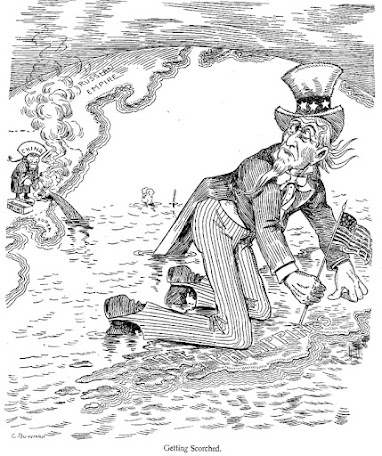
"Getting Scorched"

About six months ago, Mr. Bowman's health broke down slightly under the strain of his work, and since that time he had done his drawing in the restful seclusion of his own home. He had planned for the coming summer an extensive trip through Europe, taken by the advice of his friends for the benefit of his health.

WAS A MICHIGAN BOY

Roland C. Bowman was born in St. Joe, Mich. December 29, 1870. That city and Benton Harbor are divided only by a narrow river, and in the two he spent his boyhood and young manhood, and gathered unconsciously the boyish experiences which were later to be wrought by his genius into sources of mingled smiles and tears to those who knew his work. His memories of school, of work, and of play were colors which he took frequently from the palette of his mind to tint the tender, playful verses and the cartoons of child-life, which he loved most to create.

His marked talent for making pictures which told a humorous or forceful story appeared early in life, and his first work in newspaper illustration was done on a small newspaper in St. Joe. At the age of 19 he contributed illustrations and a few cartoons to the Arkansas Traveler.

"Not Worth Landing"

He never attended an art school, was entirely self-taught, and in a large measure self-developed. From St. Joe he went to Grand Rapids, Mich., where he worked for a time on the staff of the Herald, after which he started for the West.

After a brief sojourn in La Crosse, Wis., where he made chalk plates for a local paper, he came to Minneapolis, and secured a position with the Times, where he did general art work, illustrating, sketching, etc. Nearly seven years ago, after working with the Times six months, he became the cartoonist of the Tribune. His subsequent advance was rapid, but was the well deserved fruit of his genius and tireless industry.

"Rah! Rah! Rah"

He created the irresistible child characters Little Alf and Susan Mary, whose adventures with their Grandpa Tabor in the Sunday Tribune delighted and entertained thousands of children of all ages through the Northwest.

THE FAMOUS DOG

Another creation of Mr. Bowman's, which well illustrated his power of wielding little things, and of touching all he did with a captivating originality, was the famous "dog," which figured in all his cartoon work.

This little animal, which became the household pet of the children of the Northwest, first appeared in a cartoon several years ago, showing the triumphant return to Minneapolis of the baseball team bearing the pennant. Dancing and shouting around the coach which bore the triumphant team, were many quaint and ridiculous figures, among which was the dog. The favorable comments made upon the little canine led to its being introduced again, and still again, until finally Mr. Bowman adopted the quaint plan of putting it into all of his daily cartoons. Occasionally, he would hide the little fellow in a corner, or behind a tree or rock, and then his mail would be full of letters asking where the dog was, or announcing someone's success or failure in discovering it.

"The Run-Away Bill"

"FRECKLES AND TAN"

Of Mr. Bowman's publications the best known is "Freckles and Tan," a collection of clever verses, full of the true spirit of happy simple childhood, which Mr. Bowman possessed in greater measure than many children themselves; and replete with the every day, homely human touches which distinguished and beautified his drawings. Several editions of the little book were issued, and it enjoyed a marked vogue and flattering success.

HIS CHALK TALKS

Mr. Bowman's chalk talks, or illustrated lectures, which have been for several years a most popular entertainment in the Twin Cities and the Northwest, are difficult to describe adequately. Their great charm, so evident to their hearers, is illusive as a butterfly to catch and analyze. Most prominent, however, among their many delightful qualities, and the one, perhaps, to which their peculiar delight was due, is again the human note which sounded so clearly and sweetly through all his work. As he drew his odd, mischievous youngsters, and told of their pranks and plays, their troubles and sorrows, he was one with the little heroes and heroines of his story, and in perfect sympathy also with those who heard him.
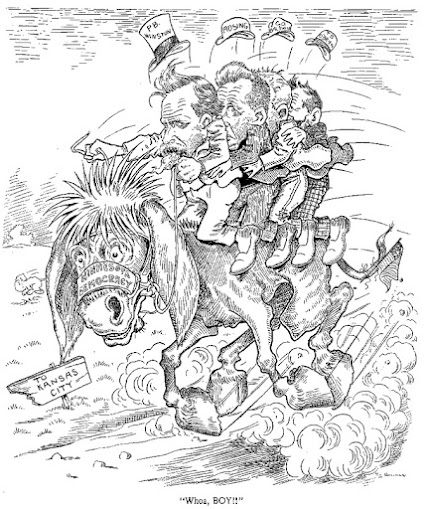
"Whoa, Boy"

THE STRAND ARTICLE

His cartoons were widely copied, newspapers the country over making use of them, and reviews and magazines delighting to reproduce them. In a series of articles written for The Strand by Arthur Lord on "American Cartoonists and Their Work," Mr. Bowman's work is analyzed as follows in the issue for October, 1902:

"Mr. R.C. Bowman, of The Minneapolis Tribune, belongs to the ever-spreading good-natured school. This artist, who began at the age of 19 on the Arkansas Traveler, has devoted about twelve years to the art of caricature, and he possesses theories about his work which many a less-known man might take to heart, with accruing advantage to himself and the public. Bowman believes that a cartoon can be to the point without being malicious, and that it is not necessary to make ogres of men in order to show that you differ with them politically. A running glance at his various cartoons shows that Mr. Bowman has pronounced ideas of right and wrong, and that he takes his stand conscientiously on all matters of social and political import, but you will hunt in vain for any trace of partisan spleen. During the five years that he has been with the Tribune his output has been as enormous as its scope has been varied, and the friendships he has made have been not only among those of his own party, but also among his political foes. The man who laughs most heartily at a cartoon when that cartoon is good-humored is very often the subject of the cartoon himself. Where Davenport, in short, would make an enemy, Bowman would make a friend, so great is the difference in the styles of the two men.
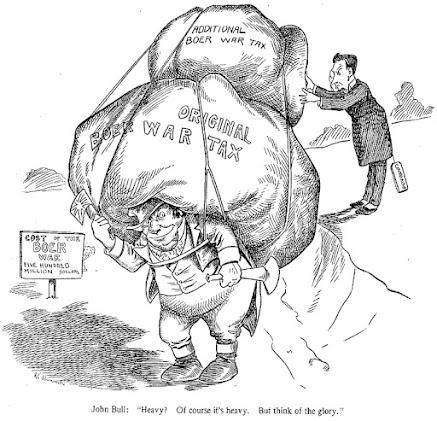
"Of Course It's Heavy. But Think of the Glory"

"Bowman is a careful student of politics, and his picture editorials always present a strong argument. He possesses a rare originality, and spontaneous humor and that his drawings are well thought out is proved by their simplicity in detail. Bowman is a humorist and not a satirist, and has attained his success through adherence to well-defined principles of directness, simplicity and gentleness. The Tribune reader opens his paper with the knowledge that he is not going to squirm.

"Look, by the way, at Bowman's cartoons, and see if you can find the dog. The Bowman dog has become famous. This remarkable little canine which the cartoonist introduces into nearly all of his work is full of expression and the keynote of the story [is] often found in the antics of the pup. If he is scared, in common with the elephant and the donkey, at the advent of the Third Party, you will find him running into the distance with marvelous alacrity. He rests, with wonder-eyed demureness, beside Carnegie and Morgan, while John Bull tacks down his island, and when the battleship Kentucky arrives off the coast of Turkey, he is — well, find him for yourself. If the small boys of Minneapolis, as is said, may be found chalking Bowman's dog on sidewalks and fences, it is proof of the popularity of the cartoonist, which needs no further to be proved.

"The Meanderings of Willie and Little Steve" (from a series)

"Bowman has a great fondness for children, and we believe that it is his highest ambition to become a successful writer of child's verse. He has already published one volume which contains verse of this sort that may reasonably be compared with the late Eugene Field. He is also a "chalk talker" and indulges now and then in a funny lecture, which he illustrates with his own hand. In our photograph you may [see in] him an able bodied, happy and good natured gentleman, standing by the side of his blackboard as if in lecture pose, and from the appearance of the man and examples of his work we may easily understand the quality of the reputation made by him throughout the great and enterprising West."

"It Turns Out to Be a Hornet's Nest"

The following verses from "Freckles and Tan," page 12, is a good illustration of Mr. Bowman's child poems.

THE ODE TO THE HAIR BRUSH


"Mandy, Pass Up Here and Let Me Give You Another Slice of the Paramount Issue"

Tuesday, March 1, 2022

Remembering Richard Guindon

Daily Cartoonist passed along the news yesterday that Dick Guindon has died at the age of 86.

"Guindon" in Minneapolis Tribune, Jan. 15, 1978

His eponymous cartoon panel in the Minneapolis Tribune (later Star Tribune) was something I looked for every day when I was in college, and which I missed after I graduated and returned to Wisconsin. Because I saw his cartoons nowhere else until the internet became a big deal, I've always associated his off-beat sense of humor with Minnesota.

"Guindon" in The World According to Carp, 1983

So, several years later, when I wanted to include a Minnesota native in a cartoon for the Business Journal of Greater Milwaukee, did I draw Mary Richards Tyler Moore? Garrison Keillor? Al Franken? Prince? 

No.

Even though there was very, very, very close to zero percent of the Beej readership who would have the remotest glimmer of an off-chance possibility of recognizing her, I drew my Minneapolitan in the style of Dick Guindon.

in Business Journal, Milwaukee, March 24, 2005

To one of my all-time favorite cartoonists: rest in peace, sir. We'll fly the carp at half-staff in your memory.

Saturday, September 11, 2021

Kill Bill, Part 2

"A Great Nation Prostrate" by Canfield in Pittsburg [sic] Press, September 14, 1901

You were probably expecting something commemorating the 20th anniversary of 9/11 today; but I haven't drawn any new cartoons about it since the last time I marked its anniversary. And besides, I started commemorating the 120th anniversary of the assassination of President William McKinley last Saturday, and I wasn't finished yet.

So anyway, doctors were able to remove one of the two bullets in the president's body, and within a week after the shooting, they were optimistic for his recovery. They also felt that rummaging around for the second bullet was riskier than leaving it in. But on September 14, 1901, President McKinley succumbed to infection around that second bullet.

"William McKinley" by Wm. C. Rogers in Harper's Weekly, September 21, 1901

By chance, a new X-ray machine had been on display at the Pan-American Exposition where McKinley was shot, and would have been able to show the president's doctors where the bullet was. But the opportunity, and the president, were lost to history.

"In This Day of Mourning..." by Carter Simons in Brooklyn Daily Eagle, September 14, 1901 

There were a lot of mourning Columbia cartoons, rather than the weeping Uncle Sams that would flood editorial pages 100 years later. Columbia predated Uncle Sam as the personification of the U.S. by over 100 years; she flourished as a cartoon character in the 18th and 19th Centuries. But by World War II, if a cartoonist wanted to depict the U.S. as a woman, he or she was more likely to draw the Statue of Liberty.

I've come across a couple of cartoons that are more interesting than all those mourning Columbias:

Felix Mahony in Washington (DC) Evening Star, September 14, 1901

Felix Mahony's sketchbook illustration highlights the story of James "Big Ben" Parker, a Black American in the presidential receiving line immediately behind the assassin Czolgosz. According to a Secret Service agent present, "Parker struck the assassin in the neck with one hand and with the other reached for the revolver which had been discharged through the handkerchief and the shots had set fire to the linen. While on the floor Czolgosz again tried to discharge the revolver but before he got to the president the Negro knocked it from his hand."

There is a poem by Lena Doolin Mason extolling Parker's deeds that day.

"It Is God's Way" by Canfield in Pittsburg Press, September 18, 1901

The sangfroid of Canfield's cartoon of Father Pitt, drawn as the train carrying McKinley's body passed through Pittsburgh, would probably get any cartoonist into a heap of trouble today. The president is dead? Oh, well. Que será será.

But I can see certain right-wing cartoonists who might to get away with it these days.

"What, Wouldst Thou Have a Serpent Sting Thee Twice" by Wm. Walker in Life, September 26, 1901

Aside from grief-stricken Lady Columbias, there was another theme that ran through a lot of editorial cartoons after Leon Czolgosz shot President McKinley.

"Now, Uncle, Come Down Hard" by Canfield in Pittsburg Press, September 8, 1901

It's as if some memo came down from Cartoon Headquarters telling the nation's scribblers that everyone had to represent anarchists and anarchism as snakes. This presented Pittsburgh's Canfield with the dilemma of how to depict a snake holding a gun and a bomb.

He evidently decided, what the hell, I'll draw it with ears, too.

Felix Mahony in Washington (DC) Evening Star, September 9, 1901

Felix Mahony was content that a snake is threatening enough without adding limbs and ears. But you don't want to try to kill a snake by stomping on its middle.

"While I'm About It..." by Gennette in Brooklyn Daily Eagle, September 15, 1901

Gennette adds in a few more vipers for Uncle Sam to bludgeon, notably including "lynchings" and "burnings at the stake." The cartoon is more aspirational on Gennette's part than factual on Uncle Sam's part; the ensuing crackdown on anarchists was not accompanied by much civil rights legislation. As President Theodore Roosevelt put it, "When compared with the suppression of anarchy, every other question sinks into insignificance."

"No Room on This Ship" by Wm. A. Rogers in Harper's Weekly, October 5, 1901

Czolgosz was quickly brought to trial, and readily admitted murdering the President. He told authorities that he had been inspired by the speeches of anarchist Emma Goldman; but as it turns out, he had never been able to ingratiate himself into her inner circle. He had been the sort of guy who is too eager, and asks too many questions. Some of her associates were convinced that he must be a government spy.

"A Proper Concert of the Powers" by Wm. Walker in Life, October 3, 1901

Most anarchists disavowed Czolgosz, but for her part, Goldman refused to condemn what he had done. She instead characterized him as a "supersensitive being" and likened him to Julius Caesar's assassin Marcus Brutus.

Czolgosz tried to plead guilty at his trial, which began on September 23, but was overruled by presiding Judge Truman White. His jury deliberated for less than 30 minutes before returning guilty verdicts the very next day.  

"Wasn't You Present at the Execution?" by Rowland C. Bowman in Minneapolis Tribune, October, 1901

On October 29, Czolgosz was electrocuted to death at Auburn State Prison. In order to prevent any macabre Czolgosz memorabilia getting out, prison officials burned his clothes and other possessions, and doused his corpse with acid before burying him on the prison grounds.

The Temple of Music where McKinley was shot, and the rest of the Exposition buildings, were razed that November. That wasn't entirely in order to erase unpleasant memories of the assassination; the Exposition buildings were never intended to be permanent structures.

But unlike with John Wilkes Booth, Lee Harvey Oswald, or Sirhan Sirhan, (or, for that matter, Osama bin Laden,) the Spirit of Notoriety has kept its distance from Leon Czolgosz. Unless you've seen Assassins, chances are you don't even know how to pronounce his name.

Saturday, September 4, 2021

Aside from That, Mrs. McKinley, How Was the Expo?

This coming week marks the 120th anniversary of the assassination of President William McKinley. I will admit that vinticentennials tend to get overlooked, and McKinley's is generally ranked in the middle of U.S. administrations. But without McKinley's assassination, instead of ending up on Mt. Rushmore, Teddy Roosevelt would probably have languished in the obscurity endured by most vice presidents from Daniel Tompkins to Alben Barkley.

Besides, I have no idea whether I'll still feel like keeping up this Saturday history schtick for another five years for when the quasquicentennial comes around.

"Night at the Pan-American" by Lucius Hitchcock in Harper's Weekly, September 7, 1901

To refresh your American History 101, McKinley was shot by anarchist Leon Czolgosz at the Pan-American Exposition in Buffalo, New York, on September 6, 1901.

"Put Me Off at Buffalo" by Rowland C. Bowman in Minneapolis Tribune, May, 1901

The Pan-American Exposition was a chance for the U.S., fresh off its victory in the Spanish-American War, to show off to the world, and President McKinley had every intention of milking it for all it was worth. 

The previous decade had witnessed a wave of assassinations by anarchists in Europe: President Marie François Sadi Carnot of France in 1894; Prime Minister Antonio Cánovas del Castillo of Spain in 1897; Empress Elizabeth of Austria in 1898; and King Umberto I of Italy in 1900. Because of this, McKinley's personal secretary, George Cortelyou, twice tried to take shaking hands with the public off McKinley's schedule. Having had to cancel a "President's Day" appearance at the Exposition in May when his wife took ill, however, McKinley insisted on getting to press the flesh on September 5 and 6.

"My Harp Is Also Turned to Mourning..." by Gennette (?) in Brooklyn Daily Eagle, September 7, 1901
Fired up by the speeches of anarchist Emma Goldman, Czolgosz decided on September 3 to assassinate McKinley. He was unable to get close enough to shoot McKinley at the Exposition on September 5, but returned the next day with his gun concealed in a cloth rag, and waited in the president's receiving line until he was right up in front of his target. He fired two shots at point blank range before he was wrestled to the ground.
"One Bandage Too Many" by Gennette in Brooklyn Daily Eagle, September 8, 1901

I'm having to guess at this Brooklyn Daily Eagle cartoonist's name from his signature alone. Whether the name begins with a J or a G, I have not come across any information about him.

"Why Not Make This a Law, Uncle" by Gennette in Brooklyn Eagle, September 10, 1901

This is a peculiar cartoon: to nobody's surprise, Czolgosz would be executed for his crime before the end of October, so what difference would making "an attack upon the President, the Vice President or any member of the Cabinet... treason punishable with death"?

In part, the Brooklyn Eagle was arguing in favor of making attempted assassination of officials of the executive branch a federal crime. Czolgosz would be tried and executed by the State of New York, in whose jurisdiction the crime took place. (Assassination of the president or vice president was not made a federal crime until after John Kennedy's assassination in 1963.)

"At the Threshold" by Wm. A. Rogers in Harper's Weekly, September 14, 1901
 

As McKinley lay in hospital for several days, cartoonists for the weekly newspapers had the difficult task of eulogizing him in case he died, without pronouncing him dead in case he didn't.

Indeed, banner headlines on September 11 proclaimed McKinley's recovery from his injuries.

"The Crisis Passed" by Felix Mahony in Washington (DC) Evening Star, September 11, 1901

Was he really going to make it? Tune in next Saturday to find out!

(Spoiler alert: I've already told you.)

Saturday, April 14, 2018

New to My Comic Book Collection

Today's installment of Sketchback Saturday takes the form of a book report.

A few months ago, I pre-ordered Bill Sanders's forthcoming retrospective of his editorial cartooning career. I have both of the books published while he was the cartoonist for The Milwaukee Journal. Head for the Oval Room deals primarily the Nixon administration, some of which is also repeated in The Sanders Book. The latter book includes cartoons not only about the Ford, Carter and Reagan administrations, but about Wisconsin and Milwaukee issues as well.

I'm looking forward to receiving the new book, which promises cartoons from his retiree years, but also examples of Sanders's early career with Stars and Stripes, The Greensboro Daily News, and The Kansas City Star. Given how different in style his Milwaukee cartoons are from his earlier work, it should be interesting to see how that evolution took place.
"How Much Are We Really Involved Here" by Bill Sanders in Greensboro Daily News, ca. March, 1962
When I pre-ordered Against the Grain, I browsed around amazon.com to see if there was anything else I'd be interested in, finding Jim Morin's 2016 collection from his 40+ years with The Miami Herald. I've long been fascinated by his distinctive cross-hatch style, which I'd describe as David Levine meets "Ding" Darling.
One of the more intriguing facets of Morin's book is how its date of publication influenced his choice of cartoons. In particular, there are a handful of cartoons about Donald Trump's brief campaign in 1999 for the presidential nomination of H. Ross Perot's Reform Party. Editorial cartoon books take up two and a half shelves of my bookcase, and although three or four of those books deal specifically with the year 1999, Jim Morin's World is the first book I've seen to devote any ink to Trump's short-lived flirtation with presidential politics that year.

I have to say that I barely took any notice of Candidate Trump at the time, myself; my editors at Q Syndicate, the Milwaukee Business Journal, and the Racine Journal Times probably wouldn't have been interested in cartoons about him anyway. Had Jim Morin published his book a year earlier, I suspect none of his Donald Trump cartoons would have made the cut for this book, so it's fortuitous that he had a chance to dig up his material about a nearly forgotten episode from when the current president first dipped his toes into political waters.
"Looks Like His Last Trip to Moscow Just Backfired" by Jim Morin in Miami Herald, June, 1985.
As another example of how the date of publication influences choice of material, the above cartoon is not in Morin's book. I'm not advocating for this particular cartoon, merely noting that it might have been included if this were a book about the Reagan years, since Nicaragua was a BFD in the 1980s. The Iran-Contra scandal, which hinged in part on a White House scheme to circumvent Congress to send arms to right-wing guerrillas in the Central American country, threatened to bring down the Reagan administration, but rates only two cartoons in this book. Nowadays, we only hear about Nicaragua when it gets hit by an earthquake or hurricane, so it's of less interest today.

Besides, there was so much else going on in the 1980s, even without a president tweeting all his brain farts every morning. If anyone is still publishing editorial cartoon memoirs thirty years from now, there will be an awful lot that seems of tremendous import today that will end up on the cutting room floor tomorrow.


Another cartooning memoir recent to my collection is The First and Only Book of Sack (only available from the Star Tribune and currently only on back order) by Steve Sack, featuring the best of his cartoons for the Minneapolis Star Tribune from 1981 to 2017. It's too bad that he didn't also include his older cartoons for The Fort Wayne Journal Gazette, such as the one below. Mr. Sack is not a packrat, however, and it's extremely unlikely that foraging through his Indiana cartoons would have turned up any early drawings of Mike Pence, who, after all, was still in college at the time.
"Jump!" by Steve Sack in Fort Wayne Journal-Gazette, August, 1980
From a cartoonist's standpoint, one of the joys of this book is to watch how Sack has adapted his style to evolving technologies. Sack has been an early adopter of computerized drawing techniques, ditching the extensive pen and ink crosshatching of his early work in favor of a succession of various media: charcoal, sharpie, watercolor, digital tablet, and iPad. Through it all remains a distinctive touch unlike that of anyone else in the biz.

Due to its publication date, Sack's book includes a handful of cartoons about Senator Al Franken (who also wrote the first of the book's four forewords) and one of Garrison Keillor, but none which reflect either man's #TimesUp fall from grace. The Keillor cartoon is especially unintentionally ironic, depicting the Prairie Home Companion host hiding out from a horde of sex-crazed women. The original context of the cartoon was that Keillor had been named one of Playgirl's Sexiest Men Alive in 1986. (Sack observes that one of the other men on that year's list was Donald Trump).

Such is the risk in any collection of topical writing; editorial cartoons almost always have an ephemeral quality to them. (Just check out any cartoon about Herbert Hoover before October, 1929.) I don't imagine that Sack's book is on back order because he's slipping in some hasty updates, because he'd just have to do it again in a matter of months.

We'll just have to wait until The First and Only Book's sequel.