Showing posts with label South Africa. Show all posts

Saturday, August 2, 2025

August Assembly Required

Back when I was drawing cartoons for University of Wisconsin student newspapers, there would be one cartoon I drew every August in order to make the deadline of the first edition of the new fall semester.

in UW-Parkside Ranger, Kenosha Wis., Sept. 5, 1985

As it happens, the UW-Parkside Ranger did publish Volume 14, Issue 1 on August 29, 1985; but this cartoon I drew that August only made it into Volume 14, Issue 2. I don't remember whether I hadn't known there would be an August 29 issue, or whether there wasn't space for this cartoon. It was probably the former, though.

Anyway, there was a white minority government ruling South Africa in those days. Apartheid meant a strict segregation of the races; native Blacks were kept subjugated in impoverished villages, forbidden the vote, and generally treated like trespassers in their own land. In response, corporations and universities were responding to demands to divest from South African companies.

Amid violent suppression of Black South African protests against a new constitution, President Ronald Reagan resisted congressional and citizen calls to impose sanctions on the South African government. Even with a Republican majority in the Senate, Congress would pass the Comprehensive Anti-Apartheid Act of 1986 over Reagan's veto, banning new U.S. investment in South Africa and sales to the country's police and military, while cutting off South African imports.

in UW-M Post, Milwaukee, Sept. 5, 1995

The UWM Post published three issues during the summer semester in those days; I would contribute cartoons to the summer editions in 1996.

As for this cartoon, Sen. Phil Gramm (R-TX) was a prominent fiscal conservative, and the lead namesake of the Gramm-Rudman-Hollings Balanced Budget Act on 1985. The bill promised to balance the federal budget by 1990 by mandating across-the-board cuts in government programs if Congress failed to pass budgets beneath a prescribed deficit level.

It didn't work. The federal deficit would be eliminated, temporarily, under President Bill Clinton, but thanks to tax increases that were anathema to Gramm and the rest of his party — which were reversed as soon as the supposed deficit hawks were back in total charge of things.

The line in the third panel of my cartoon is a direct quote of his rationale for simultaneously cutting benefits for the poor and taxes for the rich — still Republican dogma to this day. They got their way in spades with the Big Abomnibus Budget Bill of 2025, which proved that Republicans never really cared about running up the deficit in the first place — in case anybody thought that George W. Bush's deficits were a fluke.

Gramm was running for president in the summer of 1995, and made a good showing in an Iowa straw poll in August; but his campaign didn't make it past the Iowa caucuses in January. The one positive thing I can say about him is that he was a hoot to draw.

✍

I've got one other cartoon from August, 1995 that I'd like to include here, because it never got published. I'll leave it up to you to decide why that was.

It's about a local news item, and drawn for the Racine Journal Times. The Ku Klux Klan announced plans to hold a rally on August 19 in front of the courthouse in Elkhorn, population then around 5,000, in Walworth County. In response, the county's Republican and Democratic parties issued a joint statement denouncing the Klan while affirming their First Amendment right "to have and declare" their beliefs. 

"We do not support the belief that hatred solves problems," their joint letter read. "We believe hate crimes and hate group activities negatively affect everyone in the community."

When the Walworth County board took up a resolution in support of "peaceful counteractions against hate groups," someone objected to the term "hate groups." So the board amended the resolution so that it lent its support to "peaceful counteractions against unhappy groups."

Unpublished, August, 1995

Lake Geneva Supervisor Dan Janowak explained to the Milwaukee Journal Sentinel's Meg Jones that he suggested the alternative phrasing because the KKK "is not a hate program. It's more or less people that are unhappy with what's going on and they don't necessarily hate."

Board Chairman Lawrence Scharine weaseled, "'Hate' or 'unhappy,' it doesn't make much of a difference. The point is still there."

"Lied" or "weaseled," it doesn't make much of a difference. The point is still there.

The Klan rally took place as planned, separated from counter-protesters by "a small army of police in riot gear." The Journal Times didn't offer an estimate of the number of Klansmen involved (and Imperial spokesWizard David Neumann wouldn't say how many members the local Klan had), but implied that they were outnumbered by the 400-500 counter-protesters and curious on-lookers. "Klansmen spoke against affirmative action and hiring quotas," the JT''s Joseph Scolaro reported. "They continually called protesters 'scum' and decried homosexuals and minorities."

The only arrests made at the rally were of two anti-Klan protesters from Milwaukee, released on signature bonds.

Speaking of affirmative action...

in Business Journal of Greater Milwaukee, August 5, 2005

As difficult as it may be to remember only twenty short years ago, a little corporate diversity was thought to be a good thing. I drew this cartoon to accompany a Business Journal editorial in favor of favoring "disadvantaged" businesses.

The idea was that businesses owned by racial minorities, women, and/or physically challenged persons should be given favorable consideration in bidding for government contracts; in practice, just having one or two such persons serving on the corporate board would qualify a company as labeled disadvantaged.

Under the present regime, of course, these companies would have to fire any racial minorities, women, and physically challenged persons on their corporate board just to have a glimmer of hope to compete with and out-bribe all-white, all-male, all-cis family and golfing partners of La Cosa di Trump.

for Q Syndicate, August, 2015

And finally today, marriage equality vs. religious liberty.

Thursday, March 20, 2025

Q Toon: Desperately Seeking Leo


Max probably doesn't get a lot of sympathy wearing that cap into a government office.

Plotting out the dialogue for this week's cartoon, I immediately realized that Max and Leo do not have last names; the government worker here should have addressed Max as Mr. Whatever-his-last-name-is rather than by his first name. Unless they already knew each other, I suppose.

In any event, Max is getting a taste of the chaos he voted for, courtesy of the Deepstate Oligarchy's Generalissimo Elon. Musk is bringing the same reckless management style to government that he brought to Twitter: fire everybody and find out.

The resulting chaos is not a bug but a feature. Musk shares with his fellow South African expatriate  billionaire Peter Thiel a contempt for minorities, the working class. Their stated target may be bureaucracy, but it is in fact democracy itself.

That is no exaggeration or hyperbole. In Thiel's own words, “I no longer believe that freedom and democracy are compatible.”

The New York Times reported on the Paypal mogul last October:

As the internet blossomed, Thiel began to encourage a new set of even more provocative thinkers. At their center was an ex-programmer named Curtis Yarvin, who blogged under the nom de plume Mencius Moldbug, sketching out the framework for a nascent reactionary movement — later called the new right — aimed at deposing the cabal of liberal elites running the country. Yarvin saw democracy as a “destructive” form of government, instead proposing a techno-monarchy run by a national chief executive. Americans, he said, had to “get over their dictator phobia.” ...

Substacker "Just Plain Kris" ties Musk into Thiel's Make Apartheid Great Again movement:  

Elon Musk, while not a formal part of the neo-reactionary movement, has been linked to its ideas through his actions and statements. Musk’s political philosophy reflects a skepticism of democratic institutions and a preference for corporate-style governance (The Atlantic, 2023). His attempts to influence government operations and his support for far-right political movements align with the neo-reactionary belief that democracy leads to social decline (Financial Times, 2024). 

In Donald Joffrey Trump, the Afrikaners found their ideal front man: a blustering, racist of extremely limited intellect, all ego but no self-awareness, easily malleable with flattery and money (remember how he used to be stubbornly opposed to electric cars, cryptocurrency, and TikTok?). As an added bonus, he is anti-democratic, polarizing, mercurial — and expendable. Back to NYT:

As Thiel became wealthier and more powerful, he continued to help like-minded men accumulate their own wealth and power. They included a lot of Stanford Review alumni, like Josh Hawley, now the 44-year-old senator from Missouri, but also others who came to him via different routes — most prominently JD Vance, who has cited Yarvin as an influence himself. ...When Vance ran for Senate in 2022, Thiel was by far the biggest donor to his super PAC, giving $15 million.

If the day ever comes when Trump overplays his hand, his luck runs out, he outlives his usefulness, or gets to be the star at a state funeral, the Afrikaners' hand-picked protégé is right there presiding over the U.S. Senate. Even without impeachment and conviction, or the 25th Amendment, JD Vance will be the heir apparent in 2028 to continue the dismantling of democracy.

To which end Musk will have all the data he needs on every voter, polling place, and computer system in the country to pre-determine the outcome of any election he wants.

And no pesky bureaucracy in his way.

see also https://www.truthdig.com/articles/elon-musk-and-peter-thiels-war-on-democracy/


Saturday, April 15, 2023

Hold My Beer

This week's cartoon wasn't the first time I've drawn a cartoon about a Budweiser product. The company has apparently progressed a lot since the last time, however.

in In Step Newsmagazine, Milwaukee, Dec. 11, 1997

The lizards in my cartoon had lately become the spokescritters for Budweiser, taking over from a trio of frogs who had simply croaked out the name of their sponsor in a more memorable ad campaign. The lizards may have had more personality than the frogs, but before long were replaced by the "Wazzaaaaap" guys.

In my nine years drawing cartoons to accompany the editorials of the Business Journal of Greater Milwaukee, I occasionally had to address issues concerning the business that made Milwaukee famous.

Budweiser again features in this one, about the St. Louis brewery's effort to have its products sold at Milwaukee's premier summertime festival. At the time, Summerfest patrons' only choices were from Wisconsin-based brewing companies, and I am fairly sure that they still are.

in Business Journal of Greater Milwaukee, Feb. 28, 1997

The punch line references a Lite Beer from Miller ad campaign of the time featuring the offbeat ideas of supposed ad creator "Dick."

There's a reason you don't remember Dick.

It was, quite possibly, the worst ad campaign of the decade.

For more than two years, Miller Brewing Co. bombarded television viewers with multiple images of weirdness: a half-naked man walking out of a field, his privates obscured by an oversized bottle cap; a fat, bald guy dancing cheek-to-jowl with a Great Dane; a shapely blond magician's assistant who winds up with furry white mice in her armpits. The TV ads, one learned, were the work of "Dick," an advertising "superstar."

Was this any way to sell Lite Beer?

By now, the answer has become obvious. When Milwaukee-based Miller euthanized the "Dick" campaign last month after almost $250 million in media spending, the ads had failed to arrest Miller Lite's decade-long slide. Miller Lite's market share slipped an additional 2 percent over the life of the campaign, while sales of Bud Light, the No. 1 light brew, grew robustly. Even Coors Light was within striking distance of overtaking the brand that invented the business. 

What made the Lite campaign particularly unusual was the fallout that followed it. Instead of firing the ad agency that created the ads, as companies typically do in troubled times, Miller's parent, Philip Morris Cos., this month canned the company executives responsible for it.

Looking back, I'm somewhat surprised that the Business Journal, a generally pro-boosterism paper, let me get away with drawing such a run-down, foreboding place.  

in Business Journal, Milwaukee, April 5, 2002

Maybe it had something to do with the craptastic "Dick" ads, and maybe it didn't, but five years later, Miller was bought by SAB (South African Breweries), headquartered in Woking, England. This was, of course, more than a decade since the end of South Africa's apartheid regime, but what other possible cartoon possibilities were there in the foreign take-over of the last major hometown brewing company?

in Business Journal, Milwaukee, April 19, 2002

Especially when the editors came up with yet another editorial about the sale a mere two issues later?

in Business Journal, Milwaukee, Feb. 13, 2004

It was probably unfair of me to reference a decidedly unfashionable brew in this cartoon lauding the revitalization of Milwaukee's central city. The font on the keg mimics that of Old Milwaukee beer, founded as a "value-priced" lager by Schlitz Brewing Co. and currently owned by Pabst. And I'll say this for Old Milwaukee: they make a better tasting non-alcoholic beer than most.

The City of Milwaukee has done a lot in the past quarter century or so to turn what had been acres of empty warehouses (and areas that looked like the dead end where "Dick" sent the Bud truck drivers) into posh lofts, trendy restaurants, game rooms, and offices.

Which is not to gloss over the fact that there are plenty of neighborhoods with ample room for improvement.

in Business Journal, Milwaukee, May 9, 2003

The grass is always greener and golder on the other side of the fence.

Turning at last to my work for Q Syndicate: until this week, I haven't had a whole lot to say to my LGBTQ+ readers about beer over the past 25 years. I have, however had occasion many times for the setting of my cartoons to be in bars, so I'll close with one of them.

for Q Syndicate, July, 2001 (held for later release)

I remarked in Thursday's post that gay bars have lost business due to hook-up apps on the internet. I hear that millennials these days don't dig alcohol as much as their older cohorts, but the plight of the gay bar is not nearly as dire as I portrayed in this cartoon. 

Gay (and lesbian) bars are not exclusively about hooking up. (Not all of them, anyway.) As long as there are queer people who want places to dance, gossip, ogle go-go boys, play Lil Nas X on the video juke box, and see the sort of drag shows that are not fit for public libraries, gay bars will have a role to play.

Meanwhile, whither AOL Instant Messenger, huh?

Saturday, October 15, 2022

Epitaph for R. C. Bowman

I wrapped up my post the other day about this year's AAEC convention by mentioning that I used the occasion to donate a 121-year-old book of editorial cartoons to the Billy Ireland Cartoon Library and Museum.

The cover of R.C. Bowman's book

Okay, it's not on the same level as Monte Wolverton donating a busload of his father's cartoon work to the BICL&M, but my Dad isn't a cartoonist. Although he was in a Vaughn Shoemaker cartoon once and has the original hanging in his office.

Outside of my own blog posts about the book, there isn't much on line about turn-of-the-century Minneapolis Tribune editorial cartoonist Rowland C. Bowman. Part of the reason for that is that he died quite young, overpowered by gas fumes at his home.

Report in Culver (IN) Citizen, June 4, 1903

Which is not to say that Bowman was either obscure or quickly forgotten. The Strand magazine was very impressed with him (and with Minneapolis Journal cartoonist Charles "Bart" Bartholomew) in a 1902 article about U.S. editorial cartoonists. And Syd Hoff included a pair of Bowman cartoons in his 1976 tome Editorial and Political Cartooning: From Earliest Times to the Present With Over 700 Examples from the Works of the World's Greatest Cartoonists.

"Royal Leap Frog" by R.C. Bowman in Minneapolis Tribune, May 30, 1903

Bowman's last editorial cartoon in the Minneapolis Tribune appeared on Saturday, May 30, 1903. Starting on Sunday, May 31, the Tribune began running cartoons by C.F. Naughton in Bowman's front-page spot.

"And When They Grow Up, They Would Not Put Away Childish Things" by C.F. Naughton in Minneapolis Tribune, May 31, 1903

Long-time followers of these Saturday history posts may remember that Naughton was editorial cartoonist at the Duluth Evening Herald in the 19-teens.

If any readers of the Minneapolis Tribune spotted that Bowman had been replaced at the bottom of Page One, they found the explanation on the bottom of Page Eight. I'll be charitable and attribute the Tribune's misspelling his name to the news room's collective grief.
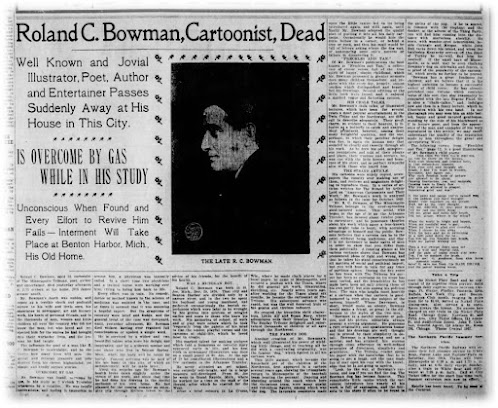
in Minneapolis Tribune, May 31, 1903

The remainder of today's post is the text verbatim of the Minneapolis Tribune article reporting Bowman's death. The Strand piece, which it quotes extensively, mentions cartoons accompanying it. The cartoons interspersed with my transcription of the Tribune's report are from Bowman's 1901 book, not the 1902 Strand article.

"Don't You Want to Buy a Dog"

Roland [sic] C. Bowman, aged 32, cartoonist at The Minneapolis Tribune, poet, author, and entertainer, died yesterday at his home, 2016 James avenue south.

Mr. Bowman's death was sudden, and comes as a terrible shock and profound sorrow to his wife and little ones, his associates in newspaper, art, and literary work, his hosts of personal friends, and to the thousands of men, women, and children all over the country who did not know the man, but loved and respected him for the smiles he had brought into their workaday lives, and the lessons he had taught.

The influence for good of a man like R.C. Bowman is incalculable, and no one knows how many lives will miss the genial and rational pleasure and help derived from his clever, highminded, yet simple and kindly picture stories.

OVERCOME BY GAS

Mr. Bowman was found overcome by gas in his study at 2 o'clock Thursday afternoon by a relative. He was totally unconscious, and finding it impossible to arouse him, a physician was instantly called. In a short time two physicians and a trained nurse were working over him trying to bring him back to life.

Every effort was in vain. No remedy, device, or method known to the science of medicine was omitted in the case, and at times it seemed that it was assuming a hopeful aspect. But the symptoms of recovery were brief and feeble, and the general trend of the case was downward, until, yesterday afternoon, Mr. Bowman died without ever having regained full consciousness or spoken a single word.

He is survived by a widow and two beautiful babies, who were his delight and inspiration, and by a widowed mother and one sister who live in Benton Harbor, Mich., where his body will be taken for burial. Funeral services will be held at his late home in this city, of which an announcement will be made later.
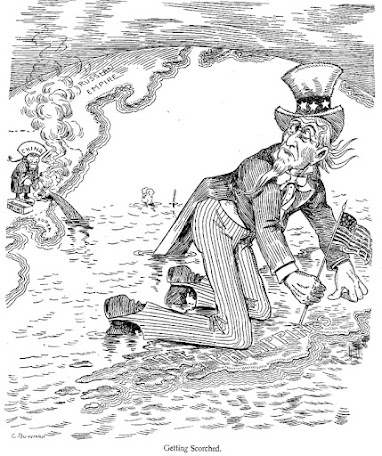
"Getting Scorched"

About six months ago, Mr. Bowman's health broke down slightly under the strain of his work, and since that time he had done his drawing in the restful seclusion of his own home. He had planned for the coming summer an extensive trip through Europe, taken by the advice of his friends for the benefit of his health.

WAS A MICHIGAN BOY

Roland C. Bowman was born in St. Joe, Mich. December 29, 1870. That city and Benton Harbor are divided only by a narrow river, and in the two he spent his boyhood and young manhood, and gathered unconsciously the boyish experiences which were later to be wrought by his genius into sources of mingled smiles and tears to those who knew his work. His memories of school, of work, and of play were colors which he took frequently from the palette of his mind to tint the tender, playful verses and the cartoons of child-life, which he loved most to create.

His marked talent for making pictures which told a humorous or forceful story appeared early in life, and his first work in newspaper illustration was done on a small newspaper in St. Joe. At the age of 19 he contributed illustrations and a few cartoons to the Arkansas Traveler.

"Not Worth Landing"

He never attended an art school, was entirely self-taught, and in a large measure self-developed. From St. Joe he went to Grand Rapids, Mich., where he worked for a time on the staff of the Herald, after which he started for the West.

After a brief sojourn in La Crosse, Wis., where he made chalk plates for a local paper, he came to Minneapolis, and secured a position with the Times, where he did general art work, illustrating, sketching, etc. Nearly seven years ago, after working with the Times six months, he became the cartoonist of the Tribune. His subsequent advance was rapid, but was the well deserved fruit of his genius and tireless industry.

"Rah! Rah! Rah"

He created the irresistible child characters Little Alf and Susan Mary, whose adventures with their Grandpa Tabor in the Sunday Tribune delighted and entertained thousands of children of all ages through the Northwest.

THE FAMOUS DOG

Another creation of Mr. Bowman's, which well illustrated his power of wielding little things, and of touching all he did with a captivating originality, was the famous "dog," which figured in all his cartoon work.

This little animal, which became the household pet of the children of the Northwest, first appeared in a cartoon several years ago, showing the triumphant return to Minneapolis of the baseball team bearing the pennant. Dancing and shouting around the coach which bore the triumphant team, were many quaint and ridiculous figures, among which was the dog. The favorable comments made upon the little canine led to its being introduced again, and still again, until finally Mr. Bowman adopted the quaint plan of putting it into all of his daily cartoons. Occasionally, he would hide the little fellow in a corner, or behind a tree or rock, and then his mail would be full of letters asking where the dog was, or announcing someone's success or failure in discovering it.

"The Run-Away Bill"

"FRECKLES AND TAN"

Of Mr. Bowman's publications the best known is "Freckles and Tan," a collection of clever verses, full of the true spirit of happy simple childhood, which Mr. Bowman possessed in greater measure than many children themselves; and replete with the every day, homely human touches which distinguished and beautified his drawings. Several editions of the little book were issued, and it enjoyed a marked vogue and flattering success.

HIS CHALK TALKS

Mr. Bowman's chalk talks, or illustrated lectures, which have been for several years a most popular entertainment in the Twin Cities and the Northwest, are difficult to describe adequately. Their great charm, so evident to their hearers, is illusive as a butterfly to catch and analyze. Most prominent, however, among their many delightful qualities, and the one, perhaps, to which their peculiar delight was due, is again the human note which sounded so clearly and sweetly through all his work. As he drew his odd, mischievous youngsters, and told of their pranks and plays, their troubles and sorrows, he was one with the little heroes and heroines of his story, and in perfect sympathy also with those who heard him.
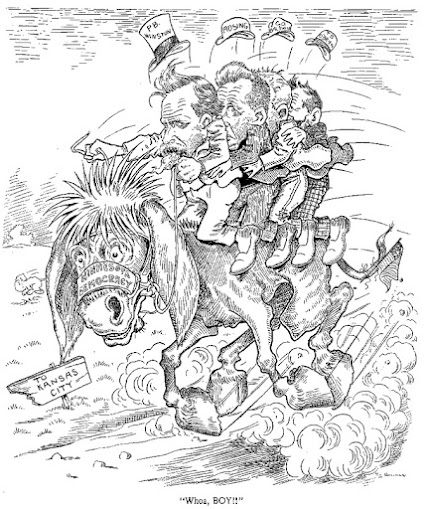
"Whoa, Boy"

THE STRAND ARTICLE

His cartoons were widely copied, newspapers the country over making use of them, and reviews and magazines delighting to reproduce them. In a series of articles written for The Strand by Arthur Lord on "American Cartoonists and Their Work," Mr. Bowman's work is analyzed as follows in the issue for October, 1902:

"Mr. R.C. Bowman, of The Minneapolis Tribune, belongs to the ever-spreading good-natured school. This artist, who began at the age of 19 on the Arkansas Traveler, has devoted about twelve years to the art of caricature, and he possesses theories about his work which many a less-known man might take to heart, with accruing advantage to himself and the public. Bowman believes that a cartoon can be to the point without being malicious, and that it is not necessary to make ogres of men in order to show that you differ with them politically. A running glance at his various cartoons shows that Mr. Bowman has pronounced ideas of right and wrong, and that he takes his stand conscientiously on all matters of social and political import, but you will hunt in vain for any trace of partisan spleen. During the five years that he has been with the Tribune his output has been as enormous as its scope has been varied, and the friendships he has made have been not only among those of his own party, but also among his political foes. The man who laughs most heartily at a cartoon when that cartoon is good-humored is very often the subject of the cartoon himself. Where Davenport, in short, would make an enemy, Bowman would make a friend, so great is the difference in the styles of the two men.
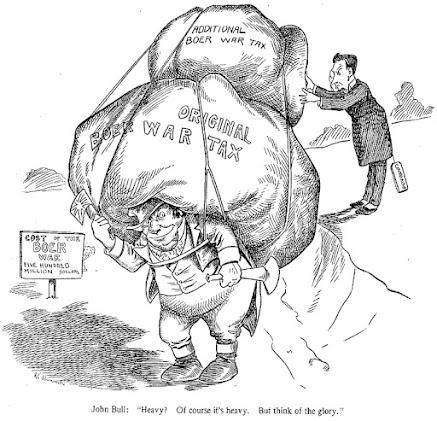
"Of Course It's Heavy. But Think of the Glory"

"Bowman is a careful student of politics, and his picture editorials always present a strong argument. He possesses a rare originality, and spontaneous humor and that his drawings are well thought out is proved by their simplicity in detail. Bowman is a humorist and not a satirist, and has attained his success through adherence to well-defined principles of directness, simplicity and gentleness. The Tribune reader opens his paper with the knowledge that he is not going to squirm.

"Look, by the way, at Bowman's cartoons, and see if you can find the dog. The Bowman dog has become famous. This remarkable little canine which the cartoonist introduces into nearly all of his work is full of expression and the keynote of the story [is] often found in the antics of the pup. If he is scared, in common with the elephant and the donkey, at the advent of the Third Party, you will find him running into the distance with marvelous alacrity. He rests, with wonder-eyed demureness, beside Carnegie and Morgan, while John Bull tacks down his island, and when the battleship Kentucky arrives off the coast of Turkey, he is — well, find him for yourself. If the small boys of Minneapolis, as is said, may be found chalking Bowman's dog on sidewalks and fences, it is proof of the popularity of the cartoonist, which needs no further to be proved.

"The Meanderings of Willie and Little Steve" (from a series)

"Bowman has a great fondness for children, and we believe that it is his highest ambition to become a successful writer of child's verse. He has already published one volume which contains verse of this sort that may reasonably be compared with the late Eugene Field. He is also a "chalk talker" and indulges now and then in a funny lecture, which he illustrates with his own hand. In our photograph you may [see in] him an able bodied, happy and good natured gentleman, standing by the side of his blackboard as if in lecture pose, and from the appearance of the man and examples of his work we may easily understand the quality of the reputation made by him throughout the great and enterprising West."

"It Turns Out to Be a Hornet's Nest"

The following verses from "Freckles and Tan," page 12, is a good illustration of Mr. Bowman's child poems.

THE ODE TO THE HAIR BRUSH


"Mandy, Pass Up Here and Let Me Give You Another Slice of the Paramount Issue"

Wednesday, December 29, 2021

All God's Children Got a Robe

In memory of Archbishop and Nobel Peace Laureate Desmond Mpile Tutu, who entered into life eternal on December 26, 2021:

Most Rev. Tutu is most identified, of course, with the struggle in South Africa against apartheid, but he also has had plenty to say, as far back as the 1970's, in support of homosexual rights. This passage from God Is Not a Christian: And Other Provocations continues:

It is also a matter of love. Every human being is precious. We are all — all of us — part of God's family. We all must be allowed to love each other with honor. Yet all over the world, lesbian, gay, bisexual, and transgender people are persecuted. We treat them as pariahs and push them outside our communities. We make them doubt that they too are children of God. This must be nearly the ultimate blasphemy. We blame them for what they are. ....

To discriminate against our sisters and brothers who are lesbian or gay on grounds of their sexual orientation for me is as totally unacceptable and unjust as apartheid ever was.

The Archbishop spoke out against persecution of gays and lesbians by political and religious leaders, including those in other nations of Africa:

“[A] wave of hate is spreading across my beloved continent. People are again being denied their fundamental rights and freedoms. Men have been falsely charged and imprisoned in Senegal…In Malawi, men have been jailed and humiliated for expressing their partnerships with other men. Just this month, mobs in Mtwapa Township, Kenya, attacked men they suspected of being gay. Kenyan religious leaders, I am ashamed to say, threatened an HIV clinic…because the clerics wanted gay men excluded. Uganda's parliament is debating legislation that would make homosexuality punishable by life imprisonment, and more discriminatory legislation has been debated in Rwanda and Burundi. These are terrible backward steps for human rights in Africa.” (in Washington Post, March 12, 2010)

It is largely to Most Rev. Tutu's credit that the 1996 South African constitution is the first in the world to guarantee the rights of that nation's LGBTQ+ citizens. There certainly was no popular clamor to have LGBTQ+ rights enshrined in the constitution; South Africa was not Castro on the Cape, on either side of the color line. But Tutu actively lobbied for it, and had the moral force to get it done.

The issue was no doubt personal for him as well as political. He gave his blessing to the wedding of his daughter, Rev. Mpho Andrea Tutu to Marceline van Furth, a marriage that got her defrocked by the Anglican Diocese of Saldanha Bay. Tutu van Furth has said of her family, "I had the extreme good fortune of growing up in a household with parents who were very clear about their faith and very clear about full inclusion of all people... regardless of gender and gender identity and regardless of sexual orientation."

✍

Why, yes, that name on the shingle outside shop in my cartoon is that of the actual patron saint of tailors, seamstresses, clothworkers and cobblers. I hadn't known that when I decided to look up their patron saint to be the proprietor of the heavenly haberdashery.

That his name happened to be homo-friendly was, shall we say, bonus.

Sunday, December 26, 2021

This Week's Sneak Peek

Instead of the usual edit snipped from the coming Thursday's cartoon, here is a cartoon I drew for Q Syndicate in November of 1998.


Friday, November 12, 2021

R.I.P. F.W. de K.

in UW-Parkside Ranger, Somers, WI, Feb. 8, 1990

Frederik Willem de Klerk, the last Apartheid Prime Minister of South Africa: March 18, 1936 - November 11, 2021

Monday, August 16, 2021

This Week's Sneak Peek


Last week at this time, I was racking my brain wondering what the hell I was going to write Saturday's history spiel about. By Friday night, I had one all written and ready to publish when another topic landed in my lap.

August has a reputation for being a slow news month, but events, current or historical, never really take a summer vacation.

Meanwhile, here's a cartoon from Kladderadatsch dating from 100 years before America's decision to go into Afghanistan that seems a propos in light of its collapse around us as we depart.

"Latest English Plaques" by L. Sautz (?) in Kladderadatsch, Berlin, Oct. 20, 1901


Thursday, August 27, 2020

Q Toon: Trump's Gay Outreach Around

Gay Republican operative Ric Grenell, lately on this blog for having come up with the Corrupt Trump Administration's tepid advocacy for international decriminalization of homosexuality, has quit his job as Jack McFarland of All Trades at the State Department to take on the unenviable role of LGBTQ+ Outreach for the Trump reelection campaign.

Ironically, with a straight face.

"As America's first openly-gay cabinet member, I can confidently say that President Trump has done more for gay and lesbian Americans than any other president, and it is not even close," Grenell said in a statement to Fox News.

Grenell went on to slam Democratic presidential nominee Joe Biden, saying that during his "four decades in Washington, he consistently fought against marriage equality and even threatened to cut funding for schools who taught acceptance of homosexuality."

"From President Trump's global campaign to decriminalize homosexuality to becoming the first president to support gay marriage on his first day in office, he has been a champion for our community and I am thrilled to be part of the fight to re-elect him for four more years," Grenell said.

One has to wonder who is going to continue Mr. Grinell's campaign to decriminalize homosexuality around the world now that he's no longer Ambassador to Germany, Special Envoy to Kosovo and Serbia, and Acting Director of National Intelligence. Mike Pompeo? Ha! 

There hasn't been much to show for Grinell's efforts: Chechnya continues its pogrom against LGBTQ+ Chechens; and Russia, Poland, most of the Islamic world, and most of Africa haven't lessened the persecution of their LGBTQ+ citizens, either.

Perhaps his campaign could maybe just possibly have been a factor in swaying the High Court of Botswana to his point of view last year; but I imagine the justices were more influenced by the example of the country's neighbor South Africa, which decriminalized homosexuality back in 1998.

But don't plan your wedding in Gaborone just yet. Thanks to COVID-19, Americans are barred from entering Botswana (as are non-citizens arriving from Austria, Belgium, China, Denmark, France, Germany, India, Iran, Italy, Japan, South Korea, Netherlands, Norway, Spain, Sweden, Switzerland, and the United Kingdom).

Ah, well. At least Mr. Grinell made no pretense that the Corrupt Trump Administration has been anything other than overtly hostile to the T, Q, and + elements of our community. But if it's fair game to "slam" Joe Biden for having opposed marriage equality while in the Senate, it's also fair to note that Biden came to support marriage equality while Trump was still opposing it on the grounds that ... uh, something to do with long putters in golf.

One also has to wonder how Mr. Grinell explains the Corrupt Trump Administration's actions to remove sexual orientation and gender identity protections under Title VII of the 1964 Civil Rights Act; to ban trans girls and women from participating in sports; to deny healthcare protections to transgender Americans; to roll back protections for trans students; to ban transgender people from the military; to strip children of bi-national same-sex couples of American citizenship; etc., etc., etc.

Saturday, September 14, 2019

When Liberal Democracy Was Ascendant

With the eighteenth anniversary of 9/11 this past week, we now have young men and women old enough to serve in the military — and to vote — who have never known a time when the U.S. was not at war. Sejmback Saturday therefore serves this reminder of a September just thirty years ago when it seemed that mankind might be making progress toward a kinder and gentler world.
in UWM Post, September 5, 1989
Eight years of repression against the Solidarność movement in Poland had not only failed to weaken it, but weakened the communist government of Wojciech Jaruzelski instead. Even Solidarność leaders were surprised by their successes in the elections in August, 1989, winning all but one of the Senate seats they were allowed to run for, and all of the contested seats in the Sejm.

Meanwhile, eight years of Reaganomics in the U.S. had left George H.W. Bush with an enormous budget deficit.
in UW-Parkside Ranger, September 7, 1989
China's quashing of the Tienanmen Square uprising in June notwithstanding, the stunning success of Solidarność quickly inspired independence movements in Lithuania, Latvia, Moldova, Hungary and East Germany.

This is the cartoon I mentioned a couple weeks ago that didn't get returned to me; so this is as well as I'm able to clean up the image from the Ranger's on-line archive. You can't see it from the above, but I had drawn Soviet President Mikhail Gorbachev speaking through gritted teeth; my recollection is that you couldn't tell that from the printed copy, either.
in UWM Post, September 19, 1989
So to make up for that poor copy, here's a colorization of what was originally just a black and white cartoon, aping Soviet imagery to depict the sudden exodus of East Germans. Hungary had opened its border with Austria, whereupon several thousand East German refugees were able to escape to West Germany in a round-about route through Czechoslovakia, Hungary, and Austria. In Berlin, there were signs that East German border patrols were no longer shooting to kill persons who tried to cross No Man's Land.
in UW-Parkside Ranger, September 14, 1989
Pressure for reform was not limited to the communist bloc. South African police initially responded to anti-apartheid protests that year with billy clubs, tear gas, and purple-dye water cannons; perhaps as many as 60 protesters were killed. In August, a new President took the reins from P.W. Botha, who had suffered a mild stroke in January. Claiming a mandate for reform in September's elections, F.W. de Klerk appeared to signal that his approach to dissent might be modeled after Gorbachev's rather than Deng Xiaoping's.
in UWM Post, September 21, 1989

Thursday, December 12, 2013

Q Toon: RIP Madiba


The death of a beloved, historic figure presents editorial cartoonists with both opportunity and challenge. Our memorial cartoons tend to be our most popular works; but for most of us, it's not enough to draw something saying that, gee, it's sad someone's gone. A cartoon that is truly worth the effort should say something unique and memorable about the person eulogized. The best do so simply and directly: Joe Heller produced his tour de 46664 within hours of the news breaking that Nelson Mandela had died.

Like many cartoonists, I often look for quintessential quotations on these occasions. At first, I wanted to draw a cartoon with Mandela's quotation that "to be free is not merely to cast off one's chains, but to live in a way that respects and enhances the freedom of others." But Scott Stantis and David Horsey used that statement from Mandela's Long Walk to Freedom in their cartoons on the AAEC web site the very next morning.

Not being on a daily deadline, I still had some time to find just the right quotation, so I wasn't worried about other cartoonists using all the good ones before mine made it to print. (Although I didn't foresee Keith Knight's memorial cartoon, for which one single quotation just wasn't good enough.) I spent several hours combing through his speeches on the African National Congress web site.

I settled on a 1998 speech marking World AIDS Day. Late in his presidency and into his retirement, Mandela became a campaigner for HIV/AIDS awareness; the disease had not yet claimed the lives of his son and daughter-in-law at the time of the speech quoted in my cartoon. I didn't get a World AIDS Day cartoon done in time for December 1 this year, so, tardy as it is, my cartoon this week pulls double duty.

Tuesday, December 10, 2013

No Peeking

In lieu of This Week's Sneak Peek, I offer a cartoon I drew in September of 1989. The speaker in the cartoon is South African Prime Minister F. W. deKlerk, making an announcement after months of police beatings of anti-apartheid demonstrators.
As the world celebrates the life of Nelson Mandela, it's striking to read educators and others remarking that students and young adults today do not know anything about him. And yet, trying to think back for an analogous case for my generation, I suppose some of my high school classmates had heard of the 1956 uprising in Hungary, but very few would have been able to identify Imre Nagy.

I went to college during a time when there were loud calls for colleges and university to divest from South Africa over its apartheid policies -- a hot-button issue at the time. The Soweto riots made headlines around the world, as did the death in police custody of Stephen Biko. America joined a wave of nations imposing sanctions against South Africa in 1986 only after the U.S. Congress overrode Ronald Reagan's veto.

The first cartoon I ever drew about South Africa was inspired by the film "Last Grave at Dimbaza" in 1975 or so. I no longer have the cartoon, which showed an armed white South African in pith helmet and safari gear using a dug grave as a warfare trench. I later discovered that Milwaukee Journal cartoonist Bill Sanders had drawn pretty much the exact same cartoon a few months earlier.

In spite of that sketchbook caricature of Nelson Mandela that I posted the other day -- drawn somewhere around the time that he was released from prison after 27 years -- I don't appear to have drawn him in any cartoons for publication at the time.


Thursday, December 5, 2013

Nelson Mandela, 1918-2013

In memory of one of the greatest political leaders of our time:

South African President Nelson Mandela passed away today at the age of 95. I drew this caricature of "Madiba" sometime around 1990 or 1991 as an early experiment with colored india ink.

The colors in the background are of the flag of the African National Congress (ANC); I don't recall whether the current South African national flag had been created at the time I drew this in my sketchbook. Either way, it's very unlikely that I would have had a picture of that flag handy before the 1992 Olympics.