Showing posts with label William McKinley. Show all posts

Saturday, January 31, 2026

...and Farewell

"Columbia proved unequal to Uncle Sam and gradually was replaced as a common cartoon character." — The Ungentlemanly Art, Stephen Hess and Milton Kaplan, 1968

Today's Graphical History Tour continues following the career of Lady Columbia into the 20th Century.

"Pan-American Puck" by Samuel Ehrart in Puck, May 8, 1901

As the personification of the nation, Lady Columbia was riding high at the turn of the century. She welcomed South America to the 1901 Pan-American exposition in Buffalo, New York (where President McKinley would be assassinated).

Ehrart's cartoon illustrated the host nation's hope that, in the words of Puck's editors,

"We have extended our trade horizon to include the Antipodes, but we have not yet secured the trade of our nearest neighbors. Central and South America still find reasons for going elsewhere to do most of their shopping. The weightiest of these reasons have to do with a certain protective tariff, and the disposition of them must await the enlightenment of a certain majority of the voters,— a condition happily promising for the near future. ... Incidentally we shall become better acquainted with the resources of our own island possessions and give their people, perhaps, a more favorable view of their relationship to us than they have thus far been able to gather."

"A Fair Return" by Louis Raemaekers in Chicago Examiner,  August 15, 1917

World War I raged in Europe for three years before the U.S. entered the fray. Dutch cartoonist Louis Raemaekers welcomed U.S. entry into World War I by depicting Lady Columbia embracing Marianne, the personification of France, telling her, "When I was a child it was you who saved me."

Columbia's gown doesn't have the usual flag motif in Raemaekers cartoon — perhaps because white stars are hard to draw in charcoal.

"It's a Great Day for America" by Albert T. Reid in National Republican, Nov. 3, 1920

The stars and stripes are back in Albert Reid's cartoon. Lady Columbia, here updating her wardrobe from the robes of classical Rome to congratulate President-elect Warren Harding, was often enlisted to welcome a new administration to office.

"My Harp Is Also Turned to Mourning" by Gennette in Brooklyn Daily Eagle, Sept. 7, 1901

One of Lady Columbia's chief roles in editorial cartoons was as chief mourner for the country. Cartoonists drew her grieving at the deaths of Presidents Lincoln, Garfield, McKinley (in this case), Harding, and the Roosevelts, as well as other prominent figures in the news. 

"Columbia's Anguish" by Clifford Berryman in Washington Evening Star, Jan. 30, 1922

Here she mourned collapse of the Knickerbocker Theater in the nation's capital that killed 98. It is possible that Berryman drew this particular Columbia to represent the District of Columbia, where the tragedy occurred, instead of the bespectacled and bewigged 18th-Century gentleman that he usually drew to represent the capital city. This Columbia lacks the Phrygian cap and wears full-length mourning black.

"Hail and Farewell" by Clyde Batchelor in Washington Times-Herald, April 13, 1945

Every reference I have found about Miss Columbia agrees that she went out of fashion sometime in the 1920's, Uncle Sam, the Statie of Liberty, and the eagle becoming the go-to cartoon personifications of the United States. 

I did find this 1945 Batchelor cartoon of her paying her respects to Franklin Delano Roosevelt upon his death the day before. Perhaps because Batchelor disagreed with much of FDR's policy (his April 12 cartoon accused the administration of covering up warnings of the attack on Pearl Harbor), his Columbia isn't racked with grief she typically was for earlier fallen presidents.

Looking back at my post a few years ago of cartoons drawn after President McKinley's assassination, whereas Columbia knelt in grief, it was Uncle Sam who meted stern justice to the assassin.

Today, Lady Columbia would be horrified and ashamed of the present government’s wanton murder and disappearing of its citizens. What would Uncle Sam be doing?

"His 146th Birthday" by Charles Kuhn in Indianapolis News, July 4, 1922

One does notice Columbia fading into the background, cartoon-wise. At the nation's 146th birthday, she serves the cake; but it's Uncle Sam's birthday, not hers, even though he was at most a mere 110 years old.

"Uncle Sam Will Take a Little of the Stuffing" by Wm. A. Rogers in Washington Post, Nov. 26, 1925

At Thanksgiving, Columbia serves the dinner, and while Uncle Sam frets that he'll have to settle for a little stuffing, there doesn't even appear to be a seat for her at the table. Unless a chair is hidden behind that turkey, Lady Columbia must have been demoted to kitchen staff.

"Why Not Flowers for the Living, Too" by Winsor McCay for Hearst newspapers, May 30, 1925

Would Uncle Sam deliver a bouquet of flowers to wounded veterans?

One theory is that Columbia as a cartoon character fell into disuse in the 1920's once she became the mascot for Columbia Pictures. Columbia Pictures wasn't named after her directly; the movie company was a division of Columbia Records, which was originally headquartered in the District of Columbia.

"Some Day They'll Come Crawling Back to Her" by Joseph Parrish in Chicago Tribune, June 26, 1948

Last week's post began with a cartoon of a female "America Triumphant" drawn before she was given the name Columbia, so we'll end here with one of that familiar lady, back in her liberty cap and Romanesque robe, but without the name coined by Edward Cave over two centuries before.

Saturday, July 5, 2025

Happy Fifth of Fourth

It's the Fifth of July and most of us still have all ten fingers, so in celebration of this extra long Independence Weekend, the Graphical History Tour sets the dial back five fourths of a century ago to July 4, 1900.

"Independence Day" by C.E. Toles in St. Paul Globe, July 4, 1900

We kick things off with an illustration by a cartoonist Allan Holtz called "the mysterious master." The highly stylized signature is a challenge to read; a researcher at the Library of Congress has concluded that the cartoonist was T.E. Coles, syndicated by the International Syndicate of Baltimore, but I lean toward those who have identified him as Claude Eldridge Toles, 1875-1901.

So, apparently, does Mr. Holtz, and that's plenty good enough for me.

I found this in the St. Paul Globe, where his work was featured regularly. Toles, however, lived his entire, brief life in New York state. (Any relation to the now retired Buffalo News and Washington Post cartoonist?)

"That Recent Trip to Lincoln, Neb." by R.C. Bowman in Minneapolis Tribune, July 4, 1900

My posts featuring historical cartoons began with examples from the Minneapolis Tribune's book of Rowland C. Bowman's editorial cartoons for the year 1900 ― a book left to me by my Aunt Barbara Jensen and since donated to the Billy Ireland Cartoon Museum because I do not have a climate-controlled room suitable to preserve it. The book included several cartoons mocking Democratic presidential nominee William Jennings Bryan, but not this one.

Bryan received the Democratic Party's nomination (for a second time) in Kansas City, Missouri on Independence Day, 1900, having already accepted the presidential nomination of the Populist Party. The Prairie Populist from Nebraska was not a favorite of the Eastern Establishment; but David Hill, a former New York Governor and Senator, had endorsed Bryan in 1896, partly due to his own rivalry with fellow New Yorker President Grover Cleveland. 

"Creating Business for the (Political) Undertaker" by Carter Simons in Brooklyn Daily Eagle, July 3, 1900

Hill is in the forefront of this Independence Eve Brooklyn Eagle cartoon (the Eagle did not publish on July 4), next to Tammany Hall boss Richard Croker. Hill was in serious contention for the Democrats' vice presidential nomination in 1900, but that went to Adlai Stevenson of Illinois instead.

Bryan had campaigned in 1896 on a platform of free coinage of silver at a ratio of silver to gold of 16 to 1, a position then popular in the rural west but strongly opposed by Cleveland and the "Gold Democrats." The "free silver" issue had lost some of its appeal by 1900, however, thanks in part to the Klondike gold rush.  

"Watching the Pinwheel Spin" by Leon Barritt in New York Tribune, July 4, 1900

In the meantime, the U.S. had taken possession of Cuba, Puerto Rico, Guam, and the Philippines after winning the Spanish-American War. Bryan's new issue was anti-imperialism. The 19th Century "manifest destiny" of pushing the nation's borders all the way to the Pacific was one thing; becoming a colonial power on the other side of the globe (with new territories moreover populated by dark-skinned Catholics and heathens!) was another thing entirely.

"The Chicago Platform Applied in St. Louis" by John S. Pughe in Puck, New York, July 4, 1900

The major news and satirical magazines of the day, Harper's Weekly, Puck and Judge, were united in their opposition to Mr. Bryan. Pughe depicts Bryan cheering on the strike by St. Louis streetcar workers, begun in May and lasting until September, in which clashes between strikers on one side and scabs and law enforcement on the other resulted in 14 deaths and hundreds of injuries.

"The Hardest Thing He Ever Had to Swallow" by Wm. A. Rogers in Harper's Weekly, New York, July 7, 1900

Democrats accused the McKinley administration of being in the thrall of oil, sugar, copper, steel, and railroad barons — the "trusts" — and Republicans in turn claimed that Tammany Hall, and by extension the Democratic Party, was beholden to the Ice Trust. 

The Ice Trust had nothing to do with Immigrant Capture and Expulsion; rather, this was about American Ice Company's monopoly of the supply of frozen water in New York City. What rival ice suppliers the company, founded in 1899 by Charles W. Morse, couldn't buy out, it drove out of business by smashing their deliveries, or getting Tammany Hall to revoke their dock privileges. 

After one year in business, monopoly achieved, American Ice Company doubled its prices to consumers, who relied on delivered ice for food refrigeration. Public outcry and media pressure forced the company to relent, and also exposed that Croker and other Tammany Hall figures had significant investments in American Ice.

"Trade Follows the Flag" by Eugene "Zim" Zimmerman in Judge, New York, July 7, 1900

Mocking the establishment Democrats falling in line behind Bryan, "Zim" Zimmerman skewers both Bryan's 1896 campaign platform of free silver and his 1900 campaign message against U.S. imperialism. The saying "Trade follows the flag" dates to 1870 or earlier, with the meaning that colonialism expands the colonizer's commercial opportunities.

"The Temptation" by Felix Mahony in Washington Evening Star, July 4, 1900

At last some political cartoons that acknowledge Independence Day! 

"An Old-Fashioned Fourth" by Tubman K. Hedrick in St. Louis Globe-Democrat, July 4, 1900

To Bryan's supposed chagrin, Hedrick in the St. Louis Globe-Democrat enthusiastically introduced the Republicans' vice-presidential nominee, New York Governor Theodore Roosevelt, nominated at the Republicans' convention the week before the Democrats'.

Republicans risked ebullient, colorful Roosevelt overshadowing staid, businesslike McKinley at the head of their ticket. (You might draw a more recent comparison with John McCain picking Sarah Palin as his running mate.) For much of U.S. history, the vice presidency was a post from which its occupants were seldom heard from again; it didn't quite work out according to plan this time.

"Kansas City's Favorite Son" by Taylor in Chicago Tribune, July 4, 1900

At this point, you might be asking whether there were any editorial cartoonists not attacking William Jennings Bryan. (Was Taylor caricaturing the Prairie Populist in this cartoon, or complaining about Kansas City's summer weather?)

The great Homer Davenport gained fame lambasting Bryan's Republican opponent, President William McKinley, and his financial backer from Ohio, Mark Hanna, so I went hunting for his work during the Democratic National Convention. I haven't been able to find any of the Hearst or Hearst-supplied newspapers that ran Davenport's cartoons that week, unfortunately.

No caption, by Robert Edgren in San Francisco Herald & Examiner, July 4, 1900

Instead, here's one by another Hearst cartoonist, drawing Mark Hanna in a  dollar-sign suitcoat, copying a Davenport trademark. 

An October 19, 1902 article in the Times-Democrat of New Orleans quoting visiting New York Herald cartoonist J.C. Fireman identified Edgren as a New York Journal cartoonist "in the same class as Davenport. He also adopts the sledgehammer style, and, being the champion hammer thrower of the world, it comes natural to him to 'knock' in his cartoons."

"Willie and His Papa" by Frederick Burr Opper in New York Journal, ca. July 4, 1900

Hearst cartoonist Frederick Opper was more of a jester than hammer thrower, but no less partisan. Instead of the dollar sign suitcoat, Opper here put Hanna in a dress, as wife of McKinley's Papa, "The Trusts." I presume that the water pail President McKinley has to carry in the cartoon is a reference to his campaign slogan of "the full dinner pail."

"A Man After My Own Heart" by May in Times-Democrat, New Orleans, July 4, 1900

I've got one cartoon specifically in support of William Jennings Bryan, and I'm afraid that I haven't been able to positively identify the cartoonist. May (certainly not Ole May, unlikely Thomas May) slapped a photograph into his cartoon of the Man After Uncle Sam's Own Heart rather than attempting to caricature him. But at least he acknowledged the holiday.

"Darned If I Can Have Any Fun on Fourth of July with These Things On" by E.T. Richards in Life, New York, July 5, 1900

Picturing the United States' new identity as a colonial power, E.T. Richards fit Uncle Sam in a crown and ermine robes, accompanied by a distressed Columbia and a mortified American eagle. Given the present regime's goose-stepping into fascist autocracy, I know how they feel.

In the background, I presume that is President McKinley dressed like Napoleon while his companion lights firecrackers tied to the dog Filipino's tail — a cruel and apparently common Independence Day pastime among nasty fin de siècle boys.

"Hurrah for the 4th" by Gustavo Bronstrup in San Francisco Call, July 4, 1900

That's more than enough politics for today, so let's wrap things up with an ode to the holiday by San Francisco's Gustavo Bronstrup. Enjoy the rest of your weekend!

America! It was nice while it lasted.

Saturday, October 15, 2022

Epitaph for R. C. Bowman

I wrapped up my post the other day about this year's AAEC convention by mentioning that I used the occasion to donate a 121-year-old book of editorial cartoons to the Billy Ireland Cartoon Library and Museum.

The cover of R.C. Bowman's book

Okay, it's not on the same level as Monte Wolverton donating a busload of his father's cartoon work to the BICL&M, but my Dad isn't a cartoonist. Although he was in a Vaughn Shoemaker cartoon once and has the original hanging in his office.

Outside of my own blog posts about the book, there isn't much on line about turn-of-the-century Minneapolis Tribune editorial cartoonist Rowland C. Bowman. Part of the reason for that is that he died quite young, overpowered by gas fumes at his home.

Report in Culver (IN) Citizen, June 4, 1903

Which is not to say that Bowman was either obscure or quickly forgotten. The Strand magazine was very impressed with him (and with Minneapolis Journal cartoonist Charles "Bart" Bartholomew) in a 1902 article about U.S. editorial cartoonists. And Syd Hoff included a pair of Bowman cartoons in his 1976 tome Editorial and Political Cartooning: From Earliest Times to the Present With Over 700 Examples from the Works of the World's Greatest Cartoonists.

"Royal Leap Frog" by R.C. Bowman in Minneapolis Tribune, May 30, 1903

Bowman's last editorial cartoon in the Minneapolis Tribune appeared on Saturday, May 30, 1903. Starting on Sunday, May 31, the Tribune began running cartoons by C.F. Naughton in Bowman's front-page spot.

"And When They Grow Up, They Would Not Put Away Childish Things" by C.F. Naughton in Minneapolis Tribune, May 31, 1903

Long-time followers of these Saturday history posts may remember that Naughton was editorial cartoonist at the Duluth Evening Herald in the 19-teens.

If any readers of the Minneapolis Tribune spotted that Bowman had been replaced at the bottom of Page One, they found the explanation on the bottom of Page Eight. I'll be charitable and attribute the Tribune's misspelling his name to the news room's collective grief.
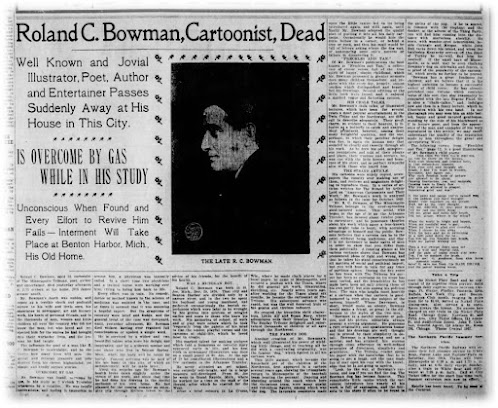
in Minneapolis Tribune, May 31, 1903

The remainder of today's post is the text verbatim of the Minneapolis Tribune article reporting Bowman's death. The Strand piece, which it quotes extensively, mentions cartoons accompanying it. The cartoons interspersed with my transcription of the Tribune's report are from Bowman's 1901 book, not the 1902 Strand article.

"Don't You Want to Buy a Dog"

Roland [sic] C. Bowman, aged 32, cartoonist at The Minneapolis Tribune, poet, author, and entertainer, died yesterday at his home, 2016 James avenue south.

Mr. Bowman's death was sudden, and comes as a terrible shock and profound sorrow to his wife and little ones, his associates in newspaper, art, and literary work, his hosts of personal friends, and to the thousands of men, women, and children all over the country who did not know the man, but loved and respected him for the smiles he had brought into their workaday lives, and the lessons he had taught.

The influence for good of a man like R.C. Bowman is incalculable, and no one knows how many lives will miss the genial and rational pleasure and help derived from his clever, highminded, yet simple and kindly picture stories.

OVERCOME BY GAS

Mr. Bowman was found overcome by gas in his study at 2 o'clock Thursday afternoon by a relative. He was totally unconscious, and finding it impossible to arouse him, a physician was instantly called. In a short time two physicians and a trained nurse were working over him trying to bring him back to life.

Every effort was in vain. No remedy, device, or method known to the science of medicine was omitted in the case, and at times it seemed that it was assuming a hopeful aspect. But the symptoms of recovery were brief and feeble, and the general trend of the case was downward, until, yesterday afternoon, Mr. Bowman died without ever having regained full consciousness or spoken a single word.

He is survived by a widow and two beautiful babies, who were his delight and inspiration, and by a widowed mother and one sister who live in Benton Harbor, Mich., where his body will be taken for burial. Funeral services will be held at his late home in this city, of which an announcement will be made later.
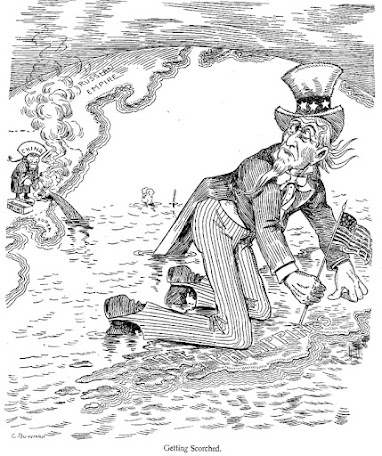
"Getting Scorched"

About six months ago, Mr. Bowman's health broke down slightly under the strain of his work, and since that time he had done his drawing in the restful seclusion of his own home. He had planned for the coming summer an extensive trip through Europe, taken by the advice of his friends for the benefit of his health.

WAS A MICHIGAN BOY

Roland C. Bowman was born in St. Joe, Mich. December 29, 1870. That city and Benton Harbor are divided only by a narrow river, and in the two he spent his boyhood and young manhood, and gathered unconsciously the boyish experiences which were later to be wrought by his genius into sources of mingled smiles and tears to those who knew his work. His memories of school, of work, and of play were colors which he took frequently from the palette of his mind to tint the tender, playful verses and the cartoons of child-life, which he loved most to create.

His marked talent for making pictures which told a humorous or forceful story appeared early in life, and his first work in newspaper illustration was done on a small newspaper in St. Joe. At the age of 19 he contributed illustrations and a few cartoons to the Arkansas Traveler.

"Not Worth Landing"

He never attended an art school, was entirely self-taught, and in a large measure self-developed. From St. Joe he went to Grand Rapids, Mich., where he worked for a time on the staff of the Herald, after which he started for the West.

After a brief sojourn in La Crosse, Wis., where he made chalk plates for a local paper, he came to Minneapolis, and secured a position with the Times, where he did general art work, illustrating, sketching, etc. Nearly seven years ago, after working with the Times six months, he became the cartoonist of the Tribune. His subsequent advance was rapid, but was the well deserved fruit of his genius and tireless industry.

"Rah! Rah! Rah"

He created the irresistible child characters Little Alf and Susan Mary, whose adventures with their Grandpa Tabor in the Sunday Tribune delighted and entertained thousands of children of all ages through the Northwest.

THE FAMOUS DOG

Another creation of Mr. Bowman's, which well illustrated his power of wielding little things, and of touching all he did with a captivating originality, was the famous "dog," which figured in all his cartoon work.

This little animal, which became the household pet of the children of the Northwest, first appeared in a cartoon several years ago, showing the triumphant return to Minneapolis of the baseball team bearing the pennant. Dancing and shouting around the coach which bore the triumphant team, were many quaint and ridiculous figures, among which was the dog. The favorable comments made upon the little canine led to its being introduced again, and still again, until finally Mr. Bowman adopted the quaint plan of putting it into all of his daily cartoons. Occasionally, he would hide the little fellow in a corner, or behind a tree or rock, and then his mail would be full of letters asking where the dog was, or announcing someone's success or failure in discovering it.

"The Run-Away Bill"

"FRECKLES AND TAN"

Of Mr. Bowman's publications the best known is "Freckles and Tan," a collection of clever verses, full of the true spirit of happy simple childhood, which Mr. Bowman possessed in greater measure than many children themselves; and replete with the every day, homely human touches which distinguished and beautified his drawings. Several editions of the little book were issued, and it enjoyed a marked vogue and flattering success.

HIS CHALK TALKS

Mr. Bowman's chalk talks, or illustrated lectures, which have been for several years a most popular entertainment in the Twin Cities and the Northwest, are difficult to describe adequately. Their great charm, so evident to their hearers, is illusive as a butterfly to catch and analyze. Most prominent, however, among their many delightful qualities, and the one, perhaps, to which their peculiar delight was due, is again the human note which sounded so clearly and sweetly through all his work. As he drew his odd, mischievous youngsters, and told of their pranks and plays, their troubles and sorrows, he was one with the little heroes and heroines of his story, and in perfect sympathy also with those who heard him.
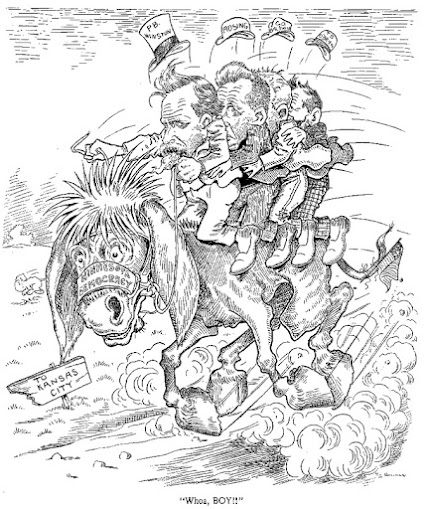
"Whoa, Boy"

THE STRAND ARTICLE

His cartoons were widely copied, newspapers the country over making use of them, and reviews and magazines delighting to reproduce them. In a series of articles written for The Strand by Arthur Lord on "American Cartoonists and Their Work," Mr. Bowman's work is analyzed as follows in the issue for October, 1902:

"Mr. R.C. Bowman, of The Minneapolis Tribune, belongs to the ever-spreading good-natured school. This artist, who began at the age of 19 on the Arkansas Traveler, has devoted about twelve years to the art of caricature, and he possesses theories about his work which many a less-known man might take to heart, with accruing advantage to himself and the public. Bowman believes that a cartoon can be to the point without being malicious, and that it is not necessary to make ogres of men in order to show that you differ with them politically. A running glance at his various cartoons shows that Mr. Bowman has pronounced ideas of right and wrong, and that he takes his stand conscientiously on all matters of social and political import, but you will hunt in vain for any trace of partisan spleen. During the five years that he has been with the Tribune his output has been as enormous as its scope has been varied, and the friendships he has made have been not only among those of his own party, but also among his political foes. The man who laughs most heartily at a cartoon when that cartoon is good-humored is very often the subject of the cartoon himself. Where Davenport, in short, would make an enemy, Bowman would make a friend, so great is the difference in the styles of the two men.
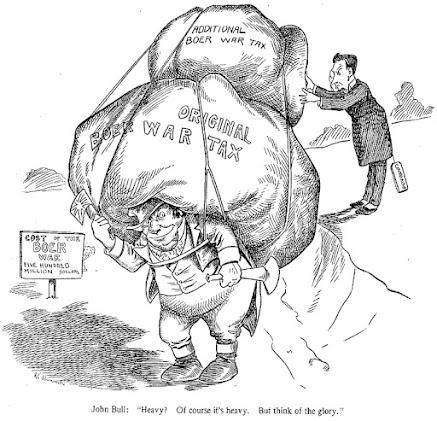
"Of Course It's Heavy. But Think of the Glory"

"Bowman is a careful student of politics, and his picture editorials always present a strong argument. He possesses a rare originality, and spontaneous humor and that his drawings are well thought out is proved by their simplicity in detail. Bowman is a humorist and not a satirist, and has attained his success through adherence to well-defined principles of directness, simplicity and gentleness. The Tribune reader opens his paper with the knowledge that he is not going to squirm.

"Look, by the way, at Bowman's cartoons, and see if you can find the dog. The Bowman dog has become famous. This remarkable little canine which the cartoonist introduces into nearly all of his work is full of expression and the keynote of the story [is] often found in the antics of the pup. If he is scared, in common with the elephant and the donkey, at the advent of the Third Party, you will find him running into the distance with marvelous alacrity. He rests, with wonder-eyed demureness, beside Carnegie and Morgan, while John Bull tacks down his island, and when the battleship Kentucky arrives off the coast of Turkey, he is — well, find him for yourself. If the small boys of Minneapolis, as is said, may be found chalking Bowman's dog on sidewalks and fences, it is proof of the popularity of the cartoonist, which needs no further to be proved.

"The Meanderings of Willie and Little Steve" (from a series)

"Bowman has a great fondness for children, and we believe that it is his highest ambition to become a successful writer of child's verse. He has already published one volume which contains verse of this sort that may reasonably be compared with the late Eugene Field. He is also a "chalk talker" and indulges now and then in a funny lecture, which he illustrates with his own hand. In our photograph you may [see in] him an able bodied, happy and good natured gentleman, standing by the side of his blackboard as if in lecture pose, and from the appearance of the man and examples of his work we may easily understand the quality of the reputation made by him throughout the great and enterprising West."

"It Turns Out to Be a Hornet's Nest"

The following verses from "Freckles and Tan," page 12, is a good illustration of Mr. Bowman's child poems.

THE ODE TO THE HAIR BRUSH


"Mandy, Pass Up Here and Let Me Give You Another Slice of the Paramount Issue"

Saturday, September 11, 2021

Kill Bill, Part 2

"A Great Nation Prostrate" by Canfield in Pittsburg [sic] Press, September 14, 1901

You were probably expecting something commemorating the 20th anniversary of 9/11 today; but I haven't drawn any new cartoons about it since the last time I marked its anniversary. And besides, I started commemorating the 120th anniversary of the assassination of President William McKinley last Saturday, and I wasn't finished yet.

So anyway, doctors were able to remove one of the two bullets in the president's body, and within a week after the shooting, they were optimistic for his recovery. They also felt that rummaging around for the second bullet was riskier than leaving it in. But on September 14, 1901, President McKinley succumbed to infection around that second bullet.

"William McKinley" by Wm. C. Rogers in Harper's Weekly, September 21, 1901

By chance, a new X-ray machine had been on display at the Pan-American Exposition where McKinley was shot, and would have been able to show the president's doctors where the bullet was. But the opportunity, and the president, were lost to history.

"In This Day of Mourning..." by Carter Simons in Brooklyn Daily Eagle, September 14, 1901 

There were a lot of mourning Columbia cartoons, rather than the weeping Uncle Sams that would flood editorial pages 100 years later. Columbia predated Uncle Sam as the personification of the U.S. by over 100 years; she flourished as a cartoon character in the 18th and 19th Centuries. But by World War II, if a cartoonist wanted to depict the U.S. as a woman, he or she was more likely to draw the Statue of Liberty.

I've come across a couple of cartoons that are more interesting than all those mourning Columbias:

Felix Mahony in Washington (DC) Evening Star, September 14, 1901

Felix Mahony's sketchbook illustration highlights the story of James "Big Ben" Parker, a Black American in the presidential receiving line immediately behind the assassin Czolgosz. According to a Secret Service agent present, "Parker struck the assassin in the neck with one hand and with the other reached for the revolver which had been discharged through the handkerchief and the shots had set fire to the linen. While on the floor Czolgosz again tried to discharge the revolver but before he got to the president the Negro knocked it from his hand."

There is a poem by Lena Doolin Mason extolling Parker's deeds that day.

"It Is God's Way" by Canfield in Pittsburg Press, September 18, 1901

The sangfroid of Canfield's cartoon of Father Pitt, drawn as the train carrying McKinley's body passed through Pittsburgh, would probably get any cartoonist into a heap of trouble today. The president is dead? Oh, well. Que será será.

But I can see certain right-wing cartoonists who might to get away with it these days.

"What, Wouldst Thou Have a Serpent Sting Thee Twice" by Wm. Walker in Life, September 26, 1901

Aside from grief-stricken Lady Columbias, there was another theme that ran through a lot of editorial cartoons after Leon Czolgosz shot President McKinley.

"Now, Uncle, Come Down Hard" by Canfield in Pittsburg Press, September 8, 1901

It's as if some memo came down from Cartoon Headquarters telling the nation's scribblers that everyone had to represent anarchists and anarchism as snakes. This presented Pittsburgh's Canfield with the dilemma of how to depict a snake holding a gun and a bomb.

He evidently decided, what the hell, I'll draw it with ears, too.

Felix Mahony in Washington (DC) Evening Star, September 9, 1901

Felix Mahony was content that a snake is threatening enough without adding limbs and ears. But you don't want to try to kill a snake by stomping on its middle.

"While I'm About It..." by Gennette in Brooklyn Daily Eagle, September 15, 1901

Gennette adds in a few more vipers for Uncle Sam to bludgeon, notably including "lynchings" and "burnings at the stake." The cartoon is more aspirational on Gennette's part than factual on Uncle Sam's part; the ensuing crackdown on anarchists was not accompanied by much civil rights legislation. As President Theodore Roosevelt put it, "When compared with the suppression of anarchy, every other question sinks into insignificance."

"No Room on This Ship" by Wm. A. Rogers in Harper's Weekly, October 5, 1901

Czolgosz was quickly brought to trial, and readily admitted murdering the President. He told authorities that he had been inspired by the speeches of anarchist Emma Goldman; but as it turns out, he had never been able to ingratiate himself into her inner circle. He had been the sort of guy who is too eager, and asks too many questions. Some of her associates were convinced that he must be a government spy.

"A Proper Concert of the Powers" by Wm. Walker in Life, October 3, 1901

Most anarchists disavowed Czolgosz, but for her part, Goldman refused to condemn what he had done. She instead characterized him as a "supersensitive being" and likened him to Julius Caesar's assassin Marcus Brutus.

Czolgosz tried to plead guilty at his trial, which began on September 23, but was overruled by presiding Judge Truman White. His jury deliberated for less than 30 minutes before returning guilty verdicts the very next day.  

"Wasn't You Present at the Execution?" by Rowland C. Bowman in Minneapolis Tribune, October, 1901

On October 29, Czolgosz was electrocuted to death at Auburn State Prison. In order to prevent any macabre Czolgosz memorabilia getting out, prison officials burned his clothes and other possessions, and doused his corpse with acid before burying him on the prison grounds.

The Temple of Music where McKinley was shot, and the rest of the Exposition buildings, were razed that November. That wasn't entirely in order to erase unpleasant memories of the assassination; the Exposition buildings were never intended to be permanent structures.

But unlike with John Wilkes Booth, Lee Harvey Oswald, or Sirhan Sirhan, (or, for that matter, Osama bin Laden,) the Spirit of Notoriety has kept its distance from Leon Czolgosz. Unless you've seen Assassins, chances are you don't even know how to pronounce his name.