Showing posts with label comic strips. Show all posts

Monday, June 17, 2024

This Week's Sneak Peek


Yeah, it's another multi-panel toon coming off the drawing board this week.

Four panels worth of trying to make characters look like the same person wearing the same outfit and hairstyle and jewelry from frame to frame without making them utterly static by copying and pasting like some editorial cartoonists who shall remain nameless but you know who they are do.

"The Berrys" by Carl Grubert, June 25, 1967

There used to be a comic strip in the local Sunday paper when I was growing up, "The Berrys" by Carl Grubert, in which the facial expressions of the characters always appeared to be cut and pasted from some master file of grins and smiles. Looking back on it, one imagines a factory full of junior cartoonists in South Korea or some such gluing bits of the cartoon together every week, a la "The Simpsons" animators.

I don't care to wade through every Sunday strip today, but I'm fairly certain that there were occasions when a everything in an old panel but the dialogue was copied into a new strip (if not the entire strip itself). But compare the last panels of these next two, a month apart:

"The Berrys" by Carl Grubert, July 16, 1967

The family was the antithesis of much of early comic fare of bickering couples, henpecked husbands,  ditsy wives and trouble-making children. Mrs. Berry didn't call Peter a nut every Sunday, but whatever arguments they had, they could laugh all the way through them.

"The Berrys" by Carl Grubert, June 18, 1967

Yet somehow, their incessant smiling was ... creepy.

"The Berrys" by Carl Grubert, October 29, 1967

Even in silhouette!


Saturday, May 18, 2024

Great Art and Some Shinola I Drew

Travel back in time with me for some of my own cartoons which celebrate their decennials this month.

for Q Syndicate, May 19, 2014

Ten years ago, University of Missouri defensive lineman Michael Sam made sports headlines as the first openly gay NFL draft pick. In his senior year, he led the SEC in quarterback tackles and sacks; he forced a fumble that was run back for a touchdown in Missouri's 2014 Cotton Bowl victory over Oklahoma.

He came out as gay to his college teammates that senior year, and went public after graduating in December. 

Cameras were rolling when he was selected by the St. Louis Rams in the seventh round of the 2014 draft and shared a celebratory kiss with his then boyfriend, Mizzou swimmer Vito Cammisano, and it was broadcast live on television. President Barack Obama was among those sending Sam congratulations, but the kiss also provoked backlash and pearl-clutching from homophobic football fans and non-fans who object to gays anywhere not being furtive about it.

Alas, Sam only ever got to play for the Rams in the pre-season. Cut from the roster at the end of August, he later spent some time on the Dallas Cowboys' practice squad, then joined the Montreal Alouettes of the Canadian Football League. He missed several games with the Alouettes over mental health issues or simply being unhappy there — he quit after playing only one game, in fact — and is currently a defensive football coach in Poland for the Panthers Wrocław.

Continuing with the sports theme, I could have sworn that I've posted the next one on this here blog before, but I'm not finding it.

in Business Journal of Greater Milwaukee, May 15, 2004 

This cartoon from May, 2004 is the one and only cartoon of mine that ever won an award.

Well, second place, actually, from the Milwaukee Press Club. First place in the editorial cartoon category that year went to Stuart Carlson of the Milwaukee Journal Sentinel. It's not as if there were a crowded field of contenders in 2004, but I'll accept what praise I can get.

The editors at the Business Journal had entered my cartoon for consideration, and I only learned anything about it after the fact. I probably missed a swell dinner. And perhaps some networking opportunities.

The topic of the cartoon, and of the editorial that it was drawn to illustrate, was the Milwaukee Brewers baseball team running up against the Major League Baseball salary cap as they hired some big names for a rebuilding year (having been in rebuilding years since 1982). It has paid off; the Brewers have been in contention off and on since 2008.

The original Brewers mascot, of course, was an anthropomorphized beer barrel swinging a baseball bat. It was replaced in the late 1970's by that mb/catcher's mitt logo, which I still think is the best and cleverest logo the team ever had. Barrel Guy does have his successor in Bernie Brewer, a mustachioed fellow who rides a slide down from his chalet to celebrate home team home runs.

in UWM Post, Milwaukee Wis., May 5, 1994
Let us leave sports aside and turn to some other topics — as we must, since according to my files, I only drew one cartoon for the whole month of May in 1994.

I'm going to skip right past the "Dr. Death" Kevorkian verdict, and the next two panels, which weren't based on any particular news story, to the two guys "just doing investigative journalism."

A reporter for the UWM Times, the upstart, right-wing rival to the UWM Post, got caught voting multiple times in the student government election that spring. His defense was that he was actually doing an investigation for the paper about election fraud. Unable to find any real election fraud, he committed the fraud himself. 

It's a tactic that continues to this very day: right-wing conspiracy fabulists sound the alarm about waves of voter fraud, but the voter fraud that is uncovered is committed by their own side.

The student provocateurs staff at the Times are the very generation of Republicans who have grown up to concoct the imagined conspiracies that get in their way at election time: of busloads of Mexican aliens, transgender feminazis voting once as a man and a second time as a woman, and hordes of zombies rising from the grave. 

Speaking of the grave:

"Before We Lay the Dearly Departed to Rest" in UW-Parkside Ranger, Somers Wis., Sept. 1, 1984

This cartoon posed something of a mystery. I dated it May, 1984, and the compositor's notation on the back indicates that it was published; but it was not in either the May 3 or May 10 editions of the UW-Parkside Ranger published at the end of that school year.

I couldn't have drawn it thinking that there was a May 17 edition. In addition to my weekly cartoon on the Ranger's editorial page, I was also drawing a continuity comic strip, a loose parody of The Maltese Falcon, which I hastened to wrap up for the May 10 issue. (The epilogue episode echoed the first strip of the series.)

"The Funny Paper Caper," episode 30, in UW-Parkside Ranger, May 10, 1984

Since I didn't write "UW-P Ranger" on the editorial cartoon, I probably drew it for my own practice or amusement.

Looking back, I assumed that I had drawn the cartoon after audio went public of President Ronald Reagan quipping during a mic check in preparation for a radio address, "My fellow Americans, I'm pleased to tell you today that I've signed legislation that will outlaw Russia forever. We begin bombing in five minutes."

But that took place in August. Which explains why the cartoon was relevant when the Ranger's first edition of the next semester came out.

I guess I was just lucky that Soviet President Constantin Chernenko (seated in the foreground) wasn't dead quite yet.

Sunday, May 5, 2024

Saturday, March 30, 2024

Something Old, Something New

Today's Graphical History Tour returns to some of my own cartoons celebrating their decennaries this month, but I'm going to shake things up a bit this time and not take them in chronological order.

I'll start with this cartoon drawn for one of the more liberal of the student newspapers at the University of Wisconsin - Milwaukee.*

in UWM Post, Milwaukee Wis., March 3, 1994

UWM has long had two vocal student groups advocating against each other for Palestine and Israel. The pro-Palestine group posted an inflamatory poster in the student union atrium in response to the Cave of the Patriarch's Massacre, in which American-Israeli physician Baruch Goldstein opened fire on Palestinians worshiping in the Ibrahimi Mosque in Hebron, killing 29 and wounding 125.

The Palestinian Human Rights Campaign's poster depicted a sequential cartoon of a Star of David morphing into a swastika. The Jewish student group complained to the chancellor of UWM, John Schroeder, that the poster was antisemitic and should be taken down.

It's an argument reflected in graphic discussion of the Israeli-Palestinian conflict at large, and never moreso than today.

If I were to draw a cartoon like this today, I would add a rule that any reference to blood is also out of bounds. You can draw Vladimir Putin as a bloodthirsty monster in Ukraine, or George W. Bush spilling blood in Iraq, or Slobodan Milošević dripping blood in Bosnia. But the moment you try any of that with Bibi Netanyahu, you're trafficking in Blood Libel against all Jews everywhere.

Cartoons by Dwayne "Mr. Fish" Booth and Serge Chapleau

A number of cartoonists have stumbled into the Blood Libel trap since the Netanyahu government's scorched earth campaign to push Palestinians in Gaza into the sea — most recently Dwayne Booth, who draws under the nom de plume "Mr. Fish," and Serge Chapleau of La Presse in Montréal, Québec. Chapleau's cartoon of Netanyahu as "Nosferatu en route to Rafah" was yanked off-line by La Presse this month after howls of protest from the Usual Quarters. The Association of Canadian Cartoonists issued a statement in support of M. Chapleau; he stands behind his cartoon, and La Presse stands behind dumping it.

Mr. Fish's cartoon from last November was singled out as anti-semitic by the right-wing Washington Free Beacon and then criticized by the Interim President of the University of Pennsylvania, Larry Jameson. Mr. Fish has not been fired from teaching his course on cartooning at U-Penn, and no journal that posted "Who Invited That Lousy Anti-Semite" on line has 404ed it with apologies; so I haven't heard any push for the Association of American Editorial Cartoonists to leap to his defense.

for Q Syndicate, March 2004

Moving on: This was a cartoon I drew as a reserve for Q Syndicate, to be released at some later date when I might be on vacation, laid up, or for some other reason fail to get a cartoon in on time. For that reason, the cartoon did not deal with any actual news story; it's not about any particular cartoon syndicate rejecting the work of any particular lesbian cartoonist.

I bring it up today because within cartooning circles here in 2024, some of us are more concerned with the decision by the major newspaper publishing conglomerates to standardize their newspapers' comic pages, because of which decision just about every comic strip currently drawn by a woman has disappeared from print.

Lynn Johnston’s “For Better Or Worse" has survived the purge, but it has been in reruns since 2008. Two other sort-of exceptions are "Luann" by Greg Evans with his daughter Karen as co-author, and "Shoe" currently drawn by Gary Brookins and Susie MacNelly, widow of the strip's original creator.

As Georgia Dunn noted in her strip "Breaking Cat News," "There are more dead men than living women in the funny pages."

Well, it's Holy Week in the Western Christian calendar, so let us open now our hymnals to page ax².

in UW-Parkside Ranger, Somers Wis., March 22, 1984

Back in the 1980's, conservatives upset by the separation of church and school and encouraged by the presidency of Ronald Reagan, were eager to impose prayer on public school students. Not mandatory, of course, but voluntary. 

Fair enough, I suppose. Turnabout, however, is fair play.

Who could have foreseen that forty years later, some tawdry huckster would be hawking Bibles with the Constitution as Apocrypha?

I wonder how many Corinthians it has.

for Q Syndicate, March, 2014

Speaking of turnabout as fair play, it's been ten years since Mr. Fred Phelps shuffled off his fetid coil. Since he based his entire career on speaking ill of the dead — loudly, through a bullhorn, at funerals — it was only fitting to dyslogize him in like manner.

He is risible indeed.

_____________________

* The other main newspapers were the right-wing Times and the Black American Invictus.

Tuesday, February 20, 2024

Address Change for the Wallets

At the end of my Valentines Day post a couple Saturdays ago, I included the February 14, 1924 installment of Frank King's "Gasoline Alley." I'm not aware of any newspapers, including its parent paper, the Chicago Tribune, that run "Gasoline Alley" in print, but I remarked that it's still available on line at GoComics.com.

In the weeks since then, its current cartoonist, Jim Scancarelli, has been teasing some Big News in the strip. The characters have been excitedly asking each other whether they have heard the news, and every one of them seems fairly upset about it. The dramatic tone led many readers in the comments section to wonder if Scancarelli were planning to bring the 106-year-old cartoon — described by Pierre Couperie and Maurice Horn as "the first Bildungsroman in pictures" — to an end.

Today's installment reveals that the Alley's fate is probably not quite as dire as that:

Will it be "The Wallets"?

"The Rectangle"?

"Das Bildungsroman in Pictures"?

"Electric Plug-in Court"?

Sunday, July 2, 2023

Tuesday, March 29, 2022

Steve Roper en français

Just something I ran across while looking for something else: the adventure cartoon "Steve Roper" in a Québécois weekly newspaper:


Steve Roper, created by Allen Saunders and Elmer Woggon, entered their comic strip, "Big Chief Wahoo," as a blond news photographer in 1940. Roper eased out the titular Seminole from the strip, and somewhere along the line he quit bleaching his hair, turning it black. Here in 1956, he and Clark Kent obviously have the same barber.

By the time I was old enough to follow the plots, Roper's temples had gone gray; and a crew-cut, blue-collar, often shirtless friend of his, Mike Nomad, was starting to have all the adventures. Roper actually vanished into the Bermuda Triangle for ten years, and I'm not making that up.

"Steve Roper and Mike Nomad," by then drawn by Frank Matera, was a wrap in 2004.

Sunday, October 24, 2021

Let's See Whether the Old Folks Notice

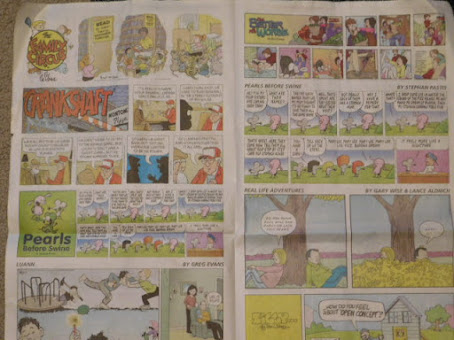
Leafing through the Sunday comic pages of the Kenosha-Racine News-Journal-Times today, I noticed that "Macanudo" by Liniers had been replaced by Brad Anderson's "Marmaduke."

I hadn't seen any notice that the combined newspapers, printed way off in Indiana, were dropping "Macanudo," so I dug last Sunday's comic page out of Dad's recycling box to check whether Linier's comic was in it. It was...


...but the odd thing in the October 17 edition was that Stephan Pastis's "Pearls Before Swine" was included twice.

Are they just getting careless at Lee Enterprise's print factory in Munster, or are they intentionally trying to find out what changes they can get away with without their aging readership raising a fuss?

The "Pearls" on the left page above took the place of the late Charles Schulz's "Peanuts"; I'm guessing that even in reruns, "Peanuts" still appeals to more of the over-80 crowd than Stephan Pastis's elaborate, boomer-centric puns.

As for "Macanudo," it's a cartoon that often puzzles Dad, and my mother never liked at all. The Journal Times ran "Marmaduke" for years before Lee started publishing one comics page for both the Racine and Kenosha newspapers, so most older readers were quite used to it. (I don't remember whether "Marmaduke" had previously been in the Kenosha News.) 

Dad hadn't noticed the switch today; he's much more aware of when the crossword puzzle has been a repeat.

Is anyone complaining? I don't know, and I'm not going to check.

I've been to the Journal Times comments section before, and man, you really do not want to get caught in that cesspool.

Saturday, June 16, 2018

Fathers' Day 1918

It's Father's Eve, so Sireback Saturday brings you a selection of 100-year-old comic strips about Father. The dialogue is tiny, in part because comic strips were given much more space in the newspaper than they are today, so you'll have to beclickify these samples to embiggen them enough for eulegibilitizationness.

It seems only natural that we should start with George McManus's long-running strip, Bringing Up Father.
"Bringing Up Father" by George McManus, June 19, 1918
What strikes us immediately is that the typical father in 1918 was pathetically henpecked, subject to the violent mood swings of his mate, just because he was an idiot who blurted out any thought that happened to cross his mind. If anybody had heard of Asperger's Syndrome at the time, perhaps Jiggs could have gotten the treatment he so sorely deserved, rather than having to escape his home on the zip line installed expressly for that purpose.

Everyone had them in those days. I've seen the photos.

"Poor Mr. W." by Gene Carr, June 16, 1918
Gene Carr patterned his Poor Mr. W. (one of several short-lived cartoons by Carr) after Bringing Up Father, but molded its title character into a civic-minded, educated gentleman who was willing to admit his own mistakes in support of the War Effort as seen in this Fathers' Day episode. Note too the forward-looking attitude toward women in the workplace!

"When a Man's Married" by William Gordon "Jack" Farr for US Feature Service, June 15, 1918
The father in Jack Farr's "When a Man's Married" illustrates how getting married drives a man to drink. Sure it may start with an innocently medicinal daily teaspoon of whiskey, but one teaspoon soon becomes a tablespoon, and before you know it, the doctor has you chugging an entire barrel of the stuff.

You may think Mr. Farr's attitudes toward medicinal alcohol quaint. 100 years hence, your great-great-grandchildren will probably think the same about medicinal marijuana.

One thing that has been missing in our Fathers' Day strips so far has been anyone fathered by the title characters. Therefore, let us check in on Dad and the kids.
"'S'Matter, Pop" by Charles M. Payne for Bell Syndicate, June 16, 1918
The father in Mr. Payne's long-running strip has obviously been reading too many books touting the supposed benefits of permissive parenting. By not sternly correcting his son's anastic delusions, the son is put at risk of drowning, or worse. Pop could use a shave, too. I'll bet he's one of them bolsheviki.

"Doings of the Duffs" by Walter Allman for Scripps Syndicate, June 21, 1918
Walter Allman's Doings of the Duffs, I guess, confirms my suspicion that fathers in the Nineteen-teens had not mastered the element of water yet. Best leave them on dry land.
"Polly and Her Pals" by Cliff Sterrett for Hearst Newspapers, June 15, 1918
Sam Perkins' daughter Polly has joined the local police department in the above installment, further entrenching the proto-feminazi domination of American incels in the 20th Century. Fortunately for Pa, there is still a rump force of traditional male patriarchy meeting clandestinely under the cover of cigar smoke around a poker table. The resistance continues.

To the father-child relationship, this next cartoon by Charles H. Wellington adds the dimension of the relationship between father-in-law and son-in-law (a relationship that apparently fascinated him, because he drew strips with three other variations on this title between 1911 and 1942). This Sunday cartoon takes up an entire broadsheet page, which is not only bigger than the phone you're trying to read this on, it's bigger than any newspaper on the newsstand today. In an attempt to make it somewhat legible, I've broken it up into three pieces.
"That Son-In-Law of Pa's" by Charles H. Wellington for Newspaper Feature Service, June 16, 1918
See what Mr. Wellington did there? He very cleverly stepped on his own gag in the topper of the cartoon in case you got tired of reading it and missed the very helpful tip for spotting German spies in the final panel. Sure, it spoiled the joke, but the country was at war, dammit. No mere joke was more important than saving the country from the Boche!
"Doings of the Duffs" by Walter Allman for Scripps Syndicate, June 13, 1918
Returning to Tom Duff: I'll bet he pulled this same trick when he was called up to the draft board, too. (The U.S. raised the draft age was to 49 in June of 1918 as these cartoons were published.)

Now, I've read several episodes of Doings of the Duffs, and I'm not at all sure what Olivia's relationship to Tom and Helen Duff is. She lives in their house and sees gentlemen callers there; but she calls Mr. and Mrs. Duff by their first names, so she doesn't seem to be their daughter or daughter-in-law. She's not their maid (that's Daisy, an African-American woman). If she were Tom or Helen's sister, one would think Tom would be less rude to her beaux in the interest of getting her out of the house.

If she isn't a Duff, is she then, the prototypical DUFF?

Saturday, September 2, 2017

Comic Caper: Back to School Edition

I was thinking of putting together a collection of back-to-school cartoons for today's Studentbacker Saturday, just so I could show off this cartoon by Chicago Daily News editorial cartoonist Vaughn Shoemaker, featuring my Dad:
"Education" by Vaughn Shoemaker for Chicago Daily News, September, 1935
Dad says he was actually five years old when this was drawn, not six. He has the autographed original framed and hanging in his office; the image above is from a photograph rather than a scan because removing the cartoon from the frame would probably ruin it. I've tweaked the photo considerably in Photoshop to minimize the effects from decades of yellowing.

But I haven't come across any inspiring vintage back-to-school cartoons yet, so a full blog post on that topic will have to wait for another day. Not that there aren't any old cartoons on education; I included one by Winsor McCay in a post for Labor Day weekend last year. But I do wonder whether the Katzenjammer Kids ever went to school at all. I read through their entire escapades for the month of September, 1917 without finding one mention of them attending classes — although they did go to the zoo once or twice a week.

🎒

So instead, here's more of my Funny Paper Caper series, drawn for the UW-Parkside Ranger in 1983-84 that I've been running here since July.

Looking back, the inconsistency in how much space my cartoon required from week to week must have really cheesed off the lay-out editor. This was the second time that an episode took up three rows of panels instead of one.

And here, ferschitzengiggels, is one more episode, standard length, for today.

Wednesday, August 30, 2017

Comic Caper: Installment VI

Here's an extra special Whaddayaknow Wednesday installment in our continuing retrospective of a comic strip I drew in 1983-84 for the UW-Parkside Ranger, "The Funny Paper Caper." I've usually presented four strips at a time, but now we have come to the episodes which ran in April. The end of the school year was just around the corner, and I needed several more than the usual three or four panels per week if I wanted to get to the end of the story before the Ranger suspended publication for the summer.

When we left off on Saturday, the Yellow Geezer had been shot just as he was about to tell our detective-cum-narrator what evil mastermind was looking for the Maltese Pelican, and who may have killed Rufus T. Pornapple in a foiled effort to get it.

Whenever the investigator goes out on a call without back-up, you know something bad is going to happen. It's a cliché, yes, but it's an essential climax to Act III in any police procedural.

Saturday, August 26, 2017

Comic Caper, Caibidil a Cúig

Sagaback Saturday returns yet again to the thrilling days of yesteryear and the gripping serial "The Funny Paper Caper." If you've been keeping up with the story but only check this blog on Saturdays, there was a fourth installment on Tuesday that you missed. It introduces the series macguffin, in case you want to go back and read it. I'll wait right here.

Moving on, The Funny Paper Caper throws in a passing reference to Jeff MacNelly's "Shoe."

In the next couple of episodes, I gave myself the challenge of imagining what a cartoon character who was a child when his cartoon originally ran might look like as a wizened old man. I also took over more space on the UW-Parkside Ranger page. Those old comics were granted more newspaper real estate than cartoons nowadays; and besides, this character's dialogue, instead of appearing in balloons, appeared on his shirt.
The next week referred to above was spring break already, so time was running out to get this story wrapped up.
The Yellow Kid was not, in fact, oriental, but Irish. The original character's name was Mickey Dugan. Richard Outcault was the cartoonist who created "The Yellow Kid" for Joseph Pulitzer's New York World in 1895; George Luks continued the strip in the World when Outcault took it to William Randolph Hearst's New York Journal the following year. "Yellow" referred to the color of Mickey's shirt (color being a resource I didn't have on the Ranger comics page), and is where the term "yellow journalism" comes from.

With the characters crouched beside a dumpster, it was possible for the strip to return to regular size. For one week.


Tuesday, August 22, 2017

Comic Caper: Kapitel Fire

In the interest of getting through this story, today is now Turnback Tuesday. This is the fourth batch of  comic strips that I drew in 1983 and 1984 for the UW-Parkside Ranger and have been rerunning here purely because I didn't have another topic handy for a Saturday retrospective back on July 29.

In case you're just joining the story, our nameless Lieutenant-cum-narrator is investigating the murder of Rufus T. Pornapple, whose son has just identified a burglary suspect, only to have the suspect's wife suddenly burst onto the scene. The month's worth of episodes presented here don't introduce any new characters, so suffice it to say our murder mystery's milieu is the comics page of your daily newspaper.
I promise that something is going to happen to nudge the plot forward very soon.

I really ought to have made that bird bigger.


Saturday, August 12, 2017

Comic Caper, Chapter Drei

For this week's Sleuthback Saturday feature, I dredge up the November installments of a comic strip I drew for the UW-Parkside Ranger back in 1983-84. "The Funny Paper Caper" told the story of  the murder investigation of one Rufus T. Pornapple, who was also the victim of an unreported burglary, and romantically linked with more than one comic strip female. As we rejoin the story, the investigation turns to a little lady whose name was McGill, and who called herself Lil, but everyone knew her by another name.


One characteristic of "Nancy" in those days was that cartoonist Ernie Bushmiller avoided use of any and all punctuation, save for the occasional dash or unavoidable question mark. It may have been part of Bushmiller's minimalist approach to cartooning overall. He put nothing in the cartoon that wasn't essential to the gag du jour. I like Wally Wood's observation about the strip that "By the time you decided not to read it, you already had."

This tenth installment, however, requires considerably more commitment.

There's an inside joke in the first panel of strip #11. John Kovalic was a cartoonist colleague at the Ranger that year, drawing a comic strip which appeared just below mine every week. Carson the Muskrat in his current "Dork Tower" is a survivor of his earlier "Wild Life."
As promised earlier this week, Dick Tracy — er, Thelma — has entered the story line. After reading Tuesday's post here, Dave Brousseau reminded me that Dick Locher continued to script Dick Tracy's story line for two years after he stopped drawing the strip in 2009, which I did not explain on Tuesday. He also noted that there was talk on some message boards that perhaps Locher was still drawing some of the strip after 2009. I can't venture an opinion on that; there are signs of Parkinson's impairing his ability to draw in his late editorial cartoons, but comic strips such as Dick Tracy employ support staff (such as Locher himself, early in his career) to polish up, ink, and letter what may only be rudimentary sketches from the person whose name is attached to the cartoon.

You can compare, for example, the rough look of Doonesbury when Garry Trudeau was a student at Yale to its slick production values once the cartoon became a marketing juggernaut a few years later.

Saturday, August 5, 2017

Comic Caper, Part Dos

Stripback Saturday returns to an old comic strip I drew about a murder mystery in the funny pages. I drew The Funny Paper Caper over the course of the 1983-84 school year for the UW-Parkside Ranger (that's four years before Who Framed Roger Rabbit... but I'm not actively considering suing Disney Corporation at this point in time).

When we left our story, our police lieutenant narrator had begun his investigation of the murder of Rufus T. Pornapple. Having just talked to Mrs. Pornapple, who thought he had arrived to take report of a burglary at their home, our intrepid detective is about to meet the neighbors.
In addition to the occasional picture on the wall of some bit of cartoon history, I mimicked the balloons and printing of the cartoon characters. I somehow failed to incorporate a gargantuan sandwich or a bathtub into this part of the story line, however.
I'm going to need to explain here the inside joke that Strollin Bowlin' was a mascot who appeared in UW-P Ranger advertisements for the campus bowling alley.

Mimicking their cartoonists' lettering, it was so much easier to cram a lot of dialogue into Kathy's balloons than Mr. Dumpstead's.

✒

How the Stephen Millers of the 19th Century Regarded Your Forebears

If I hadn't set the ball rolling on this Comic Caper nostalgia last week, I should probably have taken Trump's announcement of his No-Wretched-Refuse-Allowed immigration bill to present a more scholarly look back at 19th-Century editorial cartoons that warned against allowing your immigrant ancestors into the United States.

It's been done before, however. Here's an example that takes on almost every immigrant nationality, anyway (plus First Nations) (and even Canadians); and consider this your trigger warning that it's rather offensive.
"Please, Ma'am, May We Come In?" by Grant E. Hamilton in  Judge, 1893.