Showing posts with label DOMA. Show all posts

Saturday, October 30, 2021

WisconsInStep Cartoons

Paul "Dear Ruthie" Masterson writes about LGBTQ+ issues for the Milwaukee monthly Shepherd Express. In his October column on LGBTQ History Month, he reported on the efforts to preserve LGBTQ+ history in Wisconsin, including photographs and publications.

So, in the interest of doing my part to keep the past alive, I'm posting a handful of Wisconsin-LGBTQ-issue cartoons I drew for InStep News in the latter half of the 1990's.
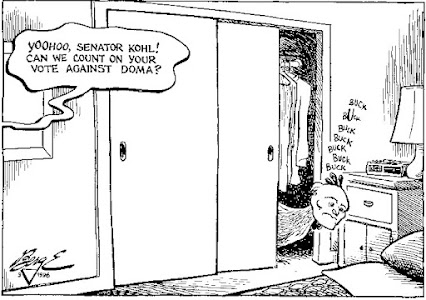
in InStep News, Sept. 18-Oct. 1, 1996

This cartoon about Wisconsin's Democratic senior Senator and the so-called Defense of Marriage Act wasn't the first one I had printed in InStep, but with it, my cartoons became a regular feature.  

InStep was one of two rival LGBTQ+ newspapers published in Milwaukee in those days. InStep and Wisconsin Light published on alternating weeks, the former in magazine format, the latter as a tabloid, both on newsprint. (InStep converted to tabloid format with the May 29, 1997 Pride issue.)
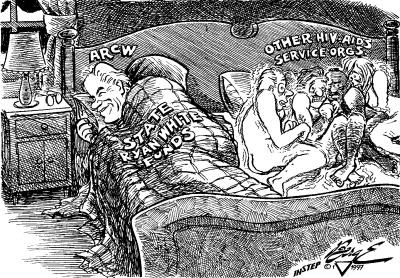
in InStep News, Jan. 22-Feb. 7, 1997

This cartoon got a fair amount of reaction; a representative of AIDS Resource Center of Wisconsin, ARCW (now Vivent Health), wrote a letter to InStep to correct what she called the cartoon's "serious misinterpretation." 

Distribution by the state of Wisconsin of federal Ryan White HIV/AIDS funds had been cut from nine independent agencies that year to five, a major portion going to the ARCW. I don't think I can claim credit for subsequent Wisconsin's re-examination of its allocation of Ryan White funds, which ARCW participated in and fully supported.

I've told this story before, but I got the idea for this cartoon from my first night sleeping over with the man who is now my better half. I was the one hogging the blankets by morning.

March 20-April 2, 1997

The face of Republicans' Wisconsin iteration of a "Defense of Marriage Act" was that of State Rep. Lorraine Serrati (R-Spread Eagle, yes, that's a real place), who sponsored AB 104 to prohibit Wisconsin from recognizing same-sex marriages performed in other states. Although the federal DOMA was passed by Congress and signed by President Clinton a year earlier, a court ruling in Hawai'i raised the possibility that same-sex marriage might become legal in the Aloha State.
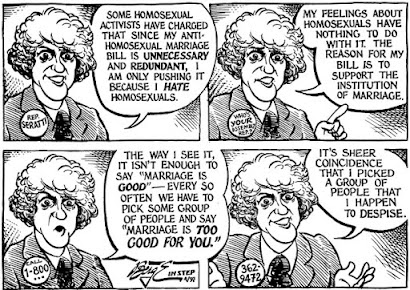
May 1-15, 1997

It didn't, but AB 104's opponents, led by Assembly Reps. Tammy Baldwin (D-Madison, now U.S. Senator) and Barbara Notestein (D-Milwaukee), charged that Ms. Serrati's bill was divisive and redundant, in that the Wisconsin Constitution already defined marriage as between a "husband" and a "wife," and futile in that the Democratic majority in the State Senate was unlikely to bring the issue to a vote.

Democrats also viewed it as a cynical attempt by Republicans to expand their narrow majority in the Assembly; Rep. Baldwin told In Step, "What my colleagues fear is the 30-second radio or TV ad in their next election campaign, which proclaims that they support ho-mo-sex-u-al marriage." 

in InStep, March 19-April 1, 1998
Serrati was hardly alone in pushing antigay legislation. State Senator Scott Fitzgerald (R-Juneau) and Rep. Stephen Nass (R-Whitewater, now a state Senator) were among thirteen legislators behind Assembly and Senate bills to deny health insurance coverage to domestic partners of state and local government employees. The bills came in response to the Madison school district offering domestic partnership ("DP") benefits.

Again, the Democratic majority in the state Senate weren't interested in passing that legislation along to Governor Thompson. On the other hand, two of the bills' co-sponsors, Fitzgerald and Glenn Grothman, are now U.S. Congresslugs.

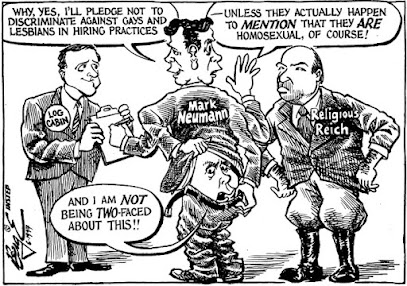
in InStep, June 12-26, 1997
After first pledging to the Wisconsin gay Republicans group that he would not discriminate against lesbians and gays in hiring his congressional staff, Congresswyrm Mark Neumann (R-WI1) completely backtracked when asked about it at a Christian Coalition meeting in La Crosse. "If someone walks in to me and says, 'I'm a gay person, I want a job in your office,' I would say that's inappropriate and they wouldn't be hired because that would mean they are promoting their agenda."

The other people in my cartoon are real Wisconsin persons. Scott Evertz, on the left, was head of the Log Cabin of Wisconsin; he would later be George W. Bush's Director of the White House Office of AIDS Policy for about a year. 

On the right, Rev. Ralph Ovadal of Wisconsin Christians United, was and is an extreme right-wing pastor; his church in Monroe is listed by the Southern Poverty Law Center as an anti-LGBTQ+ hate group. In addition to LGBTQ+ rights, he actively opposes nude beaches, women's reproductive rights, modern Bible translations, and the Roman Catholic Church.

in Q·Voice, September, 1997

In 1995, Jorge Cabal, life and business partner of InStep publisher William Attewell, launched Q·Voice, a feature magazine; this was months before they bought InStep from its founder, Ron Geiman. Q·Voice was published separately from InStep for a time, but within three years was folded back into it as an insert, then as an integrated section within the newspaper. 

I drew this caricature of  John Norquist for Q·Voice as a full-page illustration for an interview of then Mayor of Milwaukee. Time magazine had recently run its own glowing profile of Mr. Norquist, so I referenced that in the illustration.

✍

In the spring of 1998, David Bianco, then publisher of Q Syndicate, contacted me interested in syndicating my cartoons nationally, an opportunity I was happy to accept. It came with the stipulation that my LGBTQ+ cartoons would be exclusively for Q Syndicate (a provision that never caused conflict with my concurrent cartooning for the Business Journal of Greater Milwaukee).

Bianco promptly withheld my cartoons from InStep, charging that Attewell was behind in paying for Q Syndicate features.

From my standpoint, that could hardly have come at a worse time. Immensely popular Green Bay Packers star defensive end Reggie White had just gobsmacked Wisconsin politicians by attacking LGBTQ+ people in a rambling hour-long speech to a joint session of the legislatures.

As reported by William Attewell & Keith Clark:
"We have allowed sin to run rampant in our nation, and because we have, that is why our nation is in the condition that it is in," White told the legislators, saying that homosexuality was "one of the biggest sins."
White told the Wisconsin lawmakers that "homosexuality is a decision, not a race," and should not be protected under civil rights legislation the way race and ethnic minorities are.
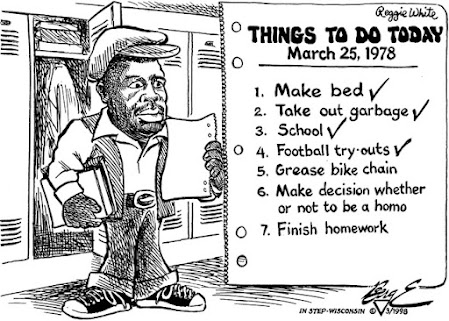
How could I possibly not draw about that? And not have my cartoon seen anywhere in Packer Land?
in InStep, April 16-30, 1998

The issue between InStep and Q Syndicate was resolved within a few weeks, and what came out of it all was that InStep was grandfathered as an exception to the syndicate's LGBTQ+ content exclusivity clause. "Things to Do Today" would be my last editorial cartoon drawn specifically for InStep, although I did draw them a couple Pridefest Issue cover illustrations after this.

The only other time I sent InStep a local-issue editorial cartoon before the paper folded in 2003 was in July of 1999. Actually, it only involved changing a bit of the dialogue in a cartoon drawn for Q Syndicate. The cartoon was about Milwaukee's Common Council approving a registry for same-sex couples; but where the rest of the country read "the religious right," my special version for InStep had the name of a local person.
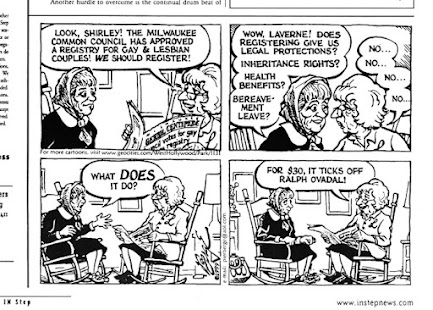
in InStep, July 29-August 11, 1999

(The other version of the cartoon is here.)

Thursday, August 19, 2021

Q Toon: In Memory of James Hormel

Today's cartoon is based upon one of the photographs in the late Ambassador James Hormel's memoir, Fit to Serve, and a quotation which sums up the main point of the book written with Erin Martin.

While much of the book focuses on what Hormel went through to become U.S. Ambassador to Luxembourg from 1999 to 2000, the lead-up to that point describes his process of coming out as gay — first to himself, then to his family, and finally as a public activist and philanthropist.

When Fit to Serve was published in 2011, marriage discrimination (DOMA) was still the law of the land, and the Employment Non-Discrimination Act couldn't get through the newly Republican Congress. The literal  LGBTQ-bashing that he also cites is still going on. Hormel concludes that progress only becomes possible when one is out and true to oneself.

"We have to be out. If not, we are complicit with the old order, the one that would have us remain invisible."


Saturday, February 20, 2016

Remembering Scalia

As promised when I posted this week's cartoon, Supremeback Saturday rummages through the dank and musty files of my early cartoons throughout the admagistracy of Supreme Court Justice Antonin Scalia. (Enbiggenification available when beclickened.)

It was 1986 and Ronald Reagan was in his second term. So far, he had named Sandra Day O'Connor to the Supreme Court, filling a 1980 campaign promise to name the first female Justice. The liberal wing of the Court consisted of Justices Harry Blackmun, Lewis Powell, Thurgood Marshall, and William Brennan (not pictured: John Paul Stevens); Reagan clearly itched for some of them to retire.
Next to Reagan in this February, 1986 cartoon are Attorney General Ed Meese, and Appeals Court Judges Robert Bork and Richard Posner (both Reagan appointees). Is that Scalia peering over Meese's suitcase? I don't remember whether I already knew who he was or what he looked like; but that's not how I drew Nixon, and it doesn't quite look like Pat Buchanan or Joe McCarthy, either.

Nevertheless, it was Antonin Scalia's name that came up a few months later when Reagan's next opportunity to shape the Court arose. Liberals were none too enthused by Scalia's nomination, but the higher profile appointment was that of William Rehnquist to succeed fellow Nixon appointee Warren Burger as Chief Justice of the Supreme Court. (Scalia was appointed to replace Rehnquist as Associate Justice.) Rehnquist was the most right-wing justice on the court at the time, having been the lone dissenter in Ake v. Oklahoma (1985), Bob Jones University v. U.S. (1983), Richmond Newspapers Inc. v. Virginia (1980) and Taylor v. Louisiana (1975). Rehnquist had also recused himself in the otherwise unanimous U.S. v. Nixon (1974).

Scalia and Rehnquist were easily confirmed anyway, and this cartoon from July, 1986 predicted that they would be joined by Donald Regan, William Clark, Bork, Meese, Clint Eastwood, and Nancy Reagan; and that claims of discrimination would become much harder to prove.

Reagan did in fact name Robert Bork to the court the next year, when Justice Powell retired; but you may remember that the Democratic Senate refused to confirm his nomination and Republicans turned his name into a verb. The Senate eventually confirmed Anthony Kennedy, in an election year, as your liberal Facebook friends have already reminded you several times. (The time between Bork's nomination and Kennedy joining the Court -- even with the aborted nomination of pot-smoker Douglas Ginsburg in the interim: 233 days.)

The first of my cartoons in which Scalia gets the starring role was in June, 2003, after Scalia's caustic dissent in Lawrence v. Texas. The case arose from the arrest of John Lawrence and Tyrone Gardner, whom Houston police found having consensual sex in Lawrence's home when they responded to an unfounded weapons complaint. The Court's decision, written by Justice Kennedy, was that Lawrence's and Gardner's right of due process was violated by Texas's laws outlawing homosexual activity between consenting adults.

Scalia scolded the majority for overturning Bowers v. Hardwick (1986) and predicted a parade of horribles: an end to state laws against obscenity, bigamy, same-sex marriage, adult incest, prostitution, masturbation, adultery, and bestiality.
"Today's opinion is the product of a Court, which is the product of a law-profession culture, that has largely signed on to the so-called homosexual agenda, by which I mean the agenda promoted by some homosexual activists directed at eliminating the moral opprobrium that has traditionally attached to homosexual conduct.... [T]he Court has taken sides in the culture war, departing from its role of assuring, as neutral observer, that the democratic rules of engagement are observed."

Two years later, this happened:
I'm sure that today, that kid is a well-respected junior partner somewhere.

There have been two Justices on the Supreme Court whom I have particularly enjoyed drawing, and it's amusing to learn that in spite of their diametrically opposed views on so many constitutional issues. and the lively exchanges in the opinions they have authored, they were actually very close friends who shared a love of opera and celebrated New Year's Eve together year after year.

When the Court struck down the "Defense of Marriage Act" (DOMA) in U.S. v. Windsor (2013), Scalia's dissent wailed that the Court had "formally declar[ed] anyone opposed to same-sex marriage an enemy of human decency."

And finally, last year, Scalia's prediction of the end of civilization was fully realized, as the Court voted 5-4 in favor of marriage equality in Obergefell v. Hodges. Each of the minority judges wrote his own dissent; Scalia called the decision "a threat to democracy." Contrast the "mummery" of the majority opinion with the sheer poetry of Scalia's uffish thoughts:
"Really? Who ever thought that intimacy and spirituality were freedoms? And if intimacy is, one would think Freedom of Intimacy is abridged rather than expanded by marriage. Ask the nearest hippie."

Saturday, July 11, 2015

Long Road to Victory, Part IV


Part IV: State by State

After voters in Hawai'i overruled their state supreme court on marriage equality, states all around the country began passing Defense / Definition of Marriage laws and constitutional amendments. Marriage rights activists believed that their best chance of stemming this tide was in the state of California. A ballot initiative written by State Senator Pete Knight to write marriage discrimination into the California constitution was on the ballot as Proposition 22 in 2000, actively supported by the Catholic and Mormon Churches, among others.

"No on Knight" tried to close the gap in the polls with print and television ads calling Prop 22 unnecessary: "You want the best for your children, but what if your child, or the child of someone you know, turns out to be gay? ... Gay marriage is already banned and it stays banned when you vote no. For your child, or someone else's, vote no on 22." This mealy-mouthed approach utterly failed, and Prop 22 passed by a whopping 61% to 39% margin.

Where marriage equality was finally able to stem the tide was in New England. I mentioned last Saturday that Vermont had led the nation with its recognition in July, 2000 of same-sex civil unions (nine years later, it would be the first state to recognize same-sex marriage by legislation rather than a court ruling). The first court ruling in favor of marriage equality came in the fall of 2003, in Massachusetts. In a 4-to-3 ruling, the Massachusetts Supreme Court gave the state legislature 180 days to legalize same-sex marriages.

The California Supreme Court found Proposition 22 unconstitutional in 2008, and the Connecticut Supreme Court found in favor of marriage equality that same year. Both decisions, like that in Massachusetts, were by one-vote majorities. Surprisingly, the first unanimous court decision came in April, 2009, not in some liberal coastal state, but in Iowa.
(Someone from central Iowa contacted me after this cartoon appeared, wondering how I knew of Sac City. As it happens, it was the only small town I found on the map with a name which clearly fit metrically in the Green Acres theme song. I've never been in Iowa west of the Mississippi River Highway.)

Conservatives in Iowa succeeded in ousting three of their Supreme Court justices in the next election, but the tide was turning in favor of marriage equality. I can't include my cartoons about each of the fifty states here, especially since the most recent progress has come, via U.S. Circuit Court rulings, several states at a time. But here are a couple favorites -- Hawai'i in 2009:

Minnesota in 2011:

And finally, from last year, featuring Wisconsin's then-Attorney General J.B. Van Hollen, whom I could have replaced with any of a few dozen elected Republicans from other states:

Wednesday, July 8, 2015

The Long Road to Overnight Victory: Part III

Part 3: The Republicans Don't

In today's Walkback Wednesday feature, we look at the Republican party's role in doing everything possible to thwart marriage equality, marriage equivalence, marriage parity, marriage approximation, and on and on and on.

Once the federal "Defense of Marriage Act" was passed in 1996, battles over marriage equality were mainly fought on the state and local level. Nationally, it was a big issue for the religious right, but as for congressmen and senators, it was just one more component of an antigay agenda along with keeping gays out of the military and the Boy Scouts, and making sure we couldn't adopt children. Oh, and there was impeaching President Clinton to keep Republicans busy.

There are a few antigay politicians in the above cartoon from January, 1998: Senator Jesse Helms (R-NC), Pat Buchanan, Congressman Bob Barr (R-GA), and House Majority Leader Dick Armey (R-TX) are closest to the foreground. Barr was the author of the DOMA, although he would repudiate it as presidential candidate of the Libertarian Party ten years after this cartoon was drawn.

With the election (by five lawyers) of a president who was a friend of the religious right, Republicans continued their pushback against marriage equality. When he came up for reelection, George W. Bush, with his Brain Karl Rove (and gay quisling Ken Mehlman) needed an issue to fire up his base, and Republicans were ready, willing and eager to run with it:

A more liberal Republican, namely California Governor Arnold Schwarzenegger, who didn't have to worry as much about appealing to Christian conservatives as Republicans who might aspire to the highest office in the land do, dared to warm to the idea of domestic partnerships. But that was about as far as it went.

Schwarzenegger, however, was pretty much an anomaly in the Republican party. He was never going to run for office outside of California, and Republicans were relieved just to have one of their own in charge of a solidly blue state, so he didn't have to toe the GOP's hard-core antigay line. The party's presidential hopefuls last time around, on the other hand, were not at all shy in that regard.

It didn't take much to remind LGBT voters that while it didn't make any difference which Republican ended up getting nominated for president, it makes a world of difference who sits in the Oval Office when the election is over.


Saturday, July 4, 2015

Long Road to Victory, Part II

Part II: The Democrats Evolve

Happy Independence Day! It's Smackback Saturday here at Bergetoons, and we're reviewing the history of the debate over same-sex marriage. (Part I was this past Wednesday.)

Republicans had no problem forcefully proclaiming that they were four-square against marriage equality from the start, but the issue posed more of a dilemma for Democrats. Gays and lesbians had been shoring up their status within the Democratic party for many years by the time the issue came to prominence; but same-sex marriage did not poll well in the 1990's.

Defense/Definition of Marriage Acts (DOMAs) swept into law across the country; many states passed these as amendments to their constitutions in order to prevent the legal challenges that nearly brought marriage equality to Hawai'i. Fearful for their electoral careers, Democrats went along with this antigay tidal wave. As far as Republicans were concerned, it didn't hurt that these ballot measures brought their right-wing Christian soldiers to the polls in droves.

Having used the issue to electoral benefit in 2002, 2004, and off-year elections, Republicans kept pushing a federal constitutional amendment to limit marriages to one man and one woman This from 2002...

And this from 2004...

In an attempt at compromise, some pro-gay Democrats offered lesbians and gays legal arrangements that were sort of like marriage, but not quite. The state of Vermont was first to pass a Civil Union registry, which made its governor, Howard Dean, a darling to some LGBT Democrats.

"Civil Unions" and "Domestic Partnerships" allowed Democrats to offer some support to gay and lesbian couples while still holding out some hope of not being tarred and feathered in the next election as "destroying the Family." As we'll see in another installment of this series, the religious right and their political allies really had no interest in yielding a millimeter.

Lest we forget, during both of his campaigns for president, Barack Obama was reluctant to voice any support for marriage equality, in spite of a sterling record on other LGBT issues (and in spite of having indicated his "unequivocal" support in a candidate questionnaire for a Chicago LGBT newspaper back when he ran for the Illinois State Senate in 1996). I drew this cartoon in 2011, when he visited the Human Rights Campaign to tout his administration's record.

That changed -- but that's a topic for another day.

Wednesday, July 1, 2015

The Long Road to Overnight Victory, Part I

My cartoon for this week is included in an LGBT cartoonist round-up over at Fusion -- you can check it and seven others out now, or wait for me to post it tomorrow.

Looking at the other cartoonists' submissions, I wish that I had found something more personal to say. I can blame a combination of a hectic schedule and some unpleasant prepping for a medical procedure (it turns out I'm healthy); but the fact is, I've been drawing about marriage equality for so long, I don't know how much more I could possibly find to say about it.

I've drawn so many cartoons about it, in fact, that I wasn't able to winnow them down to fit in a single blog entry.

I wasn't drawing cartoons in 1972 when Baker v. Nelson came before the Minnesota Supreme Court; but in 1996, I was drawing cartoons for InStep, one of  two LGBT newspapers in Milwaukee, when a circuit court judge in Hawai'i ruled that state's ban on same-sex marriage was unconstitutional.

Judge Kevin S.C. Chang's ruling in Baehr. v. Miike would be overturned by Hawai'i voters, but not before giving LGBT marriage advocates hope, and antigay activists a fund-raising and vote-getting bonanza. Legislators in Hawai'i and just about every other state, as well as the U.S. Congress, rushed to define "marriage" as a special rite that could only be entered into by one man and one woman.

Very well, replied some LGBT activists and liberal allies. If we can't get "married," how about if we call it something else?

Fine. We're in a "committed relationship." We've even had a "commitment ceremony." But what do I call you? My "committee"?

Another term to come down the pike was "domestic partnership"; one could at least refer to the other as "partner." Like dancers, law firms, and bridge players have.

As if there weren't already enough euphemisms for "marriage lite," I had to offer one of my own:

We'll continue this retrospective on marriage equality on Stepback Saturday, starting with "Evolution of the Democrats."

Wednesday, July 24, 2013

Q Toon: Card Game


We'll get back to the royal baby in a moment, after this message from Geeks Out. Geeks Out wants everyone to boycott Ender's Game by Orson Scott Card on the grounds that he's antigay.

Unless you're deep into science fiction, you've probably never heard of the Ender's Game series or Orson Scott Card, but the 1985 book has been made into a movie set for release this November. Here's the plot: a remnant of humanity has been fighting an insectoid race of "buggers" (wait, wait, that's not what Geeks Out is upset about yet); the hero is one of the youth who have been trained during an uneasy truce to fight the next stage of the war. Fiery explosions, decapitations, impalings, and spattered ichor and guts festoon the screen.

Of more relevance to the current controversy is that Card is a board member of the National Organization for Marriage. The anger with Card stems from a article he wrote back in February, 1990, before most of Geeks Out were born:
“Laws against homosexual behavior should remain on the books, not to be indiscriminately enforced against anyone who happens to be caught violating them, but to be used when necessary to send a clear message that those who flagrantly violate society's regulation of sexual behavior cannot be permitted to remain as acceptable, equal citizens within that society.”
— Orson Scott Card, “The Hypocrites of Homosexuality,” Sunstone Magazine
Sunstone Magazine, by the way, is a Mormon educational publication, so we do have a religious aspect to this story. And if you think that there's something incongruous about portraying the religious right gambling at cards, I would lay you odds that even One Million M*ms will be willing to overlook all the gratuitous violence in Mr. Card's film in order to burnish their antigay bona fides.

Card currently claims that his 1990 article is rendered moot by last month's Supreme Court decision striking down the Defense of Marriage Act, so everybody should cut him some slack. His own 2008 article for the Mormon Times argues otherwise:
"Regardless of law, marriage has only one definition, and any government that attempts to change it is my mortal enemy. I will act to destroy that government and bring it down …"

Wednesday, March 27, 2013

Gun-Due Burden

You were probably expecting to see a cartoon about the marriage equality cases before the Supreme Court today, but after seeing some local newsmakers echoing the NRA party line that requiring instant background checks for gun sales imposes an "undue burden on the little guy," I was compelled to draw this cartoon this week:

I find that a hard argument to swallow, considering the undue burdens Republican state legislators across the country are imposing upon the little guy who tries to exercise his or her constitutional right to vote, and the undue burdens they are imposing upon the little women who seek reproductive health services.

As an editorial in the Tucson Sun Sentinel put it:
"The NRA argues that requiring licensed gun dealers to maintain an inventory would be unduly burdensome on law-abiding dealers. But maintaining accurate inventory records is a routine business practice in nearly every other retail industry and any burden on lawful dealers—who are likely already keeping these records as part of a good business practice—is outweighed by the benefit to public safety of quickly identifying missing guns and reporting them to law enforcement. An inventory requirement would also serve as a deterrent to gun dealers tempted to break the law by selling guns to criminals, as well as an incentive to law-abiding firearms dealers to ensure that they are in full control of their dangerous inventory."
A statement from Mayors Against Illegal Guns co-chair, Boston Mayor Thomas Menino added:
"The NRA’s argument that background checks are ‘inconvenient’ for gun sellers and buyers is ridiculous, especially since almost every American lives within ten miles of a licensed gun dealer."
And speaking of undue burdens: this is the time of year to point out that in those states where gay and lesbian couples can legally marry, DOMA requires any couple who wants to take advantage of the right to jointly file their taxes to calculate their taxes once as joint filers for their state return, then recalculate their entire tax forms a second time as complete strangers for their federal return.

Friday, March 22, 2013

Hillary Clinton and the Old Ball and Chain

This week, Hillary Clinton came out in favor of marriage equality. As President, her husband had signed the "Defense of Marriage Act" which made marriage inequality a matter of federal law.

It's not the first time that Hillary has needed to distance herself from antigay legislation enacted during the Bill Clinton administration.
"Don't Ask, Don't Tell, Don't Pursue" was billed as a means of allowing gay and lesbian service members to continue their military service, but it did not have that effect. As Bill learned only too well, keeping one's sexual activity a secret ain't as easily done as said.

(Cartoon drawn in December, 1999, but copyrighted in 2000 according to Q Syndicate dating conventions.)

Wednesday, March 20, 2013

Q Toon: GOPFLAG


Last weekend, Ohio Senator Rob Portman (R-OH) publicly reversed his position on the "Defense of Marriage Act" (DOMA), a bill he co-sponsored when he was a House member in the 1990's. His reasons, as he explained in an op-ed in the Columbus Dispatch, were close and personal:
“As a congressman, and more recently as a senator, I opposed marriage for same-sex couples. Then something happened that led me to think through my position in a much deeper way.
"Two years ago, my son Will, then a college freshman, told my wife, Jane, and me that he is gay. He said he’d known for some time, and that his sexual orientation wasn’t something he chose; it was simply a part of who he is. Jane and I were proud of him for his honesty and courage. We were surprised to learn he is gay but knew he was still the same person he’d always been. The only difference was that now we had a more complete picture of the son we love.”
Over the course of two years, the Senator figured out how to resolve his love and hopes for his son with his Christian faith. After all, these things take on a different light when we're talking about one's own children.

Portman also revealed that when the Mitt Romney campaign had been considering him as a possible running mate last year, he had told them about Will. We are told that Will's sexual orientation had nothing with Romney's decision not to pass over Portman Pater, a senator from a crucial swing state with 18 electoral votes, in favor of Paul Ryan, a congressman from a swing state with only 10.

But you have to know that there was someone in the Romney campaign afraid that somewhere between the convention and November, news that Portman's son was gay would break and eclipse whatever message the Republicans were hoping to talk about that week. Worse still, it could be the big media/SNL obsession arising from the Vice Presidential debate.

No, just kidding. The big obsession was going to be Biden's smirking, laughing and finger-wagging, no matter what.

Thursday, November 22, 2012

Happy Thanksgiving!

Just for the holiday, here's an old Thanksgiving-themed cartoon from 2003:

Have a blessed and happy Thanksgiving!

Wednesday, November 14, 2012

Q Toon: A Totally Gay Election


2012 will go down in history as the first year that voters approved marriage equality.

Different-sex marriage remains the law in Minnesota; but voters in Washington and Maryland approved prior action of their legislatures in favor of marriage equality, and voters in Maine overturned a previous referendum restricting marriage to straight couples. (And voters in Iowa rebuffed an effort to unseat a fourth justice of their Supreme Court who had ruled in favor of marriage equality in 2009.)

The six congressional candidates alluded to in this cartoon are incumbents Jared Polis (D-CO), David Cicilline (D-RI), and newly elected candidates Mark Pocan (D-WI), Sean Patrick Maloney (D-NY), Mark Takano (D-WA), and Kyrsten Sinema (D-AZ). The lone gay candidate to lose last Tuesday was Republican Richard Tisei, who narrowly lost to incumbent John Tierney (D-MA).

I went somewhat out on a limb by including Sinema in that list when I drew the cartoon on Sunday night. That race wasn't called in her favor until Tuesday. She will be the first openly bisexual member of Congress, and possibly its second out atheist.

And I'm particularly proud that my home state elected Tammy Baldwin to the U.S. Senate. I'll admit that I occasionally had some doubts that Wisconsin would elect as Senator one of the most liberal members of the House (and I was not alone here) after making such a sharp turn to the right in 2010 and 2011. But, the unrelieved nastiness from all advertising comers in the fall notwithstanding, she did a great job of introducing herself to the voters while Tommy Thompson and his Republican rivals were busy attacking each other in the spring and summer.

÷ ÷ ÷
Regarding Saturday's blog entry about in the Strand Magazine, I've been trying to find the next article in Arthur Lord's series on American editorial cartoonists in 1902, so far without success. In fact, I have been unable to find Mr. Lord's article in Google's on-line digitization of the October, 1902 edition of Strand Magazine in which it is supposed to have appeared.

What Mr. Gus Frederick says on his Homer Davenport site is: "Through Ebay, I recently obtained a selection of nine original pages from the October, 1902 number of The Strand Magazine from London. This was an article entitled The American Cartoonist and His Work by Arthur Lord and featured short bios and examples of four 'famous' cartoonists of the day."

Mr. Frederick posted an Optical Character Recognition rendition of the text and illustrations rather than images of those nine pages, so we can't confirm that they have "The Strand Magazine" in the top margin of alternate pages, as the magazine would have had. I have so far found no reference to anyone in the U.S. or Canada having started up a "Strand Magazine" stateside, or that there was a separate North American edition of the London publication. (Perhaps in London, Ontario?)

One reason I suspect that the publication is American is the lack of any British condescension toward the New World cartoonists or the U.S. press. When Ohio Senator Mark Hanna is first mentioned in the article, it is by his last name alone, indicating that the author expected all of his readers to know who "Hanna" was. It's a reasonable assumption that American readers would recognize "Hanna" as the Karl Rove of William McKinley's presidency, but would British readers?

Mr. Frederick notes the British spellings -- "draughtsman," rather than "draftsman"; "abhour" instead of "abhor" -- and florid language of the article, but that doesn't guarantee that the pages were published in London. "American" spelling was not universally accepted in in this country in 1902. American spelling dates back at least as far as Noah Webster's 1828 Dictionary, but there were resistance and ridicule when Teddy Roosevelt proposed making "simplified spelling" official in 1906.

My first thought was that the pages might be from another publication. I thought of Public Opinion, which was fond of printing editorial cartoons; but it was published weekly, not monthly, and doesn't appear to have attached bylines to its feature articles. It seems unlikely that Puck would have profiled a cartoonist from the competing Harper's Weekly while ignoring its own remarkable cartoonists. Harper's Weekly, of course, was published weekly; and, like any other magazine of its day, put its own name on the top of every page.

I'll keep looking.

Wednesday, October 24, 2012

Q Toon: Marriage Equality on Balance


With election day 13 days away, it's time for this cartoonist to stop frittering his time away on cartoons about National Coming Out Day, evangelicals slumming in the gayborhood, and TV sitcoms.

The 2nd U.S. Court of Appeals ruled last week that the federal "Defense of Marriage Act" (DOMA) is unconstitutional.
[Judge Dennis Jacobs] said the law was written so broadly that it touches more than a thousand federal laws. "Homosexuals are not in a position to adequately protect themselves from the discriminatory wishes of the majoritarian public," Jacobs wrote.
He rejected arguments by supporters of the law that it was intended to limit new categories of eligibility for federal funds, promote uniform administration of federal law, protect traditional marriage and encourage responsible procreation.
"Even if preserving tradition were in itself an important goal, DOMA is not a means to achieve it," he said.
That DOMA was headed for the Supreme Court was a virtual certainty, so the question is how the ruling will affect ballot initiatives in Minnesota, Maryland, Maine and Washington state on November 6. The legislatures of Maine, Maryland and Washington have voted for, and their governors have signed into law, marriage equality. Opposite-sex marriage exclusivity, on the other hand, is the law in Minnesota, where the Catholic Church is dropping everything else to enshrine it in the state constitution.

The Washington, opponents of marriage equality succeeded in putting Measure 74 on the ballot, possibly confusing voters because passage would actually affirm what the legislature and governor have already done.


In Maine, this marks the first time that gay-rights supporters -- rather than opponents -- have chosen to put same-sex marriage before voters. A gay-marriage law passed by the legislature in 2009 was overturned in a referendum that fall. Marriage equality supporters in the state decided to put a measure in support of marriage equality on the ballot this year, when the presidential election would draw out more voters.

The polls have the Minnesota amendment on the razor's edge, while there is reason to be cautiously optimistic about one of the other three states becoming the first in the nation to support marriage equality by popular referendum.


In Maryland, as in Maine and Washington, the most recent polls show a lead for the supporters of same-sex marriage. But comparable leads in other states -- notably in California in 2008 -- evaporated by Election Day, and Josh Levin, manager of the Marylanders for Marriage Equality campaign, expects the final result to be extremely close.
With races this close, anything, from a judge's ruling exciting one side, to the Obama and Romney campaigns' decision to focus their efforts elsewhere, could have an effect on the outcome.

Wednesday, November 2, 2011

Q Toon: The Theoconoclasts


Now that gay and lesbian military personnel no longer have to lie about themselves, and since some of them are able to marry, a group of service members and veterans has filed a lawsuit that the federal Defense of Marriage Act (DOMA) is discriminatory. DOMA, passed by the Republican Congress in July, 1996 and signed into law by President Bill Clinton, forbids any aspect of the federal government from recognizing the marriage of any same-sex couple in any way.

From the Washington Post:
Massachusetts Army National Guard Maj. Shannon McLaughlin, 41, and her wife, Casey, 34, are serving as lead plaintiffs in the suit, which includes five other troops and two career Army and Navy veterans. The McLaughlins, from Foxboro, Mass., married in December 2009 and have 10-month old twins. Massachusetts legalized same-sex marriage in 2004.
Although Shannon pays for the twins’ health care through her military benefits, Casey, a former high school history teacher who gave birth to the twins, pays about $700 a month for a separate health-care account, the couple said. ...If Shannon is deployed, Casey would be barred from taking the twins to regular medical appointments at a nearby military base, the couple said.
“What Shannon and Casey are seeking is the same treatment that their straight counterparts, who are legally married, receive every day without question and take for granted,” said Aubrey Sarvis, executive director of the Servicemembers Legal Defense Network, which helped organize the suit and once represented troops discharged for violating “don’t ask, don’t tell.”
Likewise, same-sex widows and widowers of servicemembers are ineligible for survivors' benefits, unlike different-sex widows and widowers. Happily, there is nobody yet with standing to bring suit in that respect, but someone will inevitably be in that position someday.

It will be interesting to see how this legal issue plays out in court -- if the Republican-dominated state legislatures produced by the 2010 elections don't fast track a constitutional amendment first.

Thursday, March 3, 2011

Q Toon: Complainer Boehner


My goodness that was a lot of lettering.

Almost overlooked among the coverage of turmoil in the Middle East and Midwest was last week's decision by the Justice Department to stop defending DOMA (the 1996 "Defense of Marriage Act") in court. House Majority Leader John Boehner complained that the Obama administration was stirring up a controversial issue instead of focusing on job creation and balancing the budget.

Now that their workload has been freed from the needless distraction of filing briefs supporting marriage discrimination, I look forward to seeing how the Justice Department returns to their mission of job creation and budget balancing.