Showing posts sorted by relevance for query Herrin. Sort by date Show all posts

Saturday, April 27, 2024

My Country, White or Wrong

Today's Graphical History Tour returns again to the Roaring 20's just in time to check in with the war between the Ku Klux Klan and bootleggers in Williamson County, Illinois.

"Active Again" by Roy James in St. Louis Star, April 17, 1924

The mining community of Herrin had been the scene a few years earlier of a violent strike, and more recently of raids against taverns, speakeasies, and private homes. The raids were led by S. Glenn Young, a former guard at the Herrin mine who had gone on to work for — and get fired from — the U.S. Treasury Department's Prohibition Unit. Young enjoyed the enthusiastic support of the local Ku Klux Klan in his mission to wipe out every trace of alcoholic beverages in the county.

There were union miners on both sides of the "booze war" that ensued, and local law enforcement, which had quietly ignored violations of the Volstead Act, was caught in the middle. Klan sympathizers accused the the area's Italian immigrants of wantonly disregarding Prohibition, so the divide fell primarily between the county's Catholic and Protestant citizens.

Violence between the two sides resulted in at least two deaths, a hospital placed under siege by armed klansmen, and Young placing Herrin Mayor C.A. "Mage" Anderson, Williamson County Sheriff George Galligan, and 38 others under arrest for the murder of a pro-Klan police constable. Sheriff Galligan declared, "I'm through being the goat." He told the media that he had discharged all his deputies, replacing them with klansmen. "I turned the reins over and concentrated on my coming trial. As far as I am concerned, they can dig trenches and fight it out."

Local elections in Herrin on April 15 were marred by fist fights and gunfire, allegedly sparked by a Klan poll watcher challenging several Catholic voters, including a nun who had lived in Herrin for two decades. Klan candidates swept the election, and over the next several days, three klansmen and three anti-Klan combatants were killed.

Young and Herrin Police Chief John Ford placed under arrest Judge E.M. Bowen, who had called a grand jury before the election to indict over 20 klansmen for their booze war activities. Bowen was charged with election fraud.

"State Konvention Kostume" by Daniel Fitzpatrick in St. Louis Post-Dispatch, April 18, 1924

The issue of denouncing the Klan was brought before both major party state conventions in Missouri that April. An anti-Klan plank was rejected by Missouri Democrats, who also failed to take any position on other controversial issues of the day such as Prohibition and the League of Nations. Nor could they agree on endorsing any of the Democratic presidential candidates, falling back instead on long-winded, generally vague criticism of Republicans.

"The first demonstration of the character of leadership of Missouri Democracy," opined the St. Louis Post-Dispatch, "does not presage a winning battle nor results that are worth while if the battle should be won by default."

"Mouse" by Roy James in St. Louis Star, April 29, 1924

Meeting later that month, Missouri Republicans also presented themselves with a proposed anti-Klan plank. It passed, but without any mention within it of the Klan by name.

Considering that there were a number of splinter groups rivaling the Klan primarily on the basis of leadership squabbles and what sorts of violence they condoned, not adding credence to any of them might have been the most prudent tactic.

"Left at the Dock" by Dorman H. Smith for Newspaper Enterprise Assn., ca. April 26, 1924

Race played a significant role in congressional passage of Johnson-Reed Immigration Act of 1924. Placing draconian new limits on immigration into the U.S., especially from Italy and Eastern and Central Europe, it included the Asian Exclusion Act, which barred all immigrants from Asia.

Japan's Ambassador to the U.S., Masano Hanihara, conveyed to President Coolidge his government's strong objection to the bill, predicting "grave consequences" to relations between our two countries.

"Exclusion Laws and Japanese Pride" by John T. McCutcheon in Chicago Tribune, April 15, 1924


"And So the Board Is Nailed On" by J.P. Alley in Memphis Commercial Appeal, April 17, 1924

Ambassador Haniharo's letter backfired badly. Senators who had expressed skepticism about the bill took umbrage at what they viewed as foreign interference with U.S. domestic affairs. The bill passed with a veto-proof majority.

"No Discrimination Whatever" by Douglas Rodger in San Francisco Bulletin, April 18, 1924

There wasn't much sympathy for Japan's position among editorial cartoonists of the day. Orville Rodger, himself an immigrant from Scotland, appears to have dismissed Japanese complaints against the Asian Exclusion Act by pointing out that it excluded Chinese, the "Hindoo," and other Asians as well. (Chinese immigration and naturalization were already forbidden by the Chinese Exclusion Act of 1887.)

The Supreme Court had ruled in 1923 that Asians were not eligible for naturalization in United States v. Bhagat Singh Thind. Congress used the language of the Court's ruling, quoted in Rodger's cartoon, to achieve racist aims without actually referencing race or nationality in its bill.

"The Face at the Window" by Orville Williams for Star Company, ca. April 24, 1924

Orville Williams communicated the Hearst chain race-baiting against the "Yellow Peril" in this and other cartoons. In this instance, Hearst was uncharacteristically in league with the isolationist Chicago Tribune, too.

"Our Neighbor's Dog" by John T. McCutcheon in Chicago Tribune, April 16, 1924

Why, no, Mr. McCutcheon. I cannot imagine why Ambassador Haniharo's pride would have been hurt.

"Keep the Flag Waving, Charley" by Robert Minor, in The Liberator, Chicago, May, 1924

Taking a different tack to the Japan-as-dog motif, Robert Minor's cartoon seems to depict "Jap Immigration" to a loud, yapping pup on a leash held by Secretary of State Charles Evans Hughes. Hughes in fact opposed the Japanese Exclusion Act, but the political reality was that President Coolidge could not veto the bill without risking having his veto overridden. With the presidential election well underway and his nomination assured, Coolidge's main advantages were incumbency and, in contrast to the Democrats, party unity.

(Editor and cartoonist for the socialist The Liberator Robert Minor packs an awful lot of extraneous stuff into this cartoon. He includes Mexico — location of the Standard, Pan-American Petroleum, and Sinclair oilfields  — within Secretary Hughes's Japanese Exclusion Line. Oilmen connected to the Teapot Dome scandal encourage Hughes to keep waving his flag while they shelter in a teapot replacing the Capitol dome. James Pierpoint Morgan demands that Europe repay his wartime loans.

(Swimming off the coast of Florida, Washington Post publisher Ned McLean, a friend of disgraced former Secretary of the Interior Albert Fall, calls out "Yoo hoo! I haven't testified yet!" McLean had used his newspaper to defend Fall and counter other media's reporting of the Teapot Dome scandal.)

"An Ever Increasing Problem" by Sam Armstrong in Tacoma News Leader, April 21, 1924

Sam Armstrong lumped Japanese Exclusion in with another host of issues related only in the sense that our integrity of national borders lacked a force field keeping out undesirables. "The Excluded Jap" is encouraged by Mr. "Chinese Coolie Smuggler" to join the convoy of Mexican Peons, European Immigrants, The Dope Smuggler, Booze Smuggling, and Rum. His news note ominously predicts that smuggled Japanese would for some reason bring dope with them.

"He'd Better Look After that Back Fence" by Harold Talburt for Newspaper Enterprise Assn., ca. April 21, 1924

You didn't think Mexican immigrants were going to be overlooked, did you?

"We All Have Our Problems" by William C. Morris for George Matthew Adams Service, ca. April 24, 1924

At least Canada was happy to help stop the influx into the United States of Canadians, apparently.

I skimmed weeks' worth of Montreal Gazette front pages in search of help explaining William Morris's cartoon. The U.S. Asian Exclusion Act was front page news almost every day. Canadian worries about emigration to their south? Not so much.

"America, I Love Your" by Harold Wahl in Sacramento Bee, April 29, 1924

The Gentlemen's Agreement cited by Harold Wahl dated from 1907 and the Theodore Roosevelt administration. In it, Japan voluntarily agreed to limit the number of workers allowed to emigrate to the U.S. Since the Asian Exclusion Act rendered the Gentlemen's Agreement moot, the idea that renewing it would mollify Japan is ridiculous on its face.

"America of the Melting Pot Comes to an End," crowed the banner headline of an April 27, 1924 New York Times column by Immigration Act sponsor Senator David Reed (R-PA). Thanks to passage of his bill, Reed confidently predicted that “The racial composition of America at the present time thus is made permanent.”

Saturday, February 24, 2024

Checking Under the Hood

This week's Graphical History Tour circles back to February, 1924 to catch up on the big news stories of the day:

"Another Victory for the Miners" by Fred Ellis in Daily Worker, Chicago, Illinois, Feb. 15, 1924

First, let's check back in at the violence-prone mining town of Herrin, Illinois, where one Glenn Young and A.J. Armitage had led a series of raids against businesses and private homes where booze was served in violation of the Volstead Act. Young and Armitage were backed by a mob, many of whom admitted membership in the Ku Klux Klan. An anti-Klan group calling itself the Knights of the Flaming Circle rose up to battle Young and his Klan Kohorts; others fighting the Klan were the "Shelton gang" of bootlegging outlaws.

When we last left Herrin in Williamson County, Sheriff George Galligan had called in the National Guard in an attempt to restore order. He sent them home when he thought tempers had cooled, but tempers flared back up immediately. On February 8, pro-klan police officers burst into an anti-klan meeting, and in the violence that ensued, one klansman was killed and another injured. 

"The Unanswered Challenge" by Carey Orr in Chicago Tribune, Feb. 11, 1924

Sheriff Galligan took two police officers into protective custody in another county and called for the National Guard to return. 

After a police constable named Caesar Cagle was shot on a Herrin street and died at a hospital where a wounded anti-klan member was also being treated, klansmen from miles around converged on Herrin, laying siege to the hospital. Firing shots into the hospital, they set up roadblocks around the town, took over City Hall.

Young declared himself Chief of Police and had Herrin Mayor C.A. "Mage" Anderson, Sheriff Galligan, and 38 others arrested for complicity in Cagle's murder. The town council named Carl Nall to replace Anderson at request of the military. A coroner's jury the next day found that Cagle had been killed by members of the Shelton gang.

Young would be charged with "injury to property" and forced to quit his usurped office and leave town. Charges were also brought against klansmen, including some prominent Herrin and Marion businessmen, for firing upon the hospital.

Cartoonist Ellis's declaration of victory would not stand for long. Klan candidates would sweep Williamson County elections in April.

"The Newest State Capitol Decoration" by Roy James in St. Louis Star, Feb. 15, 1924

Meanwhile, in Missouri, the Klan held a rally inside the state capitol. The official who granted the permit for use of the capitol building claimed that he had no idea that the persons who made the request, an engineer with the State Highway Commission and a labor commissioner, were acting on behalf of the Klan. "However," Commissioner of the Permanent Seat of Government Harry Woodruff told the press, "it would have made no difference if I had known the meeting was a gathering of the Klan, for I would not have denied them use of the hall."

Woodruff's protestations of innocence were disputed by Heber Nations, the labor commissioner. According to Heber, Rev. Z.A. Harris, a national representative of the Klan, had heard that "a lecturer for a secret religious organization, speaking in the House chamber two weeks before, had made slurring remarks about the Klan and its principles. I mentioned the request to Mr. Woodruff, who wanted the hall and what for, and he gladly granted it."

According to press reports, a crowd estimated in the hundreds listened to Harris preach on "Americanism and the Ku Klux Klan," calling for limiting immigration "in order to prevent an influx of ideas of the ideas of internationalism."

"Knights of the Double-Crossed" by J.P. Alley in Memphis Commercial Appeal, Feb. 28, 1924

If you've been following these Graphical History Tours, you may recall that the Klan was split between factions led by self-styled "Colonel" William J. Simmons, founder of its 1920 iteration, and the more radical Hirman Wesley Evans, whose supporters dumped Simmons from their leadership. Simmons then founded a rival group, the Knights of Kamelia.

The latest offshoot was the Knights of the Mystic Clan, launched in Atlanta but establishing its headquarters in Kansas City, Missouri. The KMC forswore masks and secrecy, and declared that it "the order is not connected in any manner with the Ku Klux Klan, Hiram Wesley Evans, or William Joseph Simmons."

Like that of the Klan, KMC membership was limited to qualified men who are "white and of the Protestant Christian faith." John R. Jones of Kansas City was elected temporary chair of the splinter group, and chapters were set up in Atlanta; Kansas City; Milwaukee, Wisconsin; Tulsa, Oklahoma; El Dorado, Kansas; Durham, North Carolina; and Russell, Kentucky.

I'm finding that by April, KMC headquarters had moved to Muskogee, Oklahoma under the leadership of one H. Tom Kight. In February, 1925, someone claiming to represent the KMC left a letter on the doorstep of the Tallequa, Oklahoma Arrow Democrat — anonymously. "To protect our order and to make our enterprise possible, we maintain the utmost secrecy in our operations."

Their secrecy was pretty darned utmost; I have yet to find any mention of the Knights of the Mystic Clan after that.

Turning now to other major news:

"Every Day Is Washday for Some" by Dorman Smith for Newspaper Enterprise Assn., ca. Feb. 29, 1924

Teapot Dome was not the only scandal coming out of Washington in February, 1924, but it was by far the most prominent. Every day seemed to bring new revelations, including against at least one of the senators making hay of the scandals. Interior Secretary Albert Fall at the center of the Teapot Dome scandal was already out of office; the scandal also ensnared Secretary of the Navy Edwin Denby and Attorney General Harry Daugherty.

"His Nice New Cowboy Hat" by Burt Thomas in Detroit News ca. Feb. 14, 1924

Republican-leaning cartoonists played up the involvement of Pan-American Petroleum and Transport Company founder Edward Doheny in a separate oil leasing deal with Interior Secretary Fall at Elk Hills, California. Doheny was a benefactor of Democratic presidential candidate James McAdoo (McAdieu in Thomas's cartoon), which was enough to fuel a lot of Whataboutism.

"Can't Stem the Flood" by Orville P. Williams in New York Evening Graphic, ca. Feb. 27, 1924

Roosevelt in this cartoon is not FDR, but Assistant Secretary of the Navy Theodore Roosevelt Jr. (the son of the late president, obviously). Smoot would have to be Chair of the Senate Finance Committee, Reed Smoot (R-UT), better known for the protectionist Smoot-Hawley Tarriff Act of 1930 that worsened the Great Depression.

"Thank Goodness, They're Not All Like That" by J.N. "Ding" Darling in Des Moines Tribune, Feb. 23, 1924

Finally, amid a flurry of cartoons on the theme of They’re All Crooked (They’re Politicians, Aren’t They?), “Ding” Darling’s stands alone for offering readers a list of government officials he thought they could still look up to.

Darling was an admirer of Herbert Hoover and Agriculture Secretary Henry C. Wallace; he approved of the statecraft of Secretary of State Charles Evans Hughes, who did not share the isolationism of many other Republicans. President Coolidge allowed the investigation into the Teapot Dome scandal to proceed without interference, effectively inoculating himself from any taint of corruption.

Saturday, February 1, 2025

To Herrin Back

"Cleaning Up Williamson County" by Roy James in St. Louis Daily Star, Jan. 27, 1925

Our Graphical History Tour today returns to the bloody troubles of Williamson County in southern Illinois, the scene of years of clashes involving union miners, management goon squads, illegal drinking establishments, Prohibition agents, and the Ku Klux Klan. (Catch up with the Klan vs. Bootleggers war here.) One of the central characters of the story met his end on January 24, 1925.

"His Town" by Rollin Kirby in New York World, ca. Jan. 29, 1925

S. Glenn Young came to Williamson County on a mission to root out bootleggers, ostensibly as an agent of the federal government. A kleagle in the Klan, Young had no aversion to violence and acknowledged no limits to his authority: placing the mayor and sheriff of Herrin under arrest over the murder of a pro-Klan deputy, and also arresting the judge who tried to impanel a grand jury to investigate Klan violence.

"Their Standing as a Community" by Edward Gale in Los Angeles Times, Feb. 3, 1925

On January 24, S. Glenn Young and fellow klansman Homer Warner clashed with Deputy Sheriff Ora Thomas and his lieutenant, Ed Forbes, both known gamblers and bootleggers. There was a total eclipse of the sun visible in much of the midwestern and northeastern United States that same day, referenced in the Rollin Kirby cartoon above.

"The Arm of the Law" by J.P. Alley in Memphis Commercial Appeal, Jan. 27, 1925

Deputy Thomas had returned to town after facing corruption charges in state court, and was with Forbes at a barber shop that served as an anti-Klan headquarters. Hearing of Thomas's return, Young gathered some fellow Klansmen and headed for the barber shop. The opposing groups faced off in the street outside the shop, and somebody fatally shot Forbes — accounts differ — and all hell broke loose.

"Bootleg" by Grover Page in Louisville Courier-Journal, Feb. 2, 1925

Guns blazing, Young and his men pursued Thomas as he retreated into the barber shop. Thomas returned fire from behind a counter, killing Young with a shot through the heart. Warner was also killed, and Thomas, wounded, was executed by one of the Klansmen at point-blank range. 

"Red All Over" by Carey Orr in Chicago Tribune, Feb. 4, 1925

Sadly, even without Young on the scene, the killing continued. A "mysterious stranger" entered the Ly-Mar Hotel in Marion in the wee hours of Sunday, February 1, claiming to have an arrest warrant for a Klansman named Glenn Foster. The man forced the desk clerk at gun point to phone Foster, then proceeded to threaten a number of other hotel employees.

He was fatally shot by police officer Rufus Whitson, who arrived on the chaotic scene. The dead man was found wearing a hat belonging to Sheriff George Galligan, who later offered no explanation for how the man came into its possession.

"Human Values in Alaska and Herrin" by Daniel Fitzpatrick in St. Louis Post-Dispatch, Feb. 4, 1925

Fitzpatrick contrasted the situation in Herrin with the 674-mile delivery of antitoxin by dogsled in -50F temperatures to address an outbreak of diphtheria in Nome, Alaska. (The extent of the epidemic in Alaska is unknown; while there were no more than seven deaths in Nome itself, its only doctor supposed that hundreds of Eskimo children may have been lost to the disease.)

"All The World Is Waiting..." by Roy James in St. Louis Daily Star, Feb. 4, 1925

Sheriff George Galligan and Illinois State Attorney Arlie Boswell met in Marion, Illinois, in an effort to draw up a peace plan for Herrin. Galligan asked that the state stop judges from deputizing ordinary citizens and issuing firearms to them.

The view from Springfield was that Galligan was part of the problem, not part of the solution. In the month ahead, Illinois Governor Lennington Small, Attorney General Oscar Carlstrom, and Adjutant General Carlos Black, joined by five Williamson County supervisors friendly to the Klan forced him to resign. The sheriff's department was then under complete control of the Klan, which immediately placed hundreds of bootleggers, beer runners, and moonshiners under arrest and seized thousands of gallons of liquor, wine, and beer.

Galligan wrote a book about his tenure as Williamson County sheriff a few years later, published by Leader Press in Oklahoma City.

Saturday, January 13, 2024

Dry January Humor

It has been a while since we have discussed Prohibition in our Graphical History Tour. By 1924, cartoonists had by and large given up trying to find new jokes about Dad's stash of hooch in the coal cellar. Prohibition, it turned out, was a serious matter.

I've spared you the flurry of December cartoons warning against the dangers of wood-alcohol-based moonshine. It had also become obvious that Americans' thirst for booze was a boon to organized crime.

"Foot-sore" by J.P. Alley in Memphis Commercial Appeal, Jan. 10, 1924

Philadelphia's brand new Mayor W. Freeland Kendrick came into office determined to quash gangsterism and bootlegging. He named Marine Corps Brigadier Gen. Smedley Butler his Director of Public Safety and called on him to spare no effort to root out crime and corruption in the city.

"Frisking Him" by John L. De Mar in Philadelphia Record, ca. Jan. 16, 1924

Butler had no authority to fire police officers for being on the take, but he immediately transferred entire squads from precinct to precinct in order to disrupt connections between corrupt policemen and their criminal buddies. In the first week in office, Butler launched raids on some 900+ speakeasies — not just the corner tavern, but also the Ritz Carlton — padlocking or destroying several. 

"Wonder Why I Couldn't Do the Same Thing" by Charles Kuhn in Indianapolis News, Jan. 12, 1924

Chas Kuhn, for one, applauded Philadelphia's crackdown on bootlegging, prostitution, gambling, and official corruption, holding it up as a model for "most every city in the country."

"Wouldn't a Dustless Mop Be Better..." by Nelson Harding in Brooklyn Daily Eagle, Jan. 10, 1924

Others, however, viewed with alarm Kendrick and Butler's draconian measures such as stopping random drivers at military-style checkpoints at various locations in the city.

"Look Out for Dirt" by Roy James in St. Louis Star, Jan. 11, 1924

Skeptics couldn't argue that Butler's tactics were not effective, so Harding and James suggested instead that harsh measures in Philadelphia would simply drive the problem to other municipalities.

Kind of like Governor Abbott's approach to handling immigration.

"The War in Williamson County" by John T. McCutcheon in Chicago Tribune, Jan. 10, 1924

Some of those other municipalities, such as those in Williamson County down in the southern tip of Illinois, had been trying the get tough approach to Volstead Act enforcement a month before Mayor Kendrick in Philly. Hundreds of raids against roadhouses and private homes were conducted in Marion and surrounding towns without any legal warrants — not by the local sheriff, but by federal agents and fellow citizens.

The Chicago Tribune reported that the raids, led by A.J. Armitage and S. Glenn Young, were conducted by federal agents "assisted by hundreds of deputized citizens, many of whom admit membership in the Ku Klux Klan." 

"Klan Law and Order in Illinois" by Daniel Fitzpatrick in St. Louis Post-Dispatch, Jan. 11, 1924

The Tribune further reported that "A counterorganization to the klan known as the Knights of the Flaming Circle sprung up six months ago [in June, 1923] after klan organizers appeared in Williamson County."

Williamson County had been  the scene of the Herrin mine massacre in June of 1922; the local klan formed to push for prosecution of labor activists charged in those deaths.  Glenn Young was himself a klansman. Charged with assault for hitting a Marion restaurant owner over the head with a revolver during an argument about his raids, he was acquitted after showing up in court backed by "a large assemblage of friends, who carried two machine guns 'for protection.'" He had also been acquitted of murder even before that, resulting in what turned out to be a temporary dismissal as an enforcement agent of the Treasury Department.

Fearing further violence, Sheriff George Galligan called in the National Guard.

Galligan also attempted to persuade saloon keepers to close voluntarily until danger of trouble abated, but these efforts failed miserably, as did his attempt to disarm Herrin citizens by having gun permits revoked. The sheriff finally agreed to meet privately with any citizen who thought he had evidence of illegal activity and rapidly made eighteen raids of his own, hoping to convince the public that he was sincere in trying to enforce the law. Satisfied that he had regained control of law and order, Galligan agreed to removal of the militia after eight days, and most of the troops left Herrin on January 15 and 16.

The sheriff would be proven wrong.

But that should probably be a story for another day.

In the meantime, if you are participating in Dry January, I hope yours is going better than Sheriff Galligan's was.

Saturday, August 9, 2025

Crime and Klanishment

Last month, our Graphical History Tour dealt with jay-walking and reckless driving in the summer of 1925. Today we focus on more serious criminal behavior of the time.

"The Life of the Tree Depends on Its Roots" by Dorman H. Smith for Newspaper Enterprise Assn., ca. August 4, 1925

Dorman Smith may have had the previous year's case of the Bobbed-haired Bandit in mind when he gave "maudlin sympathy for crooks" such prominent placement among the roots of crime. Sensational newspaper coverage of murder, robbery, and kidnapping led to a certain romanticizing of some criminals; we still remember Bonnie & Clyde, Dillinger, or Pretty Boy Floyd — or at least the movie versions of them.

Not to be overlooked are the other roots beneath Smith's tree, including "easy purchasing of arms," "crooked politics," "loose morals," and "weak judges."

"The Alienist" by John T. McCutcheon in Chicago Tribune, August 22, 1925

Also coming for popular blame was the psychiatric profession — “alienists” — expert witnesses testifying for the defense. In a case grabbing nationwide attention, a Chicago jury found Russell Scott guilty of the murder of drug store clerk Joseph Maurer, only to have Superior Court Judge Joseph B. David rule that Scott was insane. Scott was then committed to a mental asylum.

"The Big Brother of Herrin, Illinois" by Billy Ireland in Columbus Dispatch, ca. July 5, 1925

When you hear Chicago and the 1920's, what comes to mind? I'll bet that gangland violence is high up on your list.

The Graphical History Tour has made several stops in Herrin, Illinois over the past few years. The southern Illinois mining town was notorious for its bloodshed over striking union miners and overzealous Prohibition agents in league with the Ku Klux Klan.

"Chicago As the Rest of the World Must Imagine It" by John T. McCutcheon in Chicago Tribune, July 31, 1925

Chicagoan John McCutcheon's cartoon defended against the caricature of his city by Billy Ireland and others. The perception that Chicago was a hotbed of violence and illegal booze was however serious enough that the federal government was pressuring Chicago to crack down on crime. The Justice Department was particularly focused on quashing rum running, an especially lucrative organized crime business.

"Now They Are Drinking Furniture Polish and Shooting Each Other" by Daniel Fitzpatrick in St. Louis Post-Dispatch, Aug. 10, 1925

Daniel Fitzpatrick pairs gangland violence and turf wars with injury and worse from amateur distillers. Bathtub booze, homemade hooch from wood grain alcohol or other legal substances not meant for human consumption, was the cause of increased blindness and death.

"Rich Man, Poor Man, Beggar Man, Thief" by Daniel Fitzpatrick in Collier's, August 15, 1925

Disregard for Prohibition, now in its seventh year, crossed social classes.

The Feds showed less interest in another serious crime issue:

"How America Makes Criminals" by Leslie Rogers in Chicago Defender, August 22, 1925

Drawing for the Black press, Leslie Rogers cited lynch mobs getting away with murder, arson, and plunder when the victims were Black as inspiration for his cartoon criminal "believing that all criminals are protected."

The column running alongside Leslie Rogers's cartoon in the Chicago Defender further explained:

A comparison of the number of crime stories on the front pages of American and European newspapers is a terrible indictment of the United States. Statistics show that the city of Chicago alone has annually more holdups and murders than England and Wales put together.

From this there can be drawn but one conclusion: the present appalling prevalence of mob rule and lynching has bred wholesale disrespect for law and order. The fact that America is the home of lynching and mob psychology has much to do with her first place position in the crime line-up.

When a mob has lynched a black man, those who took part in this lawlessness are seldom, if ever, brought to justice. And should public indignation be aroused to the extent that an "investigation" seemed advisable, the result is always a verdict of "hanged by persons unknown."

That last quotation comes straight from the ruling that shut down investigation of a lynching in Excelsior Springs, Missouri. 

"Cant See for Looking" by Fred Watson in Baltimore Afro-American, August 22, 1925

The Afro-American had run a photograph of the lynching, attended by nearly 200 people, on its August 15 front page. An editorial accompanying Fred Watson's cartoon in its next edition provided details missing from the initial reporting:

Walter B. Mitchell was lynched by a mob in Excelsior Springs, Mo., last week on the charge of halting an automobile, beating up a white man and attempting assault upon his female companion.

Investigation afterwards proved that the white man attacked was in the cattle stealing business with Mitchell, and owed the later [sic] money. Mitchell stopped Utt's car and demanded his pay. They quarreled and fought. Utt was licked. His companion interfered. Mitchell threw her in the back seat and went home. Angered by the incident, Utt spread the talk about criminal assault and the mob got in its Ku Klux law enforcement.

"Better Watch Both Holes, Kitty" by Leslie Rogers in Chicago Defender, August 29, 1925

The Chicago Defender drew a straight line from Volstead Act enforcement to a lack of protection of Black American's rights to life and liberty:

Today we find the eye of law enforcement intently fixed upon the latest addition to the Constitution — the 18th or prohibition amendment. So concentrated are the efforts of the federal government upon apprehending the violators of this amendment that others more important, as far as national welfare are concerned, go unnoticed. 

The amendments receiving less attention of any are the 13th, 14th, and 15th. These three happen to deal with the citizenship and rights of 12,000,000 black people. Hence the enforcement of them is deemed unimportant!

"A Great Day" by Edmund Duffy in Baltimore Sun, Aug. 9, 1925

Meanwhile, the Klan marched 35,000 strong in the nation's capital on August 8, 1925. Klansmen and women paraded down Pennsylvania Avenue to the Washington Monument. Festivities were interrupted by heavy rain. 

Edmund Duffy's cartoon, above, ran on the Baltimore Sun's front page instead of its usual place on the editorial page.

Saturday, July 23, 2022

The 1922 Coal Strike (continued)

One of the trends we've been following in our Graphical History Tour is the labor strife that followed once World War I was over over there.

"Intelligence" by Roy H. James in St. Louis Star, July 19, 1922

100 years ago this past week, there was more deadly violence in the coal miners' nationwide strike that had been going on since April. On July 17, 1922, eight union miners (possibly more) and local Sheriff H.H. Duval were killed in an attack on a non-union mine in Cliffton, West Virginia. Scores more were wounded, mostly union men who, according to contemporary reports, were there from just across the state line in Pennsylvania.

This after striking miners had killed a supervisor and 22 strike-breakers at Southern Illinois Coal Company near Herrin, Illinois in June.

"Time to Look Ahead" by Michael Callaghan in Minneapolis Star, July 10, 1922

Given the violence, it's surprising that most of these cartoons take the sanguine approach of worrying about the prospect of coal shortages in the colder months ahead. Or, in this next Callaghan cartoon, the more immediate effect on railroad transportation (the concurrent strike by railroad workers nearing a temporary resolution at this point).

"The Harding Plan" by Michael Callaghan in Minneapolis Star, July 26, 1922

Of course, a coal shortage in 1922 would be a bigger deal than high gasoline prices have been this year. Most U.S. homes in wintry climes were heated by coal. (If Joe Manchin had his way, they still would be.)

"The Public Should Keep Cool" by J.N. "Ding" Darling in Des Moines Register, July 19, 1922

The text next to John Q. Public's fevered imagination is too small to read on line, so here's what it says: "For instance, why not let the mind dwell on next winter?"

"Any Idea of Fire Prevention" by Nelson Harding in Brooklyn Daily Eagle, July 19, 1922

Criticized for not having acted to resolve the miners' strike, the Harding administration offered a proposal that the union workers go back to work while talks continued with the mine owners.

"No Thanks" by Walter "Pat" Enright in New York World, ca. July 19, 1922

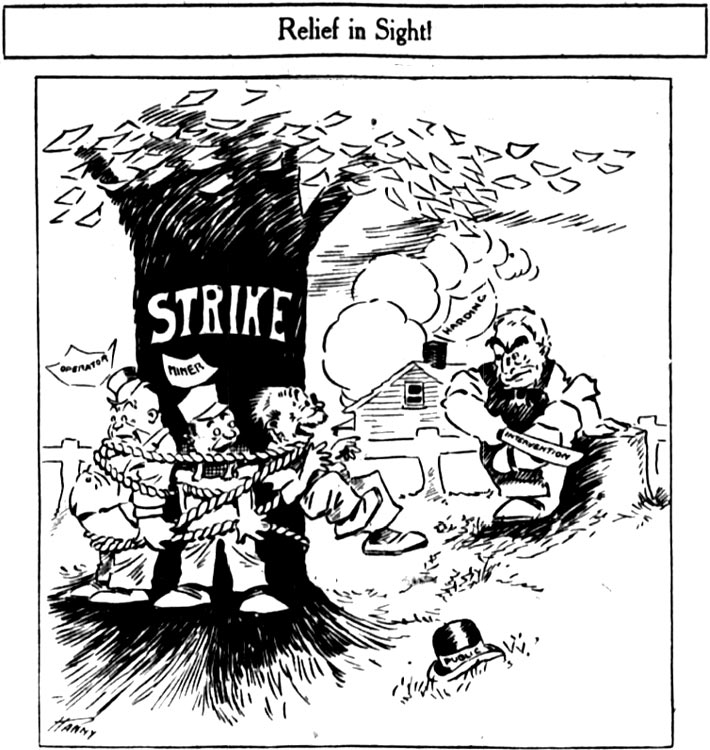
That didn't go over so well with the rank and file, so shortly after the Clifton Mine incident, President Harding ordered the striking miners to return to work. To prevent any further violence, he promised military assistance to mine owners and to state governments.

"Relief in Sight" by William Hanny in St. Joseph News-Press, July 19, 2022

This news was greeted with relief by some. Since I haven’t reprinted anything by Bill Hanny in a while, he gets to represent those cartoonists today.

"R-S-V-P" by Grover Page in Louisville Courier-Journal, July 20, 2022

I'm not entirely sure how to interpret Grover Page's cartoon here, published two days after Harding's ultimatum to the union. Page can't be criticizing Harding for resting idly by; is Harding instead all tuckered out from wrestling with the unions and mine owners? Is he waiting patiently for them to RSVP to the "Invitation to End Strike" that is still sitting on his escritoire?

Detail from "The Tiny Tribune" by Carey Orr in Chicago Tribune, July 26, 2022

Even with the heating season half a year away, cartoonists such as those at the Chicago Tribune were ready for drastic action to bring the miners' strike to an end. After all, you couldn't run a railroad, forge iron into steel, or otherwise run an industrial nation without coal.

Fortunately, the United States was blessed with a multi-talented crisis manager, Harding's Secretary of Commerce (and "Undersecretary of Everything Else"), a jack-of-all-trades go-to hero who hadn’t ain't never failed us yet:

"To the Rescue" by Bill Sykes in Philadelphia Public Register, July 27, 1922
None other than Herbert Clark Hoover!