Showing posts with label Kenosha Tribune. Show all posts

Saturday, August 19, 2023

Flights of Fantasy

Refreshing my memory about one of the cartoons in last Saturday's Graphical History Tour, I came across a bunch of Dungeons and Dragons doodles I had drawn 40 years ago this month.

in UW-Parkside Ranger, Sept. 8, 1983

The previous year, I had written a much-too-long article for the ill-fated Kenosha Tribune about GenCon, the annual August convention of fantasy gamers hosted by TSR Inc. Originally held in the company's hometown of Lake Geneva, Wisconsin (hence its name), the convention moved to the more spacious University of Wisconsin at Parkside just outside of Kenosha from 1978 to 1984.

In 1983, I stuck to drawings, GenCon having included an art show in that year's convention. GenCon was held August 18 and 19, 1983.

I had a hard time finding the original of this pen-and-ink drawing, until I remembered that in spite of the stiffness of the characters, I liked it enough to have it framed and hanging it in my old apartment.

"Arbar Laurethôl's Inexplicable Dream," August, 1983

Sure enough, there it was, somewhat yellowed from its years on a wall, still in a frame on a basement shelf of odds and ends from my apartment that have never found a home in our house. 

I'm fairly certain that I don't have the original drawings for the D&D creatures in the Ranger clipping at the top of this post, however. I do have some similar sketches for the GenCon recap in a Ranger the next September; but if I ever got the kobold, grimlock, and white dragon drawings back from the Ranger, I probably slipped them into my AD&D manuals that got soaked after our basement flooded several years ago.

For someone who hates drawing buildings, I certainly included quite a bit of architecture in "Arbar Laurethôl's Inexplicable Dream."

"Attack of the Corbinards"

I dispensed quickly with the task of drawing any architecture in "Attack of the Corbinards," in which Hitchcock gets medieval. It could probably have benefited on a cinematic level from a more populated battlefield. 


None of these drawings were stored with the others; this one shared a folder with some charcoal drawings and wound up with some charcoal smudges on it (removed with Photoshop).

But I believe it was included in the 1983 art display. It doesn't have a title on the back, but it does have my signature and the numbering of the exhibit organizers there. The signature on the front of these, by the way, is a quondam runification of my name.

Further technical arcana: the siren and "Arbar Laurethôl's Inexplicable Dream" were drawn on bristol board, whereas "Attack of the Corbinards" was drawn on plain old typing paper. It also wasn't printed in the Ranger, so now it's a Bergetoons exclusive.

Saturday, August 6, 2022

The Summer of Kenosha Tribune

For today's wallow in history, let me take you back forty Augusts ago, when I was editorial cartoonist for a little start-up newspaper, the Kenosha Tribune. The Tribune was edited by Ken Meyer, my editor at the University of Wisconsin at Parkside Ranger in the 1981-82 school year. Initially offered for sale for 25 cents, by August, the paper was free.

in Kenosha Tribune, August 5, 1982

Most of my initial cartoons for the Tribune dealt with national topics, but by August, I was making a concentrated effort to focus on state and local issues. Thus the above cartoon concerned the problem of drunk driving, exacerbated by Wisconsin having, at the time, a lower legal drinking age than just over the state line in Illinois.

in Kenosha Tribune, August 19, 1982

Another cross-border issue was Commonwealth Edison's nuclear power plant in Zion, Illinois, and concern that communication to Wisconsin communities in the event of an accident at the plant was lacking. This was three years after the meltdown at Three Mile Island, and four years before that at Chernobyl, Ukraine.

A less severe accident at the Zion plant led to its being retired in 1998. A year earlier, someone incorrectly inserted and then removed some control rods in a reactor while it was shut down; ComEd ultimately decided that the reactor was no longer economically feasible, and it has been inactive ever since. It is scheduled for complete closure in December, 2026.

For the above cartoon, I sat outside the Kenosha Municipal Building in the heat of summer to sketch the place. Kenosha city government just moved out of the building this year.

for Madison Independent, July, 1982
I'm not sure whether this cartoon belongs in this blog post. For one thing, it's dated in July. For another, I'm having difficulty remembering what the Madison Independent was, and how I came to draw one and only one cartoon for it. I haven't found any record of the Independent on line, either.

But I vaguely recall that the Tribune's publisher, Al Holzman, had dreams of establishing a publishing empire in the area. Whether he had hoped to entice the management of Madison Independent into a deal with cartoons as part of the package, or whether the newspaper ever existed in the first place, I have no idea — except that I do remember that I mimicked the font of its flag for the credit line next to my signature.

for Kenosha Tribune, July/Aug. 1982

In addition to editorial cartooning, I drew illustrations for a number of news and feature stories, such as the above one for a article about drunk driving...

in Kenosha Tribune, July 8, 1982

...this one for a front-page article about competition for the cable TV monopoly in Kenosha...

in Kenosha Tribune, August 19, 1982

... and this one to accompany Ken's obituary for Henry Fonda. The editorial board also asked me to draw sketches of the regular columnists, on account of one who didn't photograph well; we were pleased with the resulting portraits. And I wrote a way-too-long-even-after-brutal-editing feature article about GenCon XV. (It's just as well that I wrote it under a pseudonym.)

Meanwhile, all was not running smoothly at the Trib. The publisher, owner of 51% of the paper, was at odds with the other seven members of the board, who owned equal shares of the remaining 49%. Somewhere along the line, Holzman's name was removed from the masthead, but he remained in control as majority owner.

One thing the seven other members of the board were able to do without Holzman's approval was to secure a lease on a second-story office suite in downtown Kenosha. They moved necessary equipment out of the shabby little storefront on 43rd Street, and didn't give the publisher keys to the new office.

Needless to say, this didn't sit well with Mr. Holzman. Lawsuits and injunctions were threatened and filed, advertisers withdrew their support, and the first issue published out of the Haugaard-Isermann building would be the Tribune's last.

in Kenosha Tribune, August 26, 1982

Good thing the economy was picking up. This was my editorial cartoon in that final issue, mocking one of the Republican candidates for Wisconsin's Governor — Wisconsin's fall primary being held in September in those days.

To wrap this all up, I have gotten back in touch with a few Tribune people through Facebook as we've gone our separate ways — and run into one or two around town whose ways have brought them back or didn't take them very far. Ken drowned in a swimming accident in Marble Falls, Texas in 1985. Al Holzman never became the Charles Foster Kane of the Midwest; I have no clue what ultimately became of him.

And Lowell Jackson didn't get the GOP gubernatorial nomination, but did serve as Transportation Secretary in Tony Earl's administration.

Saturday, July 16, 2022

The Forty Summers of Twos

Last month, I noted that I had apparently drawn only one cartoon in the whole month of June, 1982 and offered that there was a probable reason for that.

The reason was that I was involved in the start-up of the Kenosha Tribune, which published its inaugural issue on July 1, 1982. Jumping from the well-established Journal Times in Racine to an upstart free weekly paper was a risky one, and one that didn't quite pay off. (I've already posted about the dispute between the publisher and the rest of the staff that doomed the Tribune, so I won't get into that here.)

"Hers & His" in Kenosha Tribune, July 1, 1982

The Kenosha Tribune focused on local issues, but my initial cartoons for the editorial page were devoted to national and international topics. I had put in time helping clean the new office, a block behind Washington Middle School; but I hadn't been equally diligent in catching up with Kenosha politics.

Happily, I did not draw a cartoon to accompany the publisher's issue one, page one article that alleged — without ever using the word "allegedly" or any synonym thereof — malfeasance by a police officer.  
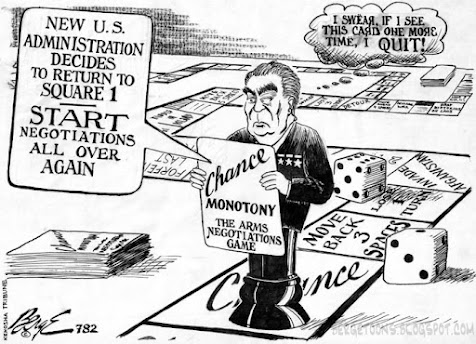
"Start Negotiations" in Kenosha Tribune, July 8, 1982

My second cartoon touches on a couple points I've discussed here recently. As in last week's Q Syndicate cartoon, I used Cyrillic-style lettering to signify that a character (here Soviet President Leonid Brezhnev) is Russian.

I've also warned against using rubber cement as an adhesive. I used rubber cement to paste the text in Brezhnev's thought balloon over my original text there, and it has since discolored significantly.

Compare that with the dog in the Phyllis Schlaffly cartoon. I used a glue stick to add the dog to the cartoon, and there's almost no discoloration at all on the original drawing.

(As for the point of the Brezhnev cartoon, Ronald Reagan had campaigned against the Strategic Arms Limitation Talks, or SALT, negotiations between the Carter administration and the Soviet Union. As President, Reagan basically renamed the negotiations "Strategic Arms Reduction Treaty," keeping one of the t's in "Strategic" so he could call it StART.)
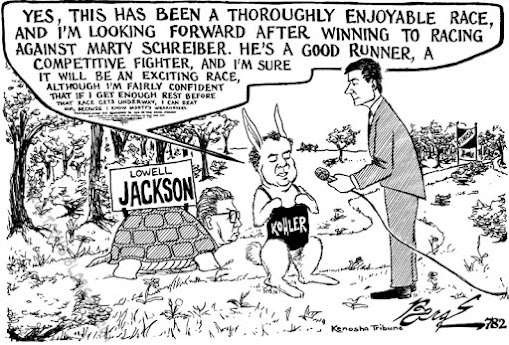
"A Thoroughly Enjoyable Race" in Kenosha Tribune, July 22, 1982

With midterm elections heating up, it wasn't long before I was drawing more local cartoons such as this one about Wisconsin's upcoming gubernatorial primary, and sketching the candidates who came to the Tribune's humble offices to be interviewed.

Interestingly, none of the candidates in this cartoon would be elected Governor in the fall: not Republican nominee Terry Kohler (of the bathroom fixture family), his Republican rival Lowell Jackson (a former and future member of the Governor's cabinet), or Democratic former Governor Marty Schreiber.
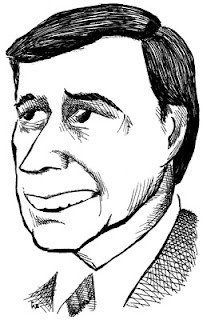
Marty Schreiber, for Kenosha Tribune, July/August, 1982, but unpublished

Kohler, the son of a past Governor of Wisconsin, would win the September primary, secured the GOP nomination for Governor, but was trounced in the general election by Democrat Tony Earl, 57% to 42%, the worst showing for a Republican gubernatorial candidate in 40 years before or 40 years since. (To be fair, three Democratic gubernatorial candidates made worse showings in those 80 years: William Sullivan in 1942, Daniel Hoan in 1946, and Bill Proxmire in 1952.)

Moving along: Having spent so much of this post on 1982, I don't want to skip over 1992 entirely...
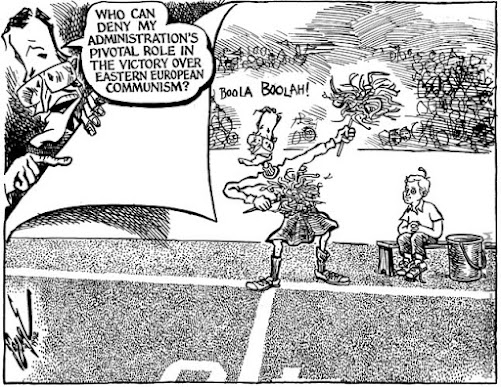
"Boola Boolah," unpublished, July, 1992

Besides, I drew each of those blades of grass individually with quill pen and ink, so it's about time they finally got to be seen by somebody somewhere.

We can discuss whether the Bush administration deserves credit for the fall of communism in Eastern Europe, and how much of it, some other time.
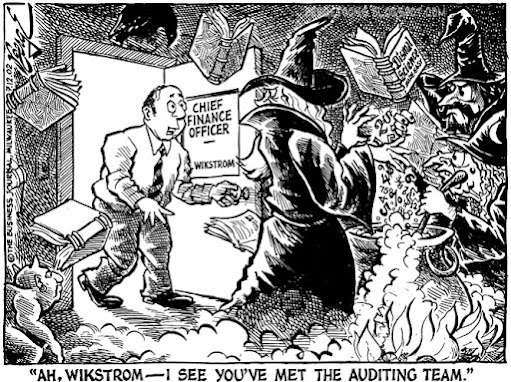
"Ah, Wikstrom" in Business Journal, Milwaukee, July 12, 2002

Jumping ahead to 2002, I have absolutely no recollection of the staff editorial this cartoon was drawn to accompany. But it affords me the opportunity to offer yet another take on Donald Joffrey Trump and his stubborn refusal to recognize that he lost the 2020 election.

Yes, he's a grifter and a spoiled brat grown up and grown old without ever once being held accountable for diddley squat. And yes, the Founding Fathers left him a glimmer of hope by creating the Electoral College because they were elitists who didn't entirely trust the Will of the People to elect the best President every time.

But I think that what the Trump presidency shows us is that coming from the World of Business is not such a great qualification for high office after all. Neither Wendell Willkie nor H. Ross Perot got to prove themselves in the Oval Office, but thanks to that damned Electoral College, we were treated to the Trumpian shitshow for four years

In the World of Business, your accounting team can take the same set of numbers and tease stockholders with tales of exponentially growing profits on the one hand, and plead to the IRS that losses swallowed up all your earnings. So naturally, if election officials in Georgia tell you that you're 11,780 votes short, you simply tell them to juggle the books and find you 11,780 more votes.

And if that fails, launch a hostile take-over.
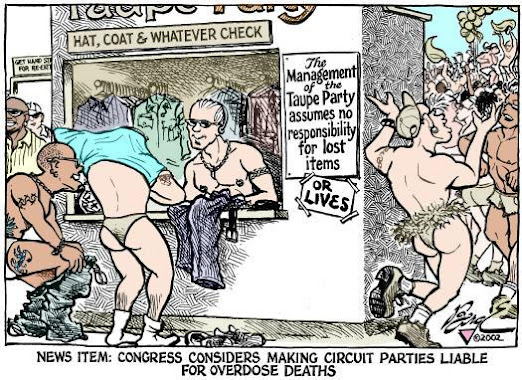
for Q Syndicate, July, 2002

I wasn't colorizing my syndicated cartoons in 2002 (I had done so for the Business Journal's Biz insert cartoons and some InStep covers), but I went ahead and added color to this one before posting it on the GeoCities site I had at the time.

It deserved a little taupe, after all.

It was in 2012 that I started including a color version of every cartoon when sending them to Q Syndicate. I'll sign off today with one of my favorites from that year.
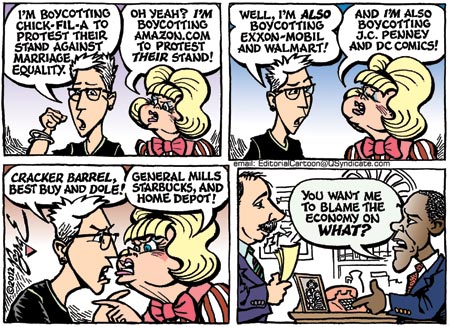
"Where the Boycotts Are," July, 2012


Saturday, March 18, 2017

Calumnated Ruins Domino

I started this week with a caricature of Donald Joffrey Trump's head of the Environmental Plunder Administration. Now that the administration has released its budget proposal cutting EPA funding by nearly a third, let's end the week with a Sierraback Saturday retrospective of the Trump gang's model for environmental policy. My cartoons below date from December, 1981 to July, 1984.
"I know Teddy Kennedy had fun at the Democratic convention when he said that I said that trees and vegetation caused 80% of the air pollution in this country. ... Well now, he was a little wrong about what I said. I didn't say 80%. I said 92%—93%, pardon me. And I didn’t say air pollution, I said oxides of nitrogen. Growing and decaying vegetation in this land are responsible for 93% of the oxides of nitrogen. ... If we are totally successful and can eliminate all the manmade oxides of nitrogen, we’ll still have 93% as much as we have in the air today." —Ronald Reagan, Oct. 9, 1980. (The 1979 quotation Kennedy was referring to: "The American Petroleum Institute filed suit against the EPA [and] charged that the agency was suppressing a scientific study for fear it might be misinterpreted... The suppressed study reveals that 80 percent of air pollution comes not from chimneys and auto exhaust pipes, but from plants and trees." —RR)

Republicans have long had a receptive ear for industrialist complaints that any attempt to protect the nation's air, water, forests, and purple mountain majesties are a job-killing, profit-choking nuisance. While Ronald Reagan's first budget cut funding for the EPA by 25%, it is useful to remember that the agency was established by a Republican president.

My cartoon above imagines that president phoning from his beachfront San Clemente estate to complain about Interior Secretary James Watt's plan to to lease a billion acres of offshore oil fields to petroleum interests.

Watt's fire sale of federal lands and waters also benefited the coal industry and suburban sprawl. Meanwhile, Anne Gorsuch, later Burford, his first head of the EPA (as discussed here a few weeks ago, now that her son is poised to claim Merrick Garland's seat on the Supreme Court), was happy to ignore pollution of the nation's air and water in the interest of protecting commercial profit margins. When scandal forced her resignation, the Reagan administration tapped the first administrator of the EPA, William Ruckelshaus, to return to the agency's helm.

Contrary to my cartoon, Ruckelshaus is generally credited with restoring public confidence the EPA, staffing the agency with competent personnel committed to its original mission. In a later interview since removed from the EPA's web page, Ruckelshaus said, "At EPA, you work for a cause that is beyond self-interest and larger than the goals people normally pursue. You're not there for the money, you're there for something beyond yourself."

James Watt's mission to make sure there was no speck of nature left unspoiled when the Lord returned was foiled by his uncanny knack for making inappropriate statements in public. He snarked that there are two kinds of people in this country, "liberals and Americans"; described Native American tribal rights as "socialism"; and banned the Beach Boys from the Washington D.C. Fourth of July celebration because they would "attract the wrong element."

He might have had a point if the Beach Boys had continued making hallucinogenic music in the mold of Smile. As it was, Watt was forced to back down and apologize. Turns out, Reagan liked the Beach Boys.

The last straw was his claim that his sale of more than a billion tons of coal from federal lands in Wyoming was above criticism because on his federal coal commission "I have a black, a woman, two Jews and a cripple. And we have talent."
A friend and colleague of mine at the UW-Parkside Ranger, Rick Luehr, satirized Watt's remark with his Hallowe'en costume that year, donning a wig, blackface, and fake breasts covered by a pair of mogen Davids. The wheelchair was already a part of his daily life.

Aside from providing the template for Donald Trump's Twitter habit, Watt pushed genuinely destructive policies that now find favor in the Very Famous Trump White House. Unlike today, however, Watt faced a Congress willing to push back:
Watt's earlier forays included a declaration that he would open wilderness areas in the West to drillers and miners. Congress put a stop to it: the House voted 350 to 58 to withdraw wilderness lands from mineral development. Fifty-two senators cosponsored similar legislation. Watt also proposed a major dilution of the Endangered Species Act and asked Congress to hold off its review of the law. Congress ignored him and renewed the law without significant weakening amendments.
He was replaced by a long-time friend of the President, jack-of-all-trades William Clark.

Clark's crowning achievement in his two years at Interior was keeping himself out of the headlines. The policies instituted under Watt continued, but without the media-eye-catching bluster and bombast.

Saturday, June 13, 2015

Bathroom Humor

The other day, I made an off-hand reference to two conservatives who have been obsessed with our nation's toilets. It's Stickleback Saturday, so what better excuse to dredge up a couple of my old cartoons about them?

First was Phyllis Schlafly, spokesperson for the Eagle Forum and vociferous opponent of the Equal Rights Amendment to the U.S. Constitution. The proposed amendment, which passed the House and Senate overwhelmingly in 1972, would have guaranteed women equal rights before the law with men. Schlafly is credited for derailing its ratification, predicting that the ERA would result in unisex bathrooms, same-sex marriage, and compulsory military service for women. The ERA fell three states short of ratification in 1982.

There was some talk of reviving the ERA after Democrats swept the 2006 elections. Only talk, apparently. Most public buildings still offer a choice of men's and women's rest rooms, and there hasn't been any military draft since the Vietnam War, As of this writing, we're still waiting for the Supreme Court's ruling on whether marriage equality should be the law of the land even without the ERA.

I drew the above cartoon for the Kenosha [Wisconsin] Tribune when the deadline for ratification had passed in July of 1982. I believe I've mentioned the Tribune before; it was a very short-lived newspaper that failed to survive that summer.

I have no idea whether Schlafly's husband, John Fred Schlafly Jr. bore any resemblance to the man in the cartoon. Or whether they had a dog.

✍ ✍ ✍

Senator Larry Craig (R-ID) had a very different interest in public rest rooms. The conservative Idahoer (yes, that's a word) had racked up a solidly antigay voting record in the House and Senate when, on June 11, 2007, he was arrested at the Minneapolis-St. Paul airport for soliciting sex from an undercover policeman in the men's room.

The nation learned how men supposedly invite sexual encounters by sticking a foot underneath the stall divider; Senator Craig protested that the officer had misinterpreted his habitual "wide stance." He later revised that to "I'm a wide guy," but ultimately pleaded guilty to a misdemeanor charge of disorderly conduct. Meanwhile, the second stall from the right in the men's room next to the lottery shop actually became a tourist attraction.

I drew a couple earlier cartoons about Craig, but my favorite is this one from June of 2008, when the retiring senator announced that he planned to write his memoirs.


Saturday, July 2, 2011

What Was the Kenosha Tribune?


I've expanded my curriculum vitae at left at the suggestion of a fellow alumnus of the Kenosha Tribune who expressed dismay -- mock dismay, I presume -- at the omission of that very short-lived foray into journalism from my list of newspapers where I have worked. Of course, my reason for omitting the Tribune is precisely because, nearly thirty years later, there is very scant record of its existence -- not even a mention on Wikipedia.

Therefore I am including a couple of the news illustrations I drew for the Tribune, which I did in addition to the weekly editorial cartoon; the one above right illustrated some wire story about bobbies in London packing heat; the one below left illustrated a front page story about cross-border cooperation between Wisconsin and Illinois.

I also had to draw portraits of the editorial and feature columnists. We had photographers, but one of the columnists in particular did not photograph well, and the editors asked me to produce a more flattering likeness. That's the opposite approach from editorial cartooning generally, but my editors liked the charcoal sketch better than the photograph and had me go ahead and sketch the other columnists for consistency's sake. (Yes, I have that sketch, but no, I'm not going to post it.)

The Tribune published during the summer of 1982 and promptly folded in the fall, the victim of a dispute between the publisher, who owned 51% of the paper, and the seven staff-shareholders who owned the other 49% plus the lease on the offices. The paper got off to a bad start with a front page article written by the publisher in the very first issue, alleging certain malfeasance on the part of some Kenosha law enforcement officials -- but neglecting throughout to include words such as "alleged" to make it clear that the acts described were not proven facts. The Tribune was lucky that it never had to defend against a libel suit.

In the end, I doubt that the Tribune could have long survived without making some deal with the older and still publishing Happenings magazine -- they featured TV and movie listings and we didn't.

The story you have just read is true. Names have been withheld to protect the innocent.

And the homely.