Showing posts with label nonpartisan. Show all posts

Saturday, July 15, 2023

Tales from the North

Continuing last Saturday's Graphical History Tour, we've got some century-late-breaking news out of Minnesota!

In a special election to fill the U.S. Senate seat of the late Cushman Davis, Minnesota elected Farmer-Labor candidate Magnus Johnson.

"Way Up in Alaska" by Harold J. Wahl in Sacramento Bee, July 19, 1923

The Senate seat won by Johnson had been held by Republicans since 1859. Fellow Farmer-Laborite Henrik Shipstead had been elected to Minnesota's other Senate seat in 1922 — a seat that had been held by Republicans almost as long, except for Charles Towne's 54-day term in 1900-1901.

"I've Seen 'Em Come..." by Edward Gale in Los Angeles Times, July 19, 1923

Edward Gale's Third Party Graveyard fails to include the Prohibition Party. By 1923, the Prohibition Party's principal campaign plank had been hammered by both major political parties into the U.S. Constitution. (That the 18th Amendment would eventually be negated by the 21st was still a decade into the future.)

The Greenback and Populist Party platforms of looser monetary policy and abandonment of the gold standard would eventually be adopted and passed by the Progressives and Democrats. This is how third parties' success is truly measured: do their issues become adopted by either or both the Democrats or Republicans?

"Some Consolation for the GOP" by John T. McCutcheon in Chicago Tribune, July 19, 1923

Where Gale gets it wrong is that the Farmer-Labor Party was not the "third" party in the Minnesota Senate race. John McCutcheon correctly notes that the Democratic Party was scarcely a factor. Johnson won the election with a commanding 57.48% of the vote to Republican Governor Jacob Preuss's 38.69%. Democrat James Carley was sent home with a measly 3.83% of votes cast.

"Powerful Katrinka Loses Her Composure" by Harold Talburt for Scripps-Howard Newspapers, before July 26, 1923

The Farmer-Labor Party and the Democrats would eventually join forces in 1944, strengthening both. Minnesota's DFL is one of only two affiliates of the Democratic Party with a name different from the national party. (North Dakota's Democratic-Nonpartisan League is the other.)

Your humble blogger provided the backstory on Fontaine Fox's Powerful Katrinka back in April.

Alaska Daily Empire, July 10, 1923

Meanwhile, President Harding was on his western non-campaign swing, making the first presidential visit ever to Alaska before heading south again. 

"Cinderella and the Golden Galoshes" by Edward Gale in Los Angeles Times, July 12, 1923

His plans were to visit Vancouver, Canada and several cities on the U.S. west coast before sailing down to the Panama Canal and stopping at Puerto Rico on the way back to Washington, D.C.

"Somewhere in Alaska" by Daniel Fitzpatrick in St. Louis Post-Dispatch, July 16, 1923

Daniel Fitzpatrick, drawing from a city Harding had already left, used the occasion to accuse administration foreign policy as being adrift; but cartoonists in cities still on the president's itinerary rolled out the welcome mat. 

"Getting Ready for the President" by Frank Kettlewell in Oakland Tribune, July 23, 1923

I see a lot of similar editorial cartoons in this period — especially in summer months — welcoming visiting conventions of all kinds to town. Even the best and brightest pens and grease pencils of the day would let the Shriners and Tulip Fancier Society know how thrilled they were to play host to them.

"Just Watch Our Smoke" by O.C. Chopin in San Francisco Examiner, July 28, 1923

But Florence Harding took ill in Alaska, and her husband experienced abdominal pain after rushing through a speech at Washington State University. His doctors diagnosed recurrence of a previous heart problem, but falsely reported to the public that it was ptomaine poisoning due to copper-tainted clams.

Harding cancelled a stop in Portland, Oregon, arriving by train in San Francisco on July 29. Although he was visibly exhausted, he insisted on walking from the train to the car that took him to the Palace Hotel. The official announcement was that he was expected to fully recover and complete the trip.

But the next day, it was reported that Harding had developed pneumonia, and his condition was pronounced "grave."

"Renominate the President" by Gustavo Bronstrup in San Francisco Chronicle, July 31, 1923

The Chronicle nevertheless ran this Bronstrup cartoon on July 31 alongside an editorial in moderately large print advocating a second Harding term. A second editorial, below the first and in regular type, acknowledged Harding's illness and regretted that he was unable to complete his San Francisco event schedule.

I have to wonder whether Bronstrup drew this portrait in case the worst were to come to pass by the newspaper's deadline. It's rather dark for an All Hail! cartoon

On the other hand, the sketch by R. H. Sommer (obviously drawn from the same photograph) on the front page of the Alaska Empire three weeks earlier is similarly dark, and that was published while, as far as the public knew, Harding was in perfect health.

Saturday, May 27, 2023

Fighting Bob LaFollette

There are several noteworthy events in May of 1923 that I haven't gotten around to highlighting in these Saturday History Tours, so it wasn't easy picking which one to end the month with today. I've decided that it's time to start paying attention to Wisconsin Senator Robert "Fighting Bob" LaFollette.

"That Kid from Wisconsin Again" by Dorman H. Smith for Newspaper Enterprise Assn., ca. May 16, 1923

LaFollette still holds a place of honor here in his home state. There are streets and schools named for him all over the place here. Save for a COVID hiatus, Madison progressives have held Fighting Bob Fest every fall since 2002 (although its website appears to have been taken over by some unrelated commercial venture these days). 

His son Robert Jr. succeeded him in the Senate; his other son, Philip, served three terms as Wisconsin Governor in the 1930's. Grandson Bronson LaFollette was elected Wisconsin Attorney General from 1965 to 1969 and again from 1975 to 1987. A great-grandson and distant cousin of Bronson, Douglas LaFollette, recently resigned as Wisconsin Secretary of State, an elected post he had held since 1974.

But you don't find a lot of love for Senator LaFollette in the editorial cartoons of a century ago. Republican partisans did not care for his open rivalry with his fellow Republican in the White House, President Warren G. Harding. Democrats remembered his opposition to Woodrow Wilson's foreign policy leading up to and during World War I.

"Valuing an Old Masterpiece" by John T. McCutcheon in Chicago Tribune, May 26, 1923

Regarding these cartoons, Senator LaFollette had for ten years charged that U.S. railroads were overvalued, allowing them to overcharge for passenger and freight travel. Following Progressives' gains in the 1922 election, his charges finally had to be taken seriously by Senate leadership, which promised to have the Senate's Interstate Commerce Commission hold hearings.

"Shoe the Old Horse..." by J.N. "Ding" Darling in Des Moines Register, May 31, 1923

LaFollette protested that those hearings would be against Senate rules, in that the 68th Congress had still not been called into session — and would not be called into session for months to come. Four seats on the commission were left vacant at the end of the 67th Congress. Progressives wanted a greater say on the commission, but the Senate couldn't seat new members before being called into session. At May's end, it appeared that no hearings would be held, and no legislation offered.

The other Senator in Darling's cartoon is Smith Brookhart (R-IA).

"Making Progress" by William C. Morris for George Matthew Adams Service, ca. May 13, 1923

The Progressive bloc of Republicans in the House and Senate, LaFollette included, were isolationists. So was conservative President Harding, until convinced by his Secretary of State, Charles Evans Hughes, to support a proposal for a World Court to adjudicate international disputes before they could break into open warfare.

The other Republicans in William Morris's cartoon are Senators William Borah (R-ID), George Moses (R-NH), Hiram Johnson (R-CA) and Henry Cabot Lodge (R-MA). Lodge was not one of the Progressives, but had found isolationism useful against the Wilson administration in 1918 and 1920.

"The Move that Will Settle the Argument" by Edward Gale in Los Angeles Times, May 19, 1923

LaFollette had turned down the idea of running for president on the Farmer-Labor Party ticket in 1920, but was now entertaining serious talk of running on the Progressive Party ticket in 1924. Sitting atop the elephant's rump in Gale's cartoon, Senator Hiram Johnson (R-CA, Teddy Roosevelt's running mate in 1912) would eventually challenge Calvin Coolidge for the 1924 Republican presidential nomination.

Meanwhile, President Harding announced what would be a fateful speaking tour of the American West from Alaska to California in the coming summer.

"Ready to Follow the President..." by Wm. A. Ceperley in Davenport Democrat, May 27, 1923

My thanks to D.D. Degg at Daily Cartoonist for identifying "CEP" for me. I was running into a lot of dead ends trying to identify the Davenport Democrat's cartoonist. (It didn't help that Davenport was the name of a much more famous cartoonist.) There is no mention of CEP in this "Our Iowa Heritage" article on Iowa cartoonists, in spite of its having a contributor from the Democrat's successor newspaper, the Quad City Times, or in "Iowa Artists of the First Hundred Years," including its list of cartoonists on page 246.

Not so much in this particular cartoon, but Ceperley's style is often reminiscent of that of fellow Iowan J.N. "Ding" Darling. Yet where Ding was generally Republican, Ceperley leaned Democratic. His last cartoon in the Davenport Democrat ran on January 1, 1933 but he continued as City Editor of the paper until 1937; he died in 1956.

"In an Open Field" by William F. "Wilfred" Canan in Minneapolis Daily Star, May 23, 1923

This cartoon by Wilfred Canan (pen name Billican) may be the closest thing I'll find to one sympathetic to Senator LaFollette. Canan (1889-1929) began his cartooning career drawing for publications associated with the Nonpartisan League in North Dakota, a leftist political organization that gave rise to the Farmer-Labor Party in Minnesota. 

Harding in this cartoon is singing an 1850 hymn by Emily Oakley based on the parable of the sower:

Sowing the seed by the wayside high,
Sowing the seed on the rocks to die,
Sowing the seed where the thorns will spoil,
Sowing the seed in the fertile soil:
O what shall the harvest be?

Given 100 years worth of hindsight, the parable of the rich fool also comes to mind.

Saturday, October 16, 2021

October Affairs: Domestic

Hey, kids! It's time to catch up on all the domestic national news from October, 1921!

We'll start with something that seems as relevant today as ever, because, like the weather, everybody talks about it but nobody ever does anything about it.

"Rather Late Canning Time..." by Clifford Berryman in Washington (DC) Evening Star, Oct. 13, 1921

It was Republicans who had complete control of the White House and both houses of Congress in 1921. But the filibuster was a favorite tactic of senators from southern states — Democrats in those days — who would thwart an anti-lynching bill throughout the entire 67th Congress. 

Other legislation killed by filibusters from both parties during that congressional session included the Harding administration's ship subsidy bill, a Railroad Refunding bill, the Rogers Foreign Service bill, the "Blue Sky" securities regulation bill, the Radio Regulation bill, and a Statute Codification bill.

"So Near, And Yet" by Bill Sykes in Philadelphia Public Ledger, Oct. 10, 1921

If getting legislation passed was easier said than done, so was breaking Americans' alcohol habit. Prohibition was in its second year, and not only were folks learning how to brew hooch in their private basements, but since not every home has its own basement, a thriving black market in liquor had sprouted up across the country in major cities and small towns.

"Autumn Leaves..." by Ted Brown in Chicago Daily News, by Oct. 27, 1921

Ted Brown's consumers look mighty happy with their crop, for now. Who that fellow is back there saying "Never again," I'm afraid I can't tell.

"Is He Worth It?" by John Cassel in New York Evening World, Oct. 19, 1921

The major national story of October was a threatened strike by railroad workers for better pay and working conditions. This was three decades before the interstate highway system; trains, not trucks, were primarily responsible for transporting goods across the country, as well as for passenger travel and mail delivery.  

"There's a Limit to All Things" by Albert Levering in New York Tribune, Oct. 23, 1921

Railroad corporations demanded significant cuts in wages and benefits to their workers in 1921, and also increased farming out work to non-union sub-contractors. Five major unions indicated they were all set to go out on strike, but the Railroad Labor Board ordered union leaders to keep their workers on the job. After the Board consented to delay Interstate Commerce Commission orders to slash half of the increases workers had enjoyed during World War I, union members voted to cancel the strike.

It was only a temporary peace, kicking the can down the railroad; the unions would go on strike within a year when that pay cut delay ended.

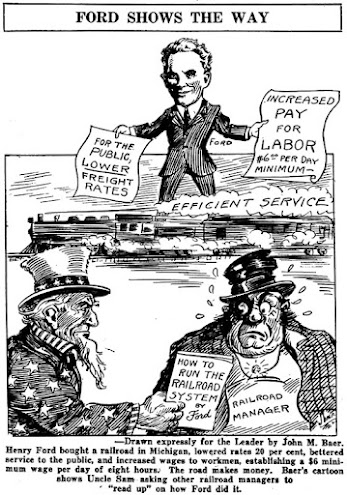
"Ford Shows the Way" by John Baer in Nonpartisan Leader, Fargo ND, Oct. 31, 1921

As peculiar bedfellows as they may have been, leftist former Congressman John Baer (Nonpartisan League-ND) here holds up right-wing Republican Henry Ford as an example for how to run a railroad. Baer cartooned for the National Railroad Union newspaper Labor as well as the Nonpartisan League's official paper (which was published in Minneapolis as the National Leader after the October 31, 1921 issue).

Looking to improve supply and distribution lines for his auto plant in Dearborn, Ford bought the Detroit, Toledo and Ironton Railroad in 1920, modernizing and transforming it, in the words of railroad historian William Pletz, "from a streak of rust into an extremely efficient and profitable operation, the likes of which has or will seldom be seen in this country." 

Under Ford, DT&I employees made higher wages than others in the industry. He also launched an electrification program for the railway, which was, however, abandoned after he sold the DT&I (at a hefty profit) to a subsidiary of the Pennsylvania Railroad in 1929.

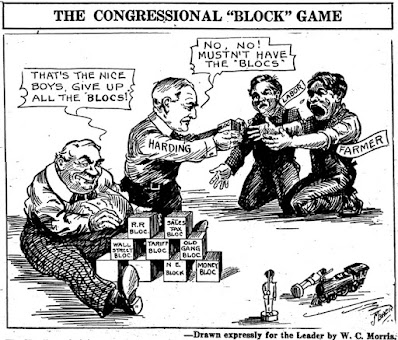
John Baer in Nonpartisan Leader, Fargo, Oct. 31, 1921
Baer (not William Morris) here accuses President Harding of trying to break up the Nonpartisan League's alliance between farmers and laborers, Minnesota's Democratic-Farmer-Labor Party being the last vestige of the movement. Republican efforts to gin up farmers' resentment of organized labor have been remarkably successful, even in ostensibly Democratic Minnesota.

"Th' Hog" by William Sykes in Philadelphia Public Ledger, Oct. 3, 1921

Oh, and the World Series was held in October, but it was the New York Yankees vs. the New York Giants, so nobody beyond the outer boroughs really cared all that much.

(Just kidding. Even game 4 getting rained out made banner headlines across the country. And the Giants took the series five games to three.) 

Saturday, July 18, 2020

The Nonpartisan League

In last week's post about the rocky birth of the Farmer-Labor Party in the summer of 1920, I made passing mention of one of the founding groups, the Nonpartisan League (NPL) and promised to expand on them today. Voici.
"Say It with the Ballot, Mr. Farmer" by William C. Morris in Nonpartisan Leader, Minneapolis, MN, June 7, 1920
Socialist Arthur C. Townley founded the Farmers Nonpartisan Organization League in 1915; the name was usually shortened to Nonpartisan League. The league rallied North Dakota farmers who resented being exploited by bankers and millers in Minneapolis and Chicago. Before long, chapters were established in surrounding states.
"Yes, and We've Seen Certain Interests..." by Wm. C. Morris in Nonpartisan Leader, Mpls, MN, June 7, 1920
Their official newspaper, the Nonpartisan Leader, was originally published in Fargo, but had moved its offices to Minneapolis by the summer of 1920. Starting out as a weekly journal (biweekly after July 26, 1920), it featured editorial cartoons prominently, often on the front page and always scattered through the inside pages.
"Breaking Family Ties..." by Wm. C. Morris in Nonpartisan Leader, Fargo, ND, September 20, 1917
Starting in 1917, many of these were drawn by William C. Morris, cartoonist for the George Matthew Adams Service and New York Mail. Having come across several of Morris's pro-Republican syndicated cartoons, I was somewhat surprised to find he had drawn cartoons expressly for the Leader, given its strong socialist bent. (Perhaps he was related to Oliver S. Morris, its editor from December, 1916 onward, but I can't prove it either way.)
"Going Down" by Wm. C. Morris in Nonpartisan Leader, St. Paul, MN, August 4, 1919
Cartoons Magazine reported on William Morris's career in August, 1916:
William C . Morris, who three years ago was doing cartoons for the Spokane Review, is rapidly making a name for himself in New York. His work in Harper's Weekly was attracting national attention at the time that historic magazine was approaching its finish. Since the demise of Harper's Mr. Morris has been publishing his cartoons in Puck and The Independent. Some of his full-page designs, satires on national and international events, show striking originality and boldness of conception.
"Then — And Now" by Wm. Morris in Nonpartisan Leader, Mpls, MN, November 15, 1920
By the way, the resemblance between Uncle Sam and many of these cartoon farmers is hardly coincidental. As we discussed a couple weeks ago, up until 1920 census, the U.S. population was majority rural. Giving Uncle Sam a farmer's features was only fitting.
"His Ten Commandments" by Wm. Morris in Nonpartisan Leader, Mpls., MN, July 12, 1920
Last week, I categorized the Republicans as being a conservative party controlled by big-money interests, and that was certainly true of the William McKinley, Henry Cabot Lodge, and Warren Harding wing of the party. Teddy Roosevelt, Bob LaFollette and Hiram Johnson were in the party's progressive wing, more favorable to government control over consumer product safety, environmental protection, and plutocratic excess.
"He Didn't Know It Had Teeth" by Wm. Morris in Nonpartisan Leader, Fargo, ND, April 27, 1917
Then, as now, Republicans were dominant in North Dakota politics. Further to the left than the Progressives, The Nonpartisan League ran an insurgent campaign in 1916, successfully running its candidates in Republican primaries. League candidates won the governorship and control of the state legislature that year.
"The Clean Sweep in North Dakota" by John M. Baer in Nonpartisan Leader, Fargo, ND, November 9, 1916
They proceeded to establish state-run agricultural enterprises: the North Dakota Mill and Elevator, the Bank of North Dakota, and a state-owned railroad. The legislature passed a graduated state income tax which distinguished between earned and unearned income; authorized a state hail insurance fund, and established a workman's compensation fund that assessed employers. The League also set up a Home Building Association to aid people in financing and building houses.
"They Lied Living—Now Lie Dead" by Wm. Morris in Nonpartisan Leader, Mpls., MN, July 12, 1920
Conservative Republicans established the Independent Voters Association (IVA) in opposition to the Nonpartisan League; apparently, several of the journals they published to rival the Nonpartisan Leader were short-lived.
"The Third Cup" by Wm. Morris in Nonpartisan Leader, Mpls, MN, July 19, 1920
For this cartoon of North Dakota Governor Lynn Frazier, I have to wonder if Morris had in mind a 1912 Boardman Robinson cartoon of Teddy Roosevelt scolding a waiter about to serve "nomination" soup to incumbent President Taft, "Bring that over here. When I said I wouldn't take the third cup a little while ago, I only meant I wouldn't take it right on top of the other two."

The text accompanying Morris's cartoon reads, "North Dakota likes Lynn J. Frazier and the people's government, of which, he, as governor, is head. It has rewarded his faithfulness to the farmers' and workers' program with a third nomination, and in November will elect him to a third term, thus assuring administration of the 'New Day' program by one who believes in it."
"It Can't Be Done" by Wm. Morris in Nonpartisan Leader, Mpls., MN, July 19, 1920
Although Leader cartoons occasionally included caricatures of specific politicians who were for or against the League, the overwhelming majority of them relied on archetypal representations of farmers, bankers, and "old guard" politicians. Many exude a supreme confidence in the NPL agenda.
"Afraid of Fire" by Wm. Morris in Nonpartisan Leader, Mpls, MN, July 19, 1920
The damned souls in Morris's frying pan are labeled usurious banker, crooked politician, profiteer and food gambler.
"Never Too Late to Mend" by Wm. Morris in Nonpartisan Leader, Mpls, MN, July 19, 1920
Many of the cartoons are accompanied by a paragraph of text, just in case the paper's readers might have missed the cartoonist's point. The explanatory note for the above cartoon read: "It's never too late to organize, but the sooner it is done, the sooner farmers of other states will have state-owned industries like North Dakota's, including flour mills, terminal elevators, a rural credits bank and marketing reforms."
"We've Carried You Just About Far Enough" by McCoy in Nonpartisan Leader, December 15, 1915
The Leader had a number of other regular cartoonists at various times, some very amateurish, but others such as this McCoy fellow showed some flair. Sadly, I have not dug up any background information on Mr. McCoy, who was no longer drawing for the Leader by the time it started including a "Drawn expressly for the Leader by [name]" credit line under its cartoons in 1918.
Uncaptioned cartoon by John M. Baer in Plumb Plan League Labor, by June 7, 1920
The cartoonist most closely associated with the Nonpartisan Leader was John M. Baer, who drew for the Leader from its first issue and for its affiliated daily Fargo Courier-News. 
"Fired" by John Baer on the cover of the first edition of Nonpartisan Leader, Fargo, ND, Sept. 23, 1915
The same issue of Cartoons Magazine I quoted above also reported on Baer's cartoon career:
J.M. Baer, cartoonist for Jim Jam Jems and for three years postmaster at Beach, N.D., has resigned his official position and will devote his entire time to cartooning. He has gone to Fargo to work for the Nonpartisan Leader, which is not only the largest paper in the state, but is owned by an organization of farmers. His cartoons on local politics have been very influential.
"Baer Is Running for Congress" by Bart O. Foss in St. Paul Daily News by July 5, 1917. Foss was another frequent contributor to the Nonpartisan Leader early on.
Baer was elected to Congress on the Nonpartisan League ticket in August, 1917 to fill the vacancy created by the death of Henry T. Helgesen (Republican). By this time, Cartoons Magazine reports that "His cartoons are appearing daily in Hearst's New York Journal and Chicago American," and that one had been commended in the Chicago Tribune. Baer stopped cartooning right after he took the new job (which may be why the Leader added Morris just then), but only very briefly.
"Gee! But It Is Lonesome Here..." by Congressman John Baer in Nonpartisan Leader, Fargo, ND, Sept. 6, 1917
After losing reelection to a second full term in 1920, He resumed his career as full-time cartoonist and journalist for the Nonpartisan Leader and Labor, the newspaper of the National Railroad Union's "Plumb Plan League."
"Won't Leave Him Alone" by John Baer in Nonpartisan Leader, Mpls, MN, October 17, 1921
The 1920's were not good to the Nonpartisan League. Falling commodities prices hit farmers and the North Dakota government programs set up to help them hard; the bankers so vilified by the Nonpartisan League were not particularly inclined to save the day.
"Hooray, We Won..." by Wm. C. Morris in National Leader, Mpls., MN, December 26, 1921
Along with the state Attorney General and Commissioner of Agriculture, Governor Frazier was  recalled from office in 1921, giving him the distinction of being one of only two U.S. Governors removed from office that way. (The other was Democrat Gray Davis of California, in 2003.) He would then, however, be elected Senator the next year, serving until 1941.

In November, 1921, NPL founder Arthur Townley exhausted his appeals to overturn a conviction for "conspiracy to discourage enlistments" during World War I and began serving a 90-day jail sentence.
"The Highest Court" by John Baer for National Leader, Minneapolis, MN., November 14, 1921
Meanwhile, the Nonpartisan Leader ran a front-page editorial warning that farmers who didn't pay their "dues" would not continue to receive the paper (not a good omen), then changed its name to The National Leader with the November 14, 1921 edition. That same year, the Fargo Forum reported that the Fargo Courier-News had suspended publication, a report vigorously denied by the Courier-News. Its publisher would end up selling off the Courier-News and suspending publication of the National Leader — publishing monthly since May, 1922 — with the July, 1923 edition. Townley and Baer were contributors to the Leader right up to the end; the last of Morris's Leader cartoons that I know of was in the September, 1922 issue.
"He's Workin' Aginst Us" by Wm. Morris in National Leader, Mpls, MN, September, 1922
The Nonpartisan League itself continued on, but became increasingly estranged from the state Republican Party. In the 1950's, its members merged with the Democratic Party of North Dakota, which officially remains the North Dakota Democratic-Nonpartisan League Party, ("D-NPL").