Monday, October 10, 2022

This Week's Sneak Peek

So I was in Columbus for the annual convention of the Association of American Editorial Cartoonists — the first in-person meeting since COVID-19 canceled the Toronto convention. I did bring some bristol board, a pencil and eraser, but no pen or ink, or I might have spent Sunday night as I usually do, cartooning.

But never fear. I left a cartoon with my editors for release this week.

Now that I'm back home, I'll have a few pictures to share about the convention on the blog — although I don't think I can improve on the coverage by Mike Peterson at Daily Cartoonist here and here — and I'll start with one observation about downtown by a visitor.


I don't know how cruisy Gay Street is but High Street is aptly named. Now that pot is legal in Ohio, the head shops there are quite open and upfront. So are the kids smoking as they walk down the sidewalk, and so is the bar boasting "beer, booze & blunts."


Apparently, 4-20 is quite Poplar.
 

Saturday, October 8, 2022

Dropping the Captain Morgan

The Columbus Day / Native Americans Day Holiday Weekend is upon us (please celebrate responsibly), so of course, our Graphical History Tour needs must get underway with this nod to the bifurcated festivities:

"Landing of Columbus in 1922" by John Knott in Galveston Daily News, Oct. 12, 1922

Leading off with John Knott for the third week in a row? Why not?

The issue Knott is so crudely addressing here is a ruling by Attorney General Harry M. Daugherty prohibiting foreign vessels in American waters from carrying alcoholic beverages. Secretary of State Charles Evans Hughes backed up Daugherty's ruling by asserting a right of U.S. law enforcement to board any foreign vessel to confiscate or destroy whatever liquor they found.

"A Good Way to Start Something" by Dennis McCarthy in New Orleans Times-Picayune, Oct. 19, 1922

Predictably, this didn't sit well with other countries. The British and French government protested against Daugherty's ruling, and threatened reprisals. Seven ships of the Cunard and Bright Star line set sail from England for American ports, fully stocked with liquor aboard, daring the U.S. to go ahead and try to do something about it.

"Marooned" by Dorman H. Smith for Newspaper Enterprise Assn., ca. Oct. 11, 1922
"For Mutiny on the High Seas" by Elmer Bushnell for Central Press Assn., ca. Oct. 14, 1922

The practical considerations of Daugherty's ruling were daunting. Another country's luxury liner might have tons of beer, wine, and liquor aboard, more than could be safely off-loaded to some other ship at the three-mile limit (in those days) of U.S. territorial waters — especially during inclement weather. 

"Dropping the Profits" by Nelson Harding in Brooklyn Daily Eagle, Oct. 30, 1930

(Nelson Harding's cartoon, and the title of this post, parody a famous cartoon by Sir John Tenniel in Punch.)

"The Old Man of the Sea" by Daniel Fitzpatrick in St. Louis Post-Dispatch, Oct. 19, 1922

Daugherty's ruling also extended Prohibition to U.S.-registered ships outside territorial waters of the United States. "Under the rules of fair intendment," he wrote, "America's ships, wherever they may be, are included in the terms of the Eighteenth Amendment."

He thus closed a loophole that benefitted the sort of people who could afford international cruises. Now they would have to wait until they disembarked at their destination before enjoying a drink at the bar.

"Rewriting It" by Rollin Kirby in New York World, Oct. 28, 1922

"I can prove to you that Mr. Daugherty is the greatest lawmaker of all time," Albert D. Lasker, chair of the Shipping Board, told the audience at a dinner at which he and Daugherty shared the dais. "Moses only made the Red Sea dry."

And so, having solved the pesky problem of boozy cruises, the prohibitionists could now turn attention to plugging some other holes in the Volstead Act. 

Detail from "Some Big Holes" by John McCutcheon in Chicago Tribune, Oct. 18, 1922

Thursday, October 6, 2022

Q Toon: True Crime

Just because it's a cartoon doesn't mean it's supposed to be funny.

When I emailed the description of last week's cartoon to my editors, I commented that I didn't want to opine about a movie — in that case "Bros" — I hadn't yet seen. This week, I'm opining about a TV miniseries that I do not intend to watch.

I didn't know anyone in Milwaukee's LGBTQ community when Jeffrey Dahmer was on the loose, but that episode in history is still too raw for me. There are people who were directly affected whose story may well deserve to be told, but I have no desire to see how Hollywood treats this dark moment in Milwaukee history.

One hopes that their miniseries is done respectfully and not as a Grand Guignol spectacle. It may become a classic alongside such headline-to-screen fare as "Psycho" and "Rope," two renowned, sensational Hitchcock films that arguably fed on real people's pain.

I'm not arguing that this miniseries should never have been filmed, even if I don't intend to watch it.

What I am upset by are the memes that have begun to show up in my Facebook and Twitter feeds using screenshots from the miniseries to make frivolous comments on other stuff.

The families of Dahmer's victims can avoid watching the Netflix show, which will be done and gone in some months. It's not as if there's likely to be a sequel.

But these stupid memes stay around forever. Many of you are too young to have seen that I'm Not Saying It's Aliens guy, but he's still popping up on everyone's screens. Ditto the Real Houswives Dinner Kitty, who ought to well onto its second or third life by now.

Yes, there were Dahmer jokes before social media took off.

They weren't funny then. And adding a picture of Evan Peters doesn't make them clever now.

Monday, October 3, 2022

This Week's Sneak Peek

I'm off to the annual convention of the Association of American Editorial Cartoonists this week, but I'll try to keep you entertained while I'm gone. Assuming I can convince Mr. Blogspot that I am who I say I am even when I'm not home.

Saturday, October 1, 2022

Everything Old Is New Again

Italy appears poised to have fascists in their ruling coalition, almost exactly one century after the National Fascist Party came to power the first time.
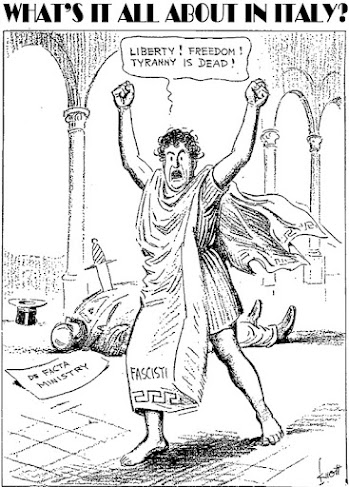
"What's It All About in Italy" by John Knott in Galveston Daily News, Oct. 30, 1922

Mussolini's March on Rome came right at the end of October, 1922, when most U.S. editorial cartoonists were preoccupied with their local elections for Congress and/or governorships. Not John Knott, in spite of a senate race in Texas pitting a Ku Klux Klansman against a last-ditch candidate suing in court to get on the ballot.

Between a couple gaps in the on-line record of the Galveston Daily News in October and a few days when it doesn't appear to have run Knott's cartoons, I'll concede the possibility that Knott drew something about the candidates running for office in Texas. I just haven't found it.

"A Perfect Fit" by Dorman H. Smith for Newspaper Enterprise Assn., ca. Nov. 4, 1922

I have come across a couple other early cartoons about the fascist victory in Italy, however. Dorman J. Smith was drawing for a national audience rather than a local one, so he wasn't as preoccupied as most cartoonists were with politics close to home. And unless I'm missing something here in an allusion that's older than Caligula, it seems to me that Smith actually approved of the fascists coming to power.

Conservatives today would never make such a mistake, would they? Would they?
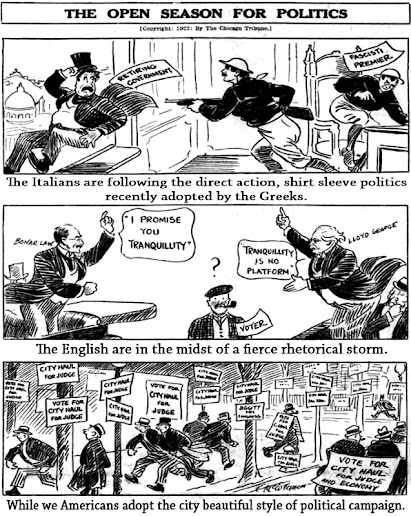
"The Open Season for Politics" by John McCutcheon in Chicago Tribune, Oct. 31, 1922

To be fair, Americans of the 1920's had no experience with fascism yet. As far as our cartoonists a century ago were concerned, this was just another change of government in a land far away. 

Nowadays, you'd think people would know better.

"The Big Four" by Grover Page in Louisville Courier-Journal, Oct. 20, 1922

If Italian fascists didn't yet catch the interest of editorial cartoonists in the U.S., more of them took note of the break-up of Great Britain's coalition behind Prime Minister David Lloyd George. Grover Page depicts Lloyd George joining the former leaders of the other Entente powers, U.S. President Woodrow Wilson, Italian Prime Minister Vittorio Orlando, and French Prime Minister Georges Clemenceau in involuntary retirement.
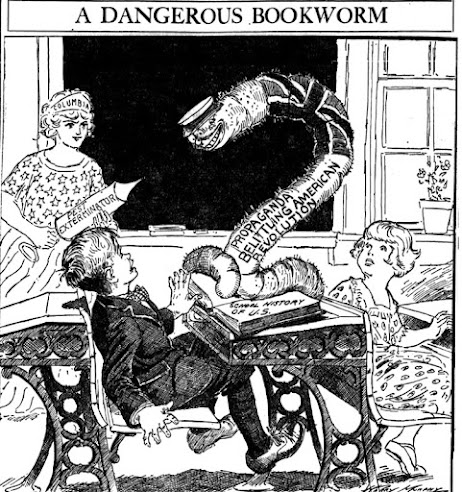
"A Dangerous Bookworm" by Harry Murphy for Star Publications, ca. Oct. 3, 1922

Joining Italian fascists in the repetition of history, we have this cartoon decrying wokeness in our schools. The newspaper empire of Anglophobe William Randolph Hearst was worried that impressionable schoolboys were being terrorized by textbooks infested with "propaganda belittling American Revolution."

"Still Teaching Treason" by Harry Murphy for Star Company, ca. Oct. 11, 1922

The textbooks weren't reminding them that many of our Founding Fathers were slave-owners, of course. Perhaps some textbook had the temerity to suggest that King George wasn't entirely wrong to expect the American colonists to help pay for the redcoats defending them from the French and Indians. 

Turn we now from America's leading Anglophobe to one of its leading Anglophiles.
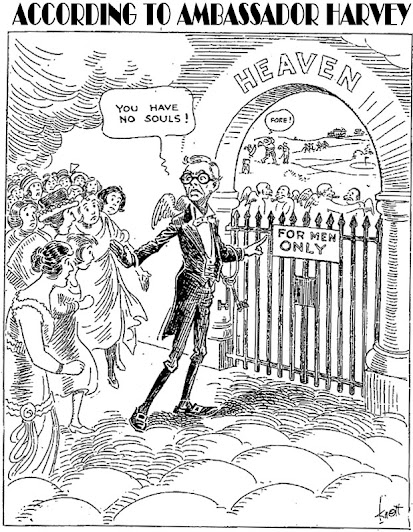
"According to Ambassador Harvey" by John Knott in Galveston Daily News, Oct. 28, 1922

Faithful followers of these Saturday History Tours may remember John Cassel having caricatured U.S. Ambassador to the Court of St. James, George Brinton McClellan Harvey with typographical symbols during a photoengravers' strike. Reported in the London Daily Telegraph, Ambassador Harvey gave an address to the Authors Club of London on the theme "Have Women Souls?"

At the start, Ambassador Harvey gave that "[O]ur preceptors in religion... would declare with concordant impatience, if pressed, that of course women have souls, and it is absurd, if not indeed positively sacrilegious, to suggest a doubt to the contrary."

Foolishly, he continued.

"And yet, they teach with like unanimity that woman is not the equal of man in the possession of inherent rights, but is and was designed by God to be his subordinate and subject."

Going on, Harvey observed that the Ten Commandments were written "exclusively for men": the fourth commandment lists who must not work in the home on the sabbath without mentioning wives; while the tenth forbids coveting one's neighbor's wife, but not one's neighbor's wife returning the coveting.

"Not a Woman Here" by John Cassel in New York Evening World, Oct. 26, 1922

"There is no recognition in the decalogue of the possession of souls or inherent rights by women. The fact of course is that women are not only not bound by but freed at last by inference of any obligation to observe the requirements of our fundamental religious law. ...

"[E]ither the commandments should be revised to meet the requirements of modern conditions, or a specific decalogue should be constructed exclusively for women." 

Harvey, it must be noted, was not being completely serious, and his audience received his talk in the light-hearted manner in which it was intended. Yet the ambassador had earned a reputation for shooting his mouth off, and his remarks rankled feminists and clergy on both sides of the Atlantic.

"Aren't They Going to Offer the Lady a Chair" by John Knott in Galveston Daily News, Oct. 18,1922

Senate-appointee Rebecca Felton (D-GA, pictured here by John Knott) had a few words to say when reporters showed her Ambassador Harvey's remarks. 

"Ambassador Harvey is at home in politics — and he seems to be at a banquet table — but he is all wrong and away out of his element in commenting on the Ten Commandments and their application to women. ... That's the most amusing thing I've seen today. Isn't it funny how so many men try to change things that have been in existence for thousands and thousands of years.

"I'm glad I saw that dispatch, though. It does one so much good to be amused when suffering from a bad cold. I feel a great deal better already."

"She May Come" by Clifford Berryman in Washington (DC) Evening Star, Oct. 5, 1922

Rebecca Felton has the distinction of being the first woman to serve as United States Senator, although it was only for one day. Appointed by the governor in an effort to appeal to women voters (in a state that resisted women's suffrage) after the death of Sen. Thomas Watson, she was named with the understanding that she wouldn't stand in the way of the men running for the seat in November.

As these two cartoons suggest, there was the distinct possibility that the Senate would not be in session to seat the 87-year-old Felton at all. Senate leadership did, however, call the body into session on November 21 just so she could be sworn in and give a speech. 

In that speech, Felton, an advocate of both Prohibition and women's suffrage predicted, "When the women of the country come in and sit with you…you will get ability, you will get integrity of purpose, you will get exalted patriotism, and you will get unstinted usefulness."

She might be a heroine to the feminist movement today if she weren't also an outspoken white supremacist and erstwhile slave owner.

You have to like Clifford Berryman's awkward attempt to address "Mrs. Senator Felton," though.

Friday, September 30, 2022

Independent (of Whom?)

Remember a couple months back when I asked whether anyone remembered a publication called the Madison Independent somewhere around 1982?

Nobody has stepped up with information about it, but we did receive two issues of this in the mail this summer:


The "About Us" insert that came with one of them claims that the Wisconsin Independent is staffed by experienced journalists, and there's a QR code if you care to send in recipes or to unsubscribe. In spite of a bare-bones crossword and articles about such things as blackbirds and the Packers, the rest does read like campaign literature.

There's no masthead, nor any boilerplate identifying it as campaign literature; just a return address for the American Independent at a P.O. box in Washington D.C.

Also, no cartoons, so, meh. 

There is a definite liberal tilt to the articles about politics. Not the sort of liberal bias conservatives complain about when the mainstream media don't act as docile cheerleaders parroting right-wing talking points. This stuff is a left-wing counterbalance to Fox News and talk radio. Or that complimentary issue of Epoch Times my dad got in his mail this week.

I figured the proof of the pudding would be if the Wisconsin Independent stopped coming to our house as soon as this year's election is over.

But we haven't received a September issue, so I guess we'll never know.

Thursday, September 29, 2022

Q Toon: And They Brought Books!

Let me just say at the outset that I realize how much I was risking drawing a cartoon on Sunday that might be considered in bad taste by Thursday. Unimaginable disaster threatens the state of Florida.

I mean, isn't having to be forever associated with Ron DeSantis and Donald Trump punishment enough?

The corrupt former president is reportedly miffed that Governor DeSantis stole his idea to kidnap fifty Venezuelan refugees in Texas and fly them to Martha's Vineyard — after the summer season is over, no less — luring them with false promises of jobs, housing, and getting to meet the Kennedys. 

Oh, sorry, I'm confusing Ron's stunt with the White Citizens Councils' reverse freedom rides of 1962. DeSantis did not actually promise the Venezuelan refugees that they would meet the Kennedys.

The townies of Martha's Vineyard, and perhaps a few well-to-do stragglers who hadn't yet left for the season, pitched in to welcome their Venezuelan guests, providing food and shelter until enlisting help from the military base at nearby Cape Cod. Right-wing media crowed, See? Them damn Yankees don't like Mexicans any more than we do! Not one Kennedy even showed up!

Well, we Yankees hear that you've got a teacher shortage down there in Dixie Land. We can send you plenty of teachers who far exceed the negligible standards your governor has set for educators these days. 

Competent? Why, they're absolutely fabulous!