Thursday, January 2, 2025

Q Toon: Jimmy Carter, 1924-2024

In case any of my publications were coming out this week, here’s my memorial tribute to President Jimmy Carter. 

There have actually been a few good ones from my colleagues whose work appears in daily newspapers — thoughtful pieces and, in some cases, apologies for misjudging him way back when it mattered.

You can count on one hand the editorial cartoonists publishing now who were getting paid to draw during Carter’s presidency. I was drawing for my college newspaper ( for exposure, before we called it that); my cartoons about Carter for the Manitou Messenger were few and far between, but generally critical.

But at least I was harsher on Teddy Kennedy and Ronald Reagan.

Those of us old enough to remember Carter’s presidency from start to finish also remember how the constant drumbeat of criticism directed at Carter resulted in eight years of Ronald Reagan. It enabled Reagan to cruise to reelection simply by making “Carter” into Walter Mondale’s first name.

This may be why some of us were too hesitant to criticize Joe Biden, who, like Carter, will probably be ranked by history in the middle of U.S. presidents (assuming he escapes the fate of James Buchanan). We saw Donald Trump, a mean-spirited liar, cheat, grifter, fascist, and overgrown brat— not in the Gen Alpha sense — plotting his comeback aided and abetted by his lickspittles in Congress, the courts, and right-wing media. (You too, Wall Street Journal.)

We did not want any responsibility for clearing the path for Trump, next to whom Ronald Reagan looks like FDR.

Well, maybe not FDR. LBJ, perhaps.

Carter had to cope with suddenly rising energy prices, inflation, and the Iran hostage crisis— that last one worsened by a rescue helicopter crash and Reagan’s lackeys colluding with Iran to keep the crisis going through the 1980 election. 

On the positive side of the ledger, he negotiated a peace treaty between Israel and Egypt that still stands, strove to run an administration that looked like America, and set policies which lessened our reliance on petrocracies that resented us then and despise us still. And even his harshest critics concede that his post-presidency was nothing short of exemplary.

May angels sing him to his well-deserved rest.

Tuesday, December 31, 2024

2024: Demokratiedämmerung

Lest auld republic be forgot, let's bring it back to mind: 

For lack of a slide-show feature in this here blog, I present here a column of some of my cartoons from 2024. I might have added the cartoon I drew Sunday, I suppose, even though it's not being published until 2025. Perhaps if I remember it a year from now, it will be part of my 2025 retrospective.

So here, at least to jog my own memory, is what the hell we have been drawing about this year:


Monday, December 30, 2024

End of the Year Sneak Peek


Unlike a lot of my fellow editorial cartoonists, I did not have a Jimmy Carter memorial cartoon in the can, so I was drawing mine last night.

Well, I could have just reissued this one from almost two years ago, but I wouldn't.

I know of at least one other cartoonist who drew his Carter memorial cartoon yesterday. Clay Jones dislikes memorial cartoons, but came up with a good one; he wrote in his Substack of another cartoonist who confided to him of having three Carter memorial cartoons waiting to go. (Since that cartoonist posted all three of them on Facebook yesterday, is there any point in keeping him anonymous?)

Editorial cartoonists have a love-hate relationship with our memorial cartoons. Our editors and readers love them, but we hate having to draw nice things about people. We also hate it when someone else draws the cartoon of a tear drop on a logo, symbol, statue, building, Uncle Sam, or whatever that we were going to draw.

On the other hand, there is usually awfully little to draw about in the week between Christmas and New Year's. Print and broadcast media have fallen back on reprinting/rebroadcasting favorite stories from the previous year, providing little news for us. Many cartoonists just take the week off as well, or crank out cartoons of people in line taking Politician X in a box to the returns desk at the store — which is kind of the same thing as taking the week off, when you come right down to it.

Saturday, December 28, 2024

Knocking Out 1924

Welcome aboard today's Graphical History Tour! You’re just in time to bid a fond farewell to the year 1924.

"Knock Out" by Arthur Johnson in Kladderadatsch, Berlin, Dec. 28, 1924

Some farewells to Old Man ’24 were fonder than others. Arthur Johnson, for one, was quite happy to see the old year go. German economic, domestic, and foreign affairs had actually begun to look up in 1924, but you couldn't convince Michel Q. Bürger of that any more than you could argue the same to today's electorates.

Instead of replacing it with a larger font, I've kept the caption to Johnson's year-end cartoon just as it originally appeared on the cover of Kladderadatsch. At the time, captions in German were always printed in Fraktur style font; foreign words, in this case "Knock Out" being borrowed from English, were printed in a Roman style font.

“Neujahr in Paris” by Hans-Maria Lindloff in Kladderadatsch, Berlin, Dec. 28, 1924

RHans-Maria Lindloff twits Mme. Marianne over French authorities' arrest of 60 Communists in Paris in December. The existence of French communists shouldn't have come as a surprise to anybody, really. Every country in Europe had its own cadre of reds loyal to the Commintern — Germany, birthplace of Marx and Engels, included.

Besides, the U.S. had shipped hundreds of American communists to Russia after the Great War, few of whom spoke any Russian. Surely some of them would have drifted westward to more fashionable and temperate cities by 1924.

"I Guess I'll Call It a Day" by James Donahey in Cleveland Plain Dealer, Dec. 31, 1924

On this side of the Atlantic, Republican-leaning Hal Donahey was fairly satisfied with the events of 1924. Father Time's ledger for the year included a recently completed round-the-world airplane flight by an American crew, the transatlantic flight of the ZR-3 Zeppelin, "better business confidence," the election of Calvin Coolidge as the 30th President of the U.S., and a "greater desire for world peace." Meanwhile, "LaFollette movement" lies in the waste bin of history.


"A Review of 1924" by Charles H. "Bill" Sykes in Life, New York, Dec. 25, 1924

Bill Sykes's two-page summary of the year for Life magazine covered just about every major news story of the year except for the murder of 14-year-old Bobby Franks by Nathan Leopold and Richard Loeb (the "Crime of the Century," and the basis for Hitchcock's "Rope").

Sykes added to Donahey's list the death of Woodrow Wilson, the conclusion of the Teapot Dome investigation, the Dawes Plan for Germany's reparation payments to the Entente allies, the two U.S. major party national conventions, a civil war in China, rising prices of wheat and corn, a visit to the U.S. by heir to the British throne Prince Edward, British suppression of a revolt against England in Egypt, a U.S. income tax cut, and rapprochement between Soviet Russia and France. 

And in the center of the second page, Sykes noted that the "prosperity" spoken of by Republicans had yet to fill the stockings of "Everybody."

Having now covered all the news that was fit to sketch, let's turn to the funny papers.

"Polly and Her Pals" by Cliff Sterrett for Newspaper Feature Service Inc., Dec. 31, 1924

Prohibition was now in its fifth year, so some folks such as Polly and her pals, who might have longed for the days when one rang in the new year with a glass of bubbly, made do with alternative libations instead. 

"Andy Gump" by Sidney Smith for Chicago Tribune Co., Dec. 31, 1924

If Polly's Pals had to make do with hypnotic suggestion for their holiday merriment, Andy Gump was able to partake of the real sauce.

The hooch came from his wife's Uncle Bim, the mustachioed fellow at the table, who had saved a carton of spirits since 1912. In spite of having vowed to himself to remain "as dry as the Congressional Record," Andy put on quite a show for the New Year's Eve party he arranged. He would renew his broken vow the following morning.

"That Guiltiest Feeling" by Clare Briggs for New York Tribune, Dec. 31, 1924 

As for the law-abiding citizens eschewing the devil's brew, you may be wondering how they passed the time without it. I've run across several cartoons toward the end of 1924 remarking on the brand new crossword puzzle craze sweeping the nation (you might remember John Knott's from my Thanksgiving weekend post). Clare Briggs seems not to think highly of the puzzles.

"The New Year Puzzle" by Oscar C. Chopin in San Francisco Examiner, Dec. 31, 1924

Here's a typical crossword puzzle reference from the editorial page. I don't think Oscar Chopin quite grasped how crossing words actually works.

"What's the Trouble Here" by Harrison Cady in Life magazine, Dec. 25, 1924

This Life magazine cartoon doesn't have anything to do with the old or new year, but perhaps it explains Mr. Briggs's beef with crossword puzzles.

It's a good thing he wasn't around to witness Sudoko and Wordle.

"Toots and Casper" by Jimmie Murphy for King Features Syndicate, Dec. 31, 1924

Returning to the comics page: if boozing it up wasn't an option for everyone on New Year's Eve, an enthusiastic tradition of noise-making was certainly available. You can make out a few noisemakers at Toot's party; banging on pots and pans was an option almost anyone could afford.

Just stay clear of Mother's favorite cast iron skillet, if you know what's good for you.

"Keeping Up with the Joneses" by Arthur "Pop" Momand for New York Herald, Dec. 31, 1924

I had not been familiar with the work of Arthur Ragland Momand (1887-1987), or with the practice of taking one's New Year resolutions to one's lawyer.

Following through on Al McGinis's annual resolution could have resulted in a breach of contract with his creator, the premise of Momand's entire strip being his efforts to keep up with the Jones family. "Keeping Up with the Joneses" ran from 1913 to 1938, so I'll have to find out how the Joneses and McGinises kept up during the Great Depression.

Here's a strip you're more likely to remember:
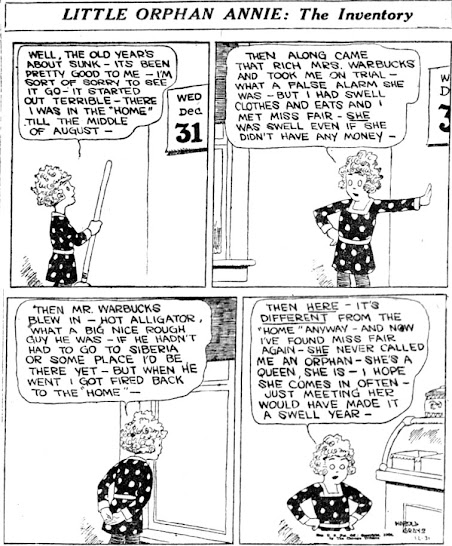
"Little Orphan Annie" by Harold Gray for Chicago Tribune, Dec. 31, 1924

Harold Gray paused Little Orphan Annie's story to recap the year — perhaps as a favor to any newspapers taking the day off or picking up the strip anew. The day's installment serves as a reminder that there was a Mrs. Daddy Warbucks.

"Little Orphan Annie" debuted on August 5, 1924; and yes, it was Mrs. Warbucks who first brought Annie home from the orphanage — but with no intention of letting her stay at the Warbucks estate. Mrs. Warbucks sent Annie back to the orphanage or simply kicked her out onto the street several times in the early years of the strip, only to have her husband retrieve or rescue the girl after returning from his frequent business trips.

"Gasoline Alley" by Frank King for Chicago Tribune, Dec. 31, 1924

"Little Orphan Alley" wrapped up its 86-year run in 2010; but "Gasoline Alley" is still with us, as is 130-something-year-old Walt Wallet, heading his five-generation family. Its present cartoonist, Jim Scancarelli, gave fans a start earlier this year when he introduced a plot line that seemed to portend the end of the strip. It turned out instead that politicians at city hall within the strip planned to update the name of Gasoline Alley, and the extended Wallet clan banded together to stop the change.

At the end of 1924, Walt was the single father of a three-year-old who had been abandoned on his doorstep, so I don't know whether he had been invited to Mr. Wicker's New Year's Eve party. Little Skeezix had a nursemaid, Rachel Brown, a Black woman who presumably had no personal life outside of the Wallet household; thus I assume Walt would have been free to go ring in the new year with the boys.

Or perhaps he was overjoyed to stay home with the boy.

After all, he had already taken him to another party in Sunday's comic.

"'Cap' Stubbs" by Edwina Dunn for George Matthew Adams Service, Dec. 31, 1924

"Cap" Stubbs and his buddies joined in the noisemaking in Edwina Dunn's strip. Do you think Grandma actually let him run loose on the streets at midnight?

I'll close out our farewell to 1924 with Winsor McCay's final Sunday episode for the year of Little Nemo in Slumberland — with my apologies that I can't present it to you in the size Mr. McCay intended for it, or in color. I invite you to embiggen these as your device will allow, and imagine the colors as best you can.


"Little Nemo in Slumberland" by Winsor McCay for New York Tribune, Dec. 28, 1924

Thursday, December 26, 2024

Q Toon: You Say You Want a Resolution


I had hoped Monday morning that I was getting this cartoon out in time for monthlies' January issues, but at least one of my client publications had already gone to press over last weekend. 'Tis the season everybody wants to take a couple weeks off, you know. 

The odd couple of MAGA Max and Liberal Leo debuted here last July in the offices of their couples therapist — Maybe I ought to her a name. Heck, this cartoon is the first time anyone in the cartoon has said Max's name, and Leo wasn't called by name until a few weeks ago. 

For the time being, Max gets to be insufferably smug. Today's cartoon, however, was my excuse have Leo voice my firm belief that "Fascism has never made any country great." 

Miriam Webster defines a fascism as "a political philosophy or system that exalts nation and race above the individual and suppresses opposition." To paraphrase, it's "Make America Great Again" by suing media for reporting Dear Leader's criminal activity and tasking the FBI with persecuting politicians with the temerity to stand up for constitutional democracy, and the military with shipping non-white residents out of the country.

If someone has an example of some country achieving greatness through fascism, I'm willing to entertain the notion. It was tried by Germany, Italy, Spain, Chile, Argentina, and Brazil in the last century, none of which approached greatness because of it.

Putin's Russia? Orbán's Hungary? Anyplace run by a Generalissimo or a President-For-Life? Hell no.

Fascism does, however, have a track record of making a country a kleptocracy.

And a pariah.

Enjoy your smugnitude while it lasts, Max.

Monday, December 23, 2024

Chrismukkah Week's Sneak Peek


You better watch out, you better not cry, you better not pout, I'm telling you why: Leo and Max are coming to town.

It's that awkward season for cartoonists. My editor is away for the week; at least one of my client publications has already put out its January edition. The politicians are rushing through their to-do-at-the-last-second list before rushing home, and there will be nothing in Google News but reviews of the lousy year behind us.

If we don't catch up with each other for a while, happy Posadas, Christmas, Hannukah, Kwanzaa, Boxing Day, and Irish Constitution Day!

Saturday, December 21, 2024

Christmastoons

Welcome aboard today's Graphical Holiday History Tour, working backward in time through some of my December cartoons from years ending in four.

Our first stop: 2014.

for Q Syndicate, December, 2014

Vlad the Defenestrator has been on his antigay crusade for over a decade now, harnessing the power of the state against any perceived threat from "homosexual propaganda." 

Among the musical sine qua nons of the Christmas season (besides "All I Want for Christmas Is You") is the Nutcracker ballet of Pyotr Illych Tchaikowsky. It no doubt irritates Mr. Putin that Tchaikowsky was gay, although the fact that the composer was miserable about it probably mitigates Putin's pique.

The Nutcracker ballet has not yet been banned in Moscow, but I wouldn't expect to see Les Ballets Trockadero de Monte Carlo's rendition of it there any time soon.

for Q Syndicate, December, 2004

In the dawning days of the 21st Century, there was no Grindr, no Scruff, and no Chappy.

What gay men had way back in 2004 were on-line chat rooms. Well, everybody had chat rooms; but as was the case with gay bars before them, specifically gay chat rooms were around for those who knew how to find them. A few operated as places, as one would expect, to chat — about theater, or cartooning, or politics, or drag pageants, what have you. But nearly all were used sooner or later for the same thing as their successor apps: hooking up. 

Early on, chat room users couldn't see what the guys they were chatting up looked like except by asking for a pic to be sent. Nor, unless a hometown were in the chatter's screen name, could they tell how many feet away the other guy was. I imagine that finding out that the other guy was all the way up at the North Pole would have been a deal-breaker for most men.

Santa, however, would have been at an advantage. Not only could he get to your place really, really quickly if he were up for it, he had already seen you while you're sleeping.

✍

Departing momentarily from the Christmas theme, this next cartoon comes with a trigger warning that it's about deadly serious criminal activity and might stir up unpleasant memories for some in the greater Milwaukee area. But it's a propos in light of the lionization — herofication, if you will — of  Luigi Mangione, Daniel Penny, and Kyle Rittenhouse.

in UWM Post, Milwaukee Wis., Dec. 1, 1994

On November 28, 1994, a fellow inmate at the maximum security Columbia Correctional Institution attacked and killed notorious serial murderer Jeffrey Dahmer and another inmate, Jesse Anderson. Anderson's case had received much local media attention; he had murdered his wife and sent police and media on a wild goose chase by claiming that two unknown black men had done it.

There were some people who promptly hailed Dahmer's and Anderson's killer, Christopher Scarver, as a hero. He was no such thing, and it surely must have grieved the family of Steven Lohan, the man he was convicted of executing in cold blood during a robbery at the Wisconsin Conservation Corps, to see Scarver lauded as such.

Would I be happier if Dahmer and/or Anderson were still languishing in prison today? No. Nor do I find any pleasure in that Scarver remains in prison, with two more murder convictions added to his sentence.

I had forgotten about this cartoon and only ran across it while trying to find the date of another cartoon I was considering for today's blog post. The original drawing of this cartoon might have gotten lost before I returned to the Post office with the following Tuesday's cartoon; it's not in my files and I can't recall pulling it out since. But since my mother was saving all my printed cartoons in a scrapbook I now have, here it is again.

Okay, folks: the trigger warning is no longer in effect. I'm going back to lighter material and you may resume reading. 

in UW-P Ranger, Somers Wis., Dec. 13, 1984

Here's a cartoon I did for the UW-Parkside student newspaper's last issue of 1984, as printed on its front page. 

The hearth in the cartoon is based on my parents'; in the living room between two bookcases, with a stone Viking ship mounted over the mantle. But that is not our dog.

I'm not sure why there's a teaser for "1982 reviewed" on the top of the page. I don't believe that the Ranger had any AARPgenarians on staff who still couldn't wrap their heads around it being 1984 already, let alone that it was soon not to be.

Well, that brings us to the end of our tour. Please return your tray tables to their upright position, make sure you have all your personal items with you, and have a happy holiday of your choice!