Wednesday, December 29, 2021

All God's Children Got a Robe

In memory of Archbishop and Nobel Peace Laureate Desmond Mpile Tutu, who entered into life eternal on December 26, 2021:
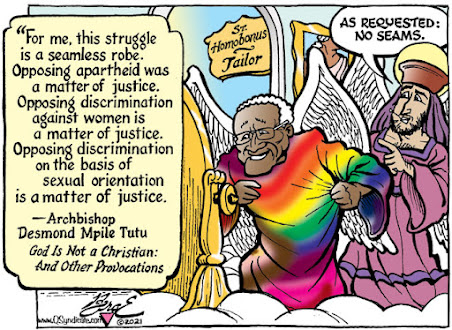
Most Rev. Tutu is most identified, of course, with the struggle in South Africa against apartheid, but he also has had plenty to say, as far back as the 1970's, in support of homosexual rights. This passage from God Is Not a Christian: And Other Provocations continues:

It is also a matter of love. Every human being is precious. We are all — all of us — part of God's family. We all must be allowed to love each other with honor. Yet all over the world, lesbian, gay, bisexual, and transgender people are persecuted. We treat them as pariahs and push them outside our communities. We make them doubt that they too are children of God. This must be nearly the ultimate blasphemy. We blame them for what they are. ....

To discriminate against our sisters and brothers who are lesbian or gay on grounds of their sexual orientation for me is as totally unacceptable and unjust as apartheid ever was.

The Archbishop spoke out against persecution of gays and lesbians by political and religious leaders, including those in other nations of Africa:

“[A] wave of hate is spreading across my beloved continent. People are again being denied their fundamental rights and freedoms. Men have been falsely charged and imprisoned in Senegal…In Malawi, men have been jailed and humiliated for expressing their partnerships with other men. Just this month, mobs in Mtwapa Township, Kenya, attacked men they suspected of being gay. Kenyan religious leaders, I am ashamed to say, threatened an HIV clinic…because the clerics wanted gay men excluded. Uganda's parliament is debating legislation that would make homosexuality punishable by life imprisonment, and more discriminatory legislation has been debated in Rwanda and Burundi. These are terrible backward steps for human rights in Africa.” (in Washington Post, March 12, 2010)

It is largely to Most Rev. Tutu's credit that the 1996 South African constitution is the first in the world to guarantee the rights of that nation's LGBTQ+ citizens. There certainly was no popular clamor to have LGBTQ+ rights enshrined in the constitution; South Africa was not Castro on the Cape, on either side of the color line. But Tutu actively lobbied for it, and had the moral force to get it done.

The issue was no doubt personal for him as well as political. He gave his blessing to the wedding of his daughter, Rev. Mpho Andrea Tutu to Marceline van Furth, a marriage that got her defrocked by the Anglican Diocese of Saldanha Bay. Tutu van Furth has said of her family, "I had the extreme good fortune of growing up in a household with parents who were very clear about their faith and very clear about full inclusion of all people... regardless of gender and gender identity and regardless of sexual orientation."

✍

Why, yes, that name on the shingle outside shop in my cartoon is that of the actual patron saint of tailors, seamstresses, clothworkers and cobblers. I hadn't known that when I decided to look up their patron saint to be the proprietor of the heavenly haberdashery.

That his name happened to be homo-friendly was, shall we say, bonus.

Sunday, December 26, 2021

This Week's Sneak Peek

Instead of the usual edit snipped from the coming Thursday's cartoon, here is a cartoon I drew for Q Syndicate in November of 1998.


Saturday, December 25, 2021

Christmas, 1921

We started last week's look at Christmas cartoons from 1921 with examples from Germany. This week's cartoons are from the United States, but we'll start with this one about Germany.

"Eine Christmas Fantasy" by Ellison Hoover in Life magazine, Dec. 22, 1921

By and large, the American cartoons are distinguished from the German ones by a Yankee sense of humor rather than a lot of Teutonic severity. 

Not that the Americans couldn't be serious. The daily one-column-inch front page cartoon on the Christmas Day edition of Brooklyn Daily Eagle (often by editorial page cartoonist Nelson Harding, but I don't find his initials on this one) references the Washington Naval Conference negotiating international arms control, but it could be equally a propos today for different reasons.

"Here And Now" in Brooklyn Daily Eagle, Dec. 25, 1921

Eat your heart out, Massie and Boebert!

"The Profiteer's Son..." in Life Magazine, Dec. 22, 1921

As in Germany, profiteers were a major target of American cartoonists.

I have not been able to identify this cartoonist — that worm-like figure behind Junior Profiteer is the cartoonist's signature, in case any of you reading this are familiar with him or her.

"Christmas for Two" by John Baer, ca. Dec. 23, 1921

Union cartoonist and former Congressman John Baer echoes the previous cartoonist's sentiments in this bleak holiday offering.

"Merry Christmas" by Dorman H. Smith for Newspaper Enterprise Assn., ca. Dec. 24, 1921

Republican cheerleader Dorman H. Smith chose to accentuate the positive in his Christmas cartoon. (I'd note that he was celebrating the naval holiday a bit early.)

"Aw, You Can't Fool Me" by H.T. Webster in Life magazine, Dec. 22, 1921

Harold Webster, whose syndicated newspaper cartoons hardly ever touched on politics, here takes on the Harding administration's proposed alternative to Wilson's League of Nations, and anti-League Republican Senator William Borah of Idaho.

"Which Shall Win?" by Louis Raemaekers in Life magazine, Dec. 29, 1921

Some of the serious stuff, however, had to be imported. Dutch cartoonist Louis Raemaekers earned his fame drawing scathing cartoons against the Kaiser's Germany. Here his target, judging from the costumes, is further east.

But today is Christmas, dammit, so let's just cut to the merriment and jollity.

"Jimminy Christmus" by Elmer Bushnell for Central Press Assn., ca. Dec. 24, 1921

Well, lookie here. At least one of the items on Jim's Christmas wish list will warm the cockles of Massie, Boebert, and the rest of the ammosexual crowd. 

"Jerry on the Job" by Walter Hoban, Dec. 24, 1921

Children's hopes for Christmas bounty have long been an evergreen topic for cartoonists. Walter Hoban's comic strip, "Jerry on the Job," stars this little boy who has a difficult-to-determine job at an office where nobody has heard of child labor laws. 

Jerry looks to me to be a few years younger than Webster's Jimmy; both are old enough to have figured out where Santa's gifts really come from.

"Smilin' Through" by Nelson Harding in Brooklyn Daily Eagle, Dec. 25, 1921

Other cartoonists used their Christmas Day space to remind readers of the spirit of the season.


"The Merry Christmas Spirit" by Rae Irvin in Life magazine, Dec. 8, 1921
Or, if you will, the lack thereof.

"Yule Log Tales" by Elmer Bushnell for Central Press Assn., ca. Dec. 26, 1921

Daily Cartoonist relayed the announcement this week that Gannett newspapers would not print editions on Thursday, Friday, or Saturday this week or next, a surprisingly long vacation in the news biz. Skipping a Christmas Day edition used to be quite common, particularly for afternoon newspapers; I'm  not finding any three-day hiatuses (hiati? Naah.) in 1921, however.

Clifford Berryman in Washington (DC) Sunday Star, Dec. 25, 1921

Christmas Day, 1921, was a Sunday, so some of the evening papers put out their regular Sunday editions. Others took Monday off instead.

"An Empty Mask Without Them" by Harry Murphy for Star Company, ca. Dec. 24, 1921

Depriving the kiddies of their Sunday funnies on Christmas, after all, would have been positively Grinchy!

"From the Evening World" by John Cassel in New York Evening World, Dec. 24, 1921
From the Evening World, and from my world, too. A merry Christmas to all, and to all a good night!


Thursday, December 23, 2021

Q Toon: The Great Right North

Here's a lede U.S. conservatives are very unlikely to match any time soon:

Conservatives led the charge in Canada's Parliament to vote to ban conversion therapy for minors.

The Senate voted without any objections on the bill proposed by Conservative Senator Leo Housakos and fast-tracked through all legislative stages December 7. Previously, the House of Commons voted unanimously to pass the bill brought forward by Conservative Leader Erin O'Toole, who has become a proponent of LGBTQ rights since becoming head of the party. O'Toole allowed his party to have a free vote on the issue.

In an unusual occurrence, conservatives voted in agreement with their liberal counterparts.

"The community has been heard," Housakos said in the Senate, reported the Toronto Star.

"It was heard by the House of Commons and we saw the House of Commons do the right thing and pass this piece of legislation unanimously and they did so because they thought it was in the national interest to do so," Housakos continued.

The Senate's passage of the bill requires royal assent from the Governor General or her designate for it to become law, reported the paper.

Assuming that Joe Manchin is not the Governor General of Canada, it looks good for Canada to become the sixth nation to ban conversion therapy, which uses psychological, physical, or spiritual pressure to convert a patient's sexual orientation or gender identity.

20 states and the District of Columbia ban conversion therapy, and there are restrictions in five more. In Wisconsin, for example, while conversion therapy on minors isn't illegal, an executive order by Governor Evers prohibits use of state funds for it. Florida, Georgia, and Alabama, on the other hand, have brought suit in federal court to prevent local governments from enforcing their own bans.

It's mighty difficult to imagine any more than a scattered few U.S. Republicans casting any pro-LGBTQ votes, incurring the vengeful wrath of the right-wing rage machine and the televangelicabal. So let's hear it for the brave and principled conservatives of our neighbor to the north!

Cu-roo-coo-coo-coo-coo-coo-coo!

Tuesday, December 21, 2021

Captcha!


A cousin of mine reports that his Tesla does just fine driving itself, except for one thing. Apparently, it gets very confused by flashing yellow arrows, which seem to be all the rage in traffic control design these days.

Monday, December 20, 2021

Saturday, December 18, 2021

Weimar Weihnachten

It has been a while since we've checked in on what German editorial cartoonists were up to a century ago, so let's see how they celebrated a not so particularly Fröhliche Weihnachten in 1921.

But first, another trigger warning! If you were offended by the words I put in Pat Buchanan's mouth in last Saturday's retrospective, prepare for some unpleasant images here. German cartoonists were no better or worse than their white American counterparts in their depictions of other races and religions. One can argue, I suppose, whose cartoons were more or less responsible for more or less horrific consequences.

"Der Deutschen Treue Weihnachtsbaum" by Werner Hahmann in Kladderadatsch, Berlin, Dec. 25, 1921

We start here with a cover cartoon lamenting the territories Germany lost in the Versailles peace agreement.

I don't believe you should attach any other significance to the six-pointed star, by the way, except that it was the traditional topper for any respectable Weihnachtsbaum. When cartoonists wanted to convey anti-Semitic or racist messages, there was no need to be circumspect about it.

For example:

"Der Verdächtige Christkind" by Hans-Maria Lindloff in Kladderadatsch, Berlin, Dec. 11, 1921

Senegalese troops had played a significant role in the Allies' defeat of German troops in the Second Battle of the Marne; von Hindenburg's account in his 1920 memoir, Mein Leben, wrote, "Where there were no tanks our enemy sent black waves against us. Waves of black Africans! Woe to us when these waves reached our lines and massacred or worse, tortured our defenseless men!"

Continued deployment during the armistice of troops from France's African colonies led to the postwar "Black Horror on the Rhine" rumors, kept alive by the nationalist press and cartoonists. Germans concocted stories of Moroccan and Senegalese troops, sent into the Rhineland in 1920 in response to the Reichwehr occupation of the demilitarized zone there, raping German women and girls at a rate of hundreds per day — baseless stories sensationally repeated abroad by horrified Whites, both right-wing and liberal, in Britain, Canada, Sweden, Italy, and the U.S.

Now, "Es" in the last sentence of the cartoon caption is usually translated to English as "It," and the Christkind, who traditionally brings gifts to children in Germany and Austria, is supposed to be a boy angel — but then, angels in art can sometimes look fairly androgynous. This one certainly does; it's probably the skirt. I've translated the pronoun "Es" as "She," reasoning that Lindloff here clearly wants his readers to read his cartoon in light of those "Schwarze Schmach" rape allegations.

"Der Heilige Spekulatius" by Arthur Johnson in Kladderadatsch, Berlin, Dec. 18, 1921

As you would expect, there were plenty of anti-Semitic cartoons about Jews, such as this one of a banker chasing after St. Nicholas. St. Spekulatius's halo, in this case, is a U.S. dollar; the trim of his gown is decorated with pigs.

Arthur Johnson is making a play on words: spekulatius is a traditional yuletide cookie, often depicting St. Nicholas riding a donkey or horse. The word derives from the Latin "speculator," meaning overseer (and from which we get the word "bishop"), but which also has the meaning of an investor who makes his income betting on the success or failure of others.

Cartoons against speculators in this period were not confined to the German press by any means. Plenty of American cartoonists also criticized profiteers of commodities, rents, and so forth; but while American cartoonists of the 1920's could be equally racist, most of their profiteers were drawn in a more generic, if corpulent, way.

"Die Putschschachtel" by Ernst Schilling in Simplicissimus, Munich, Jan. 1, 1922

In Ernst Schilling's yuletide cartoon, the forced demilitarization of Germany after the Great War has resulted in firing squads, attempted coups, and destruction. Nothing working any more, and Krampus seems to be mighty happy about it all.

But even in the doom and gloom of this interwar German Christmas, a few cartoonists managed to view events with a bit of humor that we might even recognize today.

"Das Letzte Paar" by Richard Rost in Jugend, Munich, Dec., 1921

And you thought we had supply chain issues today! 

"Die Botschaft von Washington" by Th. Th. Heine in Simplicissimus, Munich, Dec. 21, 1921

Thomas Theodor Heine employs Christmas imagery in this cartoon about U.S. Secretary of State Charles Evans Hughes and the multilateral naval arms limitation treaty being hammered out in Washington D.C. I suspect that Heine saw a resemblance between Mr. Hughes and the traditional German image of Kris Kringle.

And as long as I've brought up the Washington Naval Conference, I'll close with a cartoon that isn't on a particularly Christmasy theme — unless the lectionary at your church next week includes Isaiah 2:4 or Joel 3:10. Whatever. I really like this image.

"Abrüstung" by Erich Wilke in Jugend, Munich, December, 1921

Friede auf Erden und guten Willen für alle!

And if the Christkind shows up at a school in your town this season, it's none of your business which bathroom they use.